

by Chris Thatcher
If you were planning to modernize an army, to change its structures, reposition units and commands, identify gaps in capabilities, introduce new equipment, and bolster its reserve force, where would you start?
Over the past year, an Army Modernization Team has conducted over 400 surveys with soldiers at every level, held working groups, developed some 3,000 documents, and created around 17,000 data points, all with an aim to informing a modernization plan.
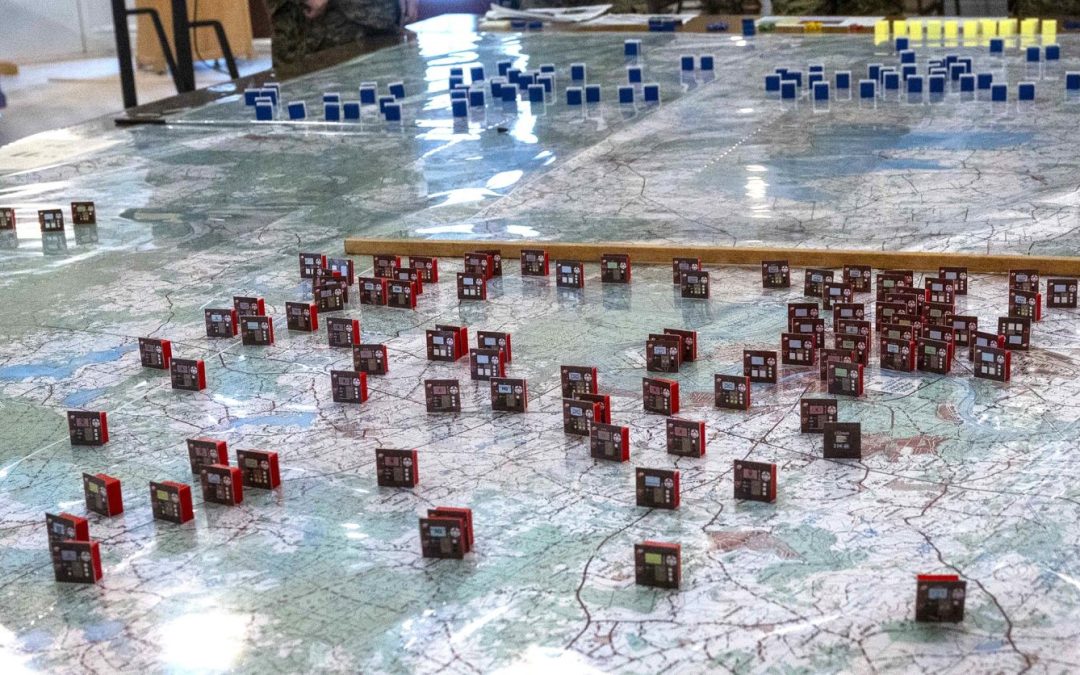
Central to that activity has been an ongoing series of war games, exercises designed to challenge conventional thinking and broaden the range of ideas as the Army strives to align its resources with the demands of the current and future force.
Though technically not a war game, the process was launched in September 2024 during the Senior Army Leadership Symposium in Ottawa, when Army Commander Lieutenant-General Michael Wright introduced an exercise, supported by gamification, to examine the Army’s structure.
Working in small groups, the leadership parsed through the strengths and vulnerabilities of the current structure, identifying what did and did not work, before weighing options for the types of units the Army could, should or must have.
Lessons from the war in Ukraine have exposed many of the Army’s capability shortfalls, but the exercise forced discussions on structure rather than equipment, explained Major Ed Farren, project officer with the Modernization Team, “because new kit and old structures are not going to get you the best right result.”
The exercise compelled leaders to step outside their branches of infantry, armour, artillery, and such, and prioritize units and capabilities from an organizational perspective. It also forced them to make decisions within fixed budgets, accepting trade-offs in a manner not dissimilar to building a fantasy football team while working with a salary cap, Farren noted.
As leaders worked through how and where to group capabilities, it “exposed a lot of the mental anchoring within the current structure,” he observed.
“If you’ve grown up in a structure that looks like X, and someone says, design a new structure, you still design one that’s X+1, as opposed to Z. So, a lot of the groups returned a mirror image of what we have now, or had some interesting alterations. Everything that was weird and wacky, for example, went into the Atlantic, because we have 6 Canadian Combat Support Brigade there now.”
The point was less an analytical exercise and more explorative, said Farren, intended to get people talking and thinking about structure in different ways. “It was an innovative approach in the sense that people didn’t feel they’d been forced to come up with the right answer. It was, just come up with an answer that works for you, and then see the variation in the room.”
Leaders would come to see the event as the starting gun for modernization, Wright told them. The event would also be the trigger for the creation of the modernization team.
A table top exercise used to plan the movement of key Army assets. Photo: MWO Colin Aitken
DESTRUCTION AND CREATION
The Army has been conducting war games of various types for decades. But without a digital repository for the reasons and results, “there’s often a lot of repeating the same questions,” said Farren. “Every couple of years, someone wants to look at the same thing, [but can’t] check the back history to see what was done or how it was done, and therefore build on it.”
Farren was part of a 2024 unclassified tactical war game exploring infantry optimization. The contest of a battlegroup versus a peer foe in the Baltics generated valuable data about capabilities the Army requires, but it did not represent the “large sea-change that the Army wants to bring in.”
The top line of the postgame report could have read, “the Royal Canadian Infantry Corps requires the Royal Canadian Artillery to have more guns with longer range and more mobility,” he said.
“One of the lessons was that it doesn’t really matter… Yes, a platoon with a drone is better than platoon without a drone, but that wasn’t the problem. The problem was that the adversary’s sense and strike complex was pretty much unassailable, and no one else was able to deconstruct that through either jamming, counter uncrewed aircraft systems, or counter battery. It’s teaching us a lesson that we already know — combined arms is the answer.”
To produce the imaginative thinking modernization requires, the modernization team applied an approach to wargaming based on John Boyd’s 1976 methodology of destruction and creation – gaining strategic advantage in complex, uncertain, and ever-changing environments by continuously breaking down and rebuilding mental models. The approach provided the foundation for his decision-making cycle of observe, orient, decide, and act, known as the OODA Loop.
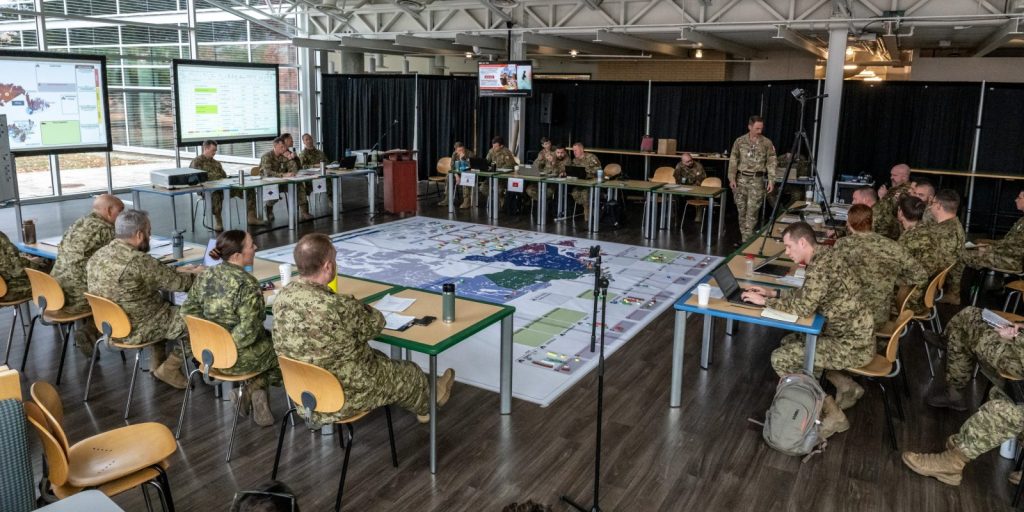
In January, a working group of six teams, representing all components of the Army, tackled the difficulties of structural change, using a gamification approach to force interactive discussions as participants worked through questions about where a unit or capability should reside, train, operate, and fight — in major combat operations and what Farren called “left of war scenarios.”
“It became obvious during the conversations that the fight discussion lacked a bit of granularity,” Farren observed. “How well does this thing fight? There was a lot of disagreement about what should and shouldn’t be in a brigade, other than the fact that people were referring to the brigade structure that we currently have.”
Three months later, in April, the modernization team hosted a tactical war game in Valcartier, Que., in which the current structure was compared with an alternative. “It wasn’t an ideal structure; it was just materially different,” he said. “We removed a light infantry battalion and we added more tanks, and we added different equipment based on the planned equipment program.”
The players were comprised of the command team of 5 Canadian Mechanized Brigade Group and other members from the brigade, split into blue and red teams. They executed four runs through the game, one set in 2027 and employing equipment and capabilities the Army expects to have by then, and the other three in 2033, “which is where the planned equipment program stops,” said Farren.
Both sides received enhanced capabilities in line with 2027 and 2033, but where blue received much of what the Army will acquire between now and 2027 just to reach a state it should already be at — think ground-based air defence — the red side was able to employ elements of machine learning, quantum computing and artificial intelligence.
“One thing that game really helped show is the sense of urgency,” Farren noted. “In 2027, not only were the results not good, the option space for the brigade wasn’t good — it could only really fight in one way. In 2033, the brigade commander had more options on what to do. In 2027, he had to be defensive. In 2033, he felt more empowered with capabilities to be offensive, which meant red felt less assured of winning, and was a bit more hesitant.”
This fall, following the release of Inflection Point 2025, the Army’s action plan for modernization, the modernization team led a war game on mobilization, set during the first five months of the next global war, when the Army and the nation were still in a transition period from peacetime structures and processes to a wartime footing — mandatory military service and nationalization of industry were not included.
The game was preceded by readings on mobilization and several presentations from experts, and the game “was summarized to [the participants] in advance, so they knew what it was covering, and what it was not covering,” said Farren. “We were in the current system, straining to achieve an increase in scale.”
Using a card-driven system, the event involved 20 separate games, all with the same start state and end objective — getting a certain number of brigades prepared and relocated to Europe — but with each group able to select a mobilization enhancement such as stockpiling munitions, investing in the defence industry, increasing the supplementary reserve, and establishing national parks as potential training areas. An indication of the current state of the Canadian Armed Forces, most opted for personnel enhancements and learned that “people already exist, it’s equipment that doesn’t — it takes time to produce,” said Farren.
“When you have 20 games going on, the variety of outcomes increases. … Every group was on a different journey. Through the course of the turns, they dealt with dilemmas and disruptions and were given options. We started to see that decision tree [grow]. … And each of those decisions then affected the game state. It was very realistic.”
The game underscored the importance of a comprehensive plan: For an army that must coordinate myriad mobilization activities so multiple brigades are not vying for the same training areas, even as critical supplies are being directed to ports for shipment overseas; for the defence industries that must know what equipment is required to then align supply chains; and for other government agencies that must help counter influence activities such as misinformation and disinformation that could disrupt a plan.
“If you go back to any major war, these are all things that are in the footnotes of history that no one wants to talk about in hindsight,” said Farren. “But if you have a plan, you can be more efficient.”
Some groups were able to achieve the objective, but the bigger success was what he called “ah ha” moments: “I didn’t realize we didn’t make that in Canada, or I didn’t realize that we didn’t have enough of X, or I didn’t realize that we couldn’t do all of these things at the same time, or I didn’t realize that this would be a good use for the supplementary reserve. … I think everyone left knowing more about the facets of mobilization.”
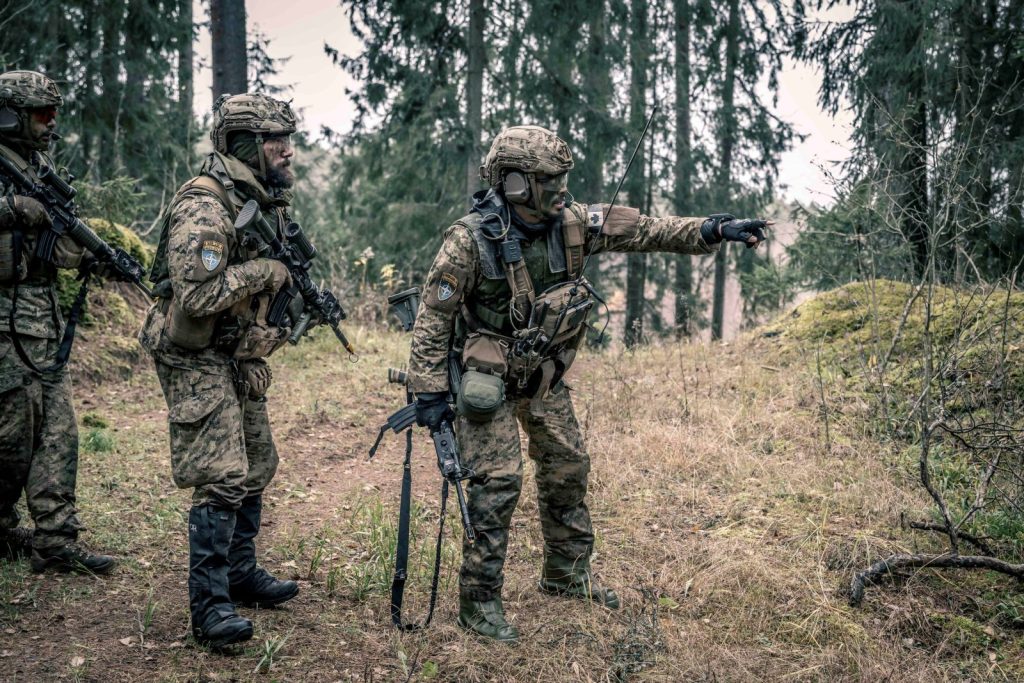
Members of the 3rd Battalion, Princess Patricia’s Canadian Light Infantry conduct rearward passage of lines drills outside of Daugavpils, Latvia, during Exe Resolute Warrior in November 2025. Photo: Sgt Aydyn Neifer Copyright ©2025 DND / MDN
REFINING A DIVISION
Each game tends to breed another game, Farren observed. In line with the Army’s new divisional structure, the next exercise, slated for February 2026, will dig into the divisional layer. More an institutional tabletop exercise than a true war game, the intent is to explore how the Army can transition from the current structure to a divisional one, “with as little pain as possible, whilst achieving the outputs we need to achieve,” he said.
That means understanding where the Army might be carrying some risk because authorities remain unclear. With such a major structural change, the Army recognizes that certain actions might require approvals that are not evident until they are played out in game, he suggested. “You’ve got all this furious scribing going on to understand who needs to be responsible to whom for what, by when.”
While the Army has accepted a new structure, the ongoing wargaming is intended to continue to define and then refine what is required within those divisions, explained Colonel Cédric Aspirault, director of the Army Modernization Team.
“A war game is [more than] just a blue-red thing — it’s where you see time and space. I can have my own idea that the Army needs 15 tank regiments, however, how do I move it? How much time do I need? The war game will force you to do that. It forces you to go outside of your bias, but also to limit great ideas that do not work in reality. I’m not saying the war game is reality, but the restrictions that we have will create a reality which will become our reality, and we’ll be able to test and look at solutions to different problems from different angles.”
Aspirault, who stood up the multinational brigade in Latvia and saw firsthand how the participating nations have structured and prioritized capabilities in their armies, suggested the process is forcing the Canadian Army to better understand scale as it addresses issues with its divisional structure.
“[We can] see how much space a division takes on the ground and … what are the limitations. … The mobilization war game was a great example of where space became a limitation because training areas have limitations. … A well-structured war game will force you to consider that and will improve the output of the game itself.”

Canada uses wooden blocks from Columbia Games for it’s wargaming.
Contact me to learn more.
No we don’t, sorry, your Games are good but we don’t use your components.
How is it that the armies of central and eastern Europe have already begun to re-capitalize their forces – and make huge strides in doing so – since 2022? Did they stage war games to validate their choices, or did they just take educated guesses about what would deter the Russians and get on with it?
It’s impressive what the CA is doing. Good intellectual exercises in their own right. But I’d trade the ‘certainties’ that endless wargaming and studies produce for some calculated risk-taking.
Get on with it! The folks posted to Latvia need stuff yesterday!