
By Allan Joyner
Operation Unifier represents the Canadian Armed Forces’ (CAF) deliberate effort to rewire the fundamental architecture of Ukrainian military decision-making established during Soviet times from the ground up. At the heart of this transformation is the concept of “mission command,” a NATO standard that holds commanders at even junior levels accountable for results while granting them wide latitude to determine methods.
One critical focus has been on developing a professional non-commissioned officer (NCO) corps, something largely non-existent in the Soviet system.
In Western armies like Canada’s, having a young lieutenant mentored by a lower-ranking but vastly more experienced sergeant creates flexibility and adaptability that Soviet-style top-down hierarchies simply cannot match. Canadian training has focused on teaching Ukrainian junior officers battlefield responsibilities, planning processes, manoeuvre coordination, and intelligence operations, essentially equipping them to think rather than merely execute.
Canadian advisors have worked with Ukrainian forces to build foundational NCO development documents — general specifications, qualification standards, and training plans — that form the bedrock of a NATO-standard professional NCO corps.
The tactical implications of this are at the core of how Canadians train Ukrainians to operate. Western doctrine dictates that it should be routine for higher echelons to trust a section sergeant to independently figure out how to accomplish a task. This is worlds apart from the Soviet model, where initiative was discouraged and orders flowed exclusively downward.
At training sites in Poland and elsewhere, Canadian instructors have taught Ukrainian recruits practical skills like disarming anti-tank mines and re-pinning enemy grenades under simulated drone fire. But more importantly, they have taught them to make split-second decisions without waiting for permission from distant commanders.
Repeatedly, Russian generals have been killed on the front lines because their system has no decentralized decision-making. When communications break down, these senior officers must move dangerously forward to sort things out themselves. The Ukrainian forces being trained by Canada fight with an entirely different operational philosophy of trusting your NCOs, empowering your small teams, and pushing authority downward.
Perhaps the most significant aspect of Op Unifier is that Canadians aren’t just training Ukrainian soldiers, they’re training Ukrainian trainers, teaching them how the CAF develops courses and builds professional military education systems. This “train-the-trainer” approach ensures transformation becomes self-sustaining rather than dependent on continued foreign assistance.
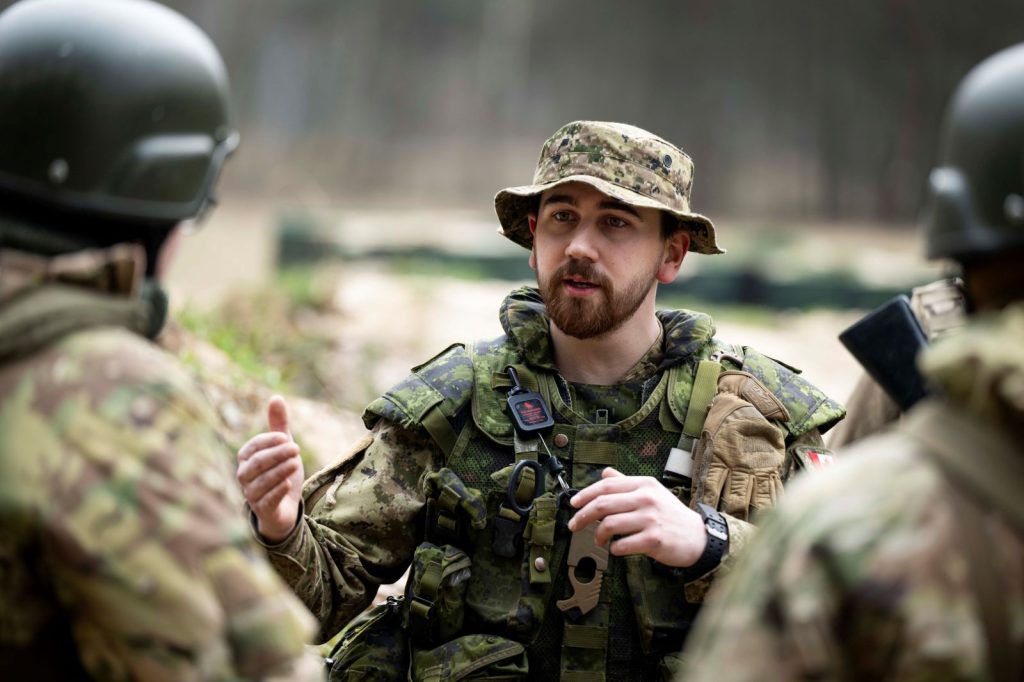
A medical technician teaches casualty evacuation techniques. Photo: CAF Imagery Technician
Since 2015, over 46,000 Ukrainian security force members have received this training, creating a critical mass of personnel who understand that effective modern warfare depends not on rigid adherence to centralized plans, but on empowered individuals making intelligent decisions at the point of contact. The result is proving to be an army that can operate more like a neural network than a traditional hierarchy — where damage to one node doesn’t paralyze the entire system, and where tactical opportunities can be exploited by whoever sees them first, rather than waiting for approval to cascade down from above.
An October video feature in the Kiev Post underscores the success of this Canadian approach. The Ukrainian infantry hasn’t merely adopted NATO-style decentralized command; they’ve taken those principles and pushed them to extremes under the brutal pressure of a drone-dominated battlefield that would have been unimaginable even five years ago.
In the video showcasing small unit training in the 41st Separate Mechanized Brigade (41 SMB), the transformation is described by soldiers like callsign ‘Timokha’ and callsign ‘Chasik’, who reveal how Canadian training in mission command and NCO empowerment has become the foundation for something entirely new, an army with units that benefits from being able think and act as the tactical situation demands.
The decentralization that Op Unifier taught has evolved into what Ukrainian soldiers now call the “lone soldier in the field” doctrine. As callsign ‘Shambala’, an instructor at the training site, explained, the emphasis has shifted entirely away from the old Soviet company-sized formations toward small, mobile groups — sometimes just a single, highly trained soldier — who can read enemy intent, strike, withdraw, and strike again.
This isn’t just a tactical choice; it’s a survival necessity in an environment where Ukrainian soldiers report that ongoing drone presence makes it hard to move to and from trenches without being detected. The infantry that once moved in predictable waves now operates in cells of four to six specialists that leave minimal signatures to the all-seeing surveillance overhead.
Significantly, the unit from 41 SMB featured in the video no longer consists solely of riflemen — they have naturally expanded to include programmers for electronic warfare, radio technicians to handle communications in a jammed environment, combat medics, and even tractor operators for fortification work. This broadening of capabilities within small teams reflects NATO decentralization taken to its logical extreme.
By early 2025, Ukrainian first-person view (FPV) drones were inflicting up to 80 percent of Russian casualties, fundamentally changing what “infantry” can accomplish. Russian forces have adapted to Ukraine’s drone effectiveness by shifting from heavy armoured columns to smaller assault units using motorcycles and dune buggies to evade drones. The training showcased in the video has an emphasis on shooting at various ranges in rapid succession, which directly responds to these fast-moving, dispersed threats that can dangerously approach positions before drones can respond.
The soldiers at the training ground in the article practice shooting drills in deliberately uncomfortable conditions like standing on shaky platforms, rapidly changing their positions, and firing at targeting at varying distances, all the while watching the sky as much as the ground. When both sides recognize that large vehicles and formations are death sentences, the army with better-trained, more autonomous small teams wins.
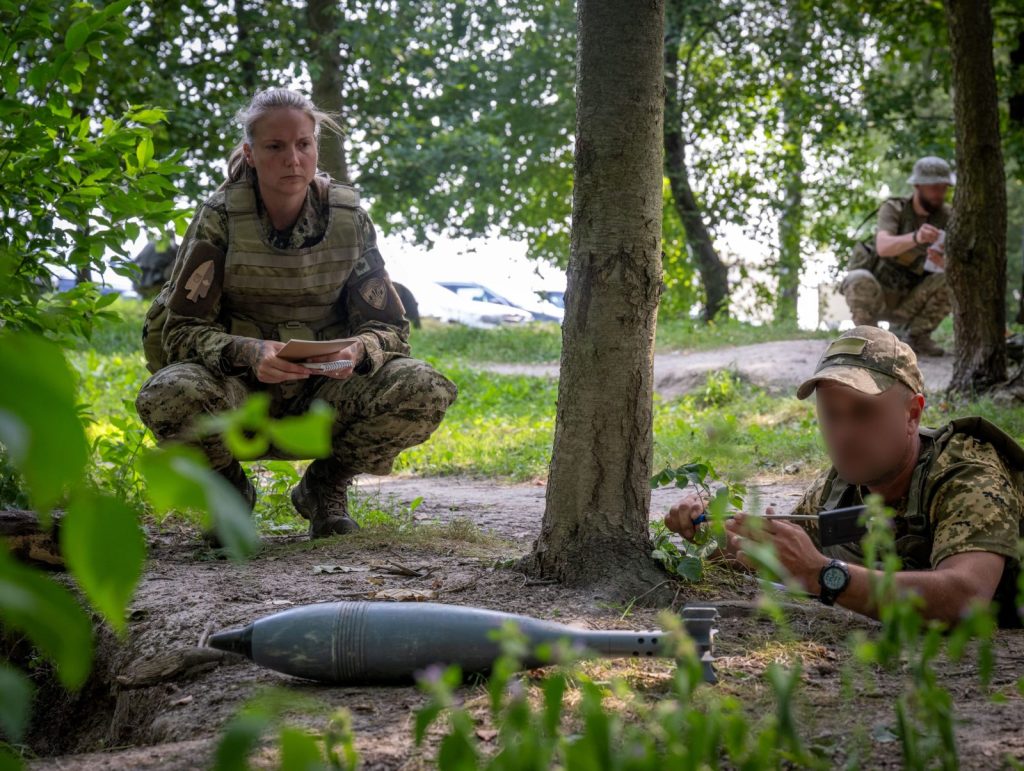
A CAF member provides counter explosives threat training. Photo: Lt(N) Jennifer Gray
What’s extraordinary is how Ukrainian soldiers have internalized the mission command philosophy to the point where they are now innovating faster than their NATO mentors could have imagined. In December 2024, for example, Ukrainian forces conducted the world’s first fully unmanned assault operation near Lyptsi, involving dozens of uncrewed ground vehicles and FPV drones with no infantry — a tactical evolution that demonstrates how empowered soldiers who understand that they are trusted to experiment will push boundaries.
Ukraine was producing 200,000 FPV drones per month by early 2025, and critically, much of this innovation comes from the bottom up rather than top down. Lessons learned in the trenches are conveyed up the development chain. And a gamification system that Ukrainian Defence Minister Fedorov introduced, where drone teams earn points for confirmed kills that can be redeemed for better equipment, works precisely because Ukrainian infantry teams have the autonomy to operate as independent units accountable for results rather than following rigid scripts.
While it didn’t have to be taught to the Ukrainians, the essential psychological dimension that 41 SMB emphasizes is in their motto, “Faith is stronger than fear.” Nerves of steel, and trusting those beside you isn’t motivational fluff. It’s courage, and it is the essential glue that holds decentralized command together when a section sergeant must make life-or-death decisions without waiting for approval from distant commanders.
An experience of callsign Chasik in Russia’s Kursk Oblast, where his “sabotage and reconnaissance” group encountered an enemy reconnaissance team and extracted without losses, exemplifies this. Small teams taking the initiative and operating deep in hostile territory can only survive through a combination of technical mastery, tactical intelligence, and absolute trust in each other’s judgment.
The Canadian training gave Ukrainians the framework for decentralized operations, and the drone-saturated battlefield gave them the motivation to perfect it. As 10-year veteran, callsign Timokha says in the video, “you have to improvise a lot” on the modern battlefield.
Their willingness to improvise and adapt has created an infantry force that’s simultaneously more dispersed and more lethal than the developers of traditional doctrine ever contemplated. They’ve proven that empowered soldiers with tremendous courage and cool heads — and the authority to act independently — aren’t just surviving the chaos of 21st century warfare, they are defining its cutting edge.