


by Chris Thatcher
What was once a singular project to acquire a ground-based air defence system has in recent years become a multi-phased approach to resurrect a capability deficient in the Army since the last air defence anti-tank system (ADATS), an Oerlikon-built turret mounted on a M113, was divested in 2012.
“It’s been a long time since we’ve had air defence,” acknowledged Major Matt Becker, project director for Ground-Based Air Defence (GBAD). “After such a long period of having nothing … it’s like a rebirth of air defence.”
At the front end of the effort is an urgent operational requirement (UOR) to get a capability to the Canadian-led multinational brigade in Latvia as quickly as possible.
In February 2024, the government awarded a $227 million contract to Saab for the RBS 70 NG, a very short-range system that includes the firing units, missiles, transport vehicles, training and support.
Since then, a training simulator arrived in Gagetown and two serials of gunners from the 4th Artillery Regiment (General Support) underwent initial cadre training in June and October 2024. A third serial began this March, as did training for the weapon maintenance. Moreover, the RBS 70 NG has begun arriving in Latvia and the Army expects to declare initial operational capability in May.
“It’s on track,” said Becker, an artillery officer with a background in surveillance and target acquisition projects.
“The first troops (from 4th Regt (GS)) have already arrived and the main body is about to deploy. Soon we’ll have a deployed operational capability for air defence, which is a big deal because ADATS was divested over a decade ago and we’ve had nothing since.”
Following closely on the heels of the UOR is a three-phased project to deliver GBAD. Like the UOR, the first phase will provide a capability to the brigade in Latvia in short order. Known as Uplift, this first project is the result of a change in the procurement strategy that saw more funding injected into the budget last September to rapidly acquire a military-off-the-shelf (MOTS) SHORAD/C-RAM (counter rocket, artillery, and mortar) capability.
“A lot of the work in the last year has been centered around enabling that,” Becker explained during an interview between visits to potential suppliers in the United States and Europe.
“We’re currently targeting November 2027 as a delivery date, and we’re in the process of industry engagements right now. We’re hoping to get a request for proposals (RFP) out later this year, with contract award in 2026.”
The SHORAD/C-RAM system will be operated by 4 Regt (GS), which is preparing to stand up a battery in 2026 to then deploy to Latvia.
The next two phases of the project, appropriately named Enduring, comprise the original GBAD project that has been progressing slowly but steadily since dedicated funding was allocated with the government’s 2017 defence policy.
The scope of the original project included acquiring one battery of SHORAD/C-RAM and one battery of very short-range air defence (VSHORAD). Those are now being procured in two separate phases, known as Enduring Phase 2 and Enduring Phase 3.
Because all three phases of GBAD are being openly competed, the project is accepting some risk, Becker acknowledged. It’s possible the SHORAD platforms for Uplift and Enduring Phase 2 could be different, as could the VSHORAD systems for the UOR and Enduring Phase 3 – meaning the Army would have to support multiple training, maintenance and parts supply chains.
“That’s a risk that’s been assumed,” he said. “Each one is going to have its own RFP, and there are multiple OEMs [original equipment manufacturers] bidding on each of these.”
The aim is to acquire similar SHORAD capabilities for both Uplift and Enduring, but the first project will accept a “viable, ready to go, operationally proven system” for immediate deployment, while the later will consider a fully Canadianized integrated solution.
“Overall, the prospective ORBAT [order of battle] that we’ve developed is for a similar capability, one just much faster and with more military off-the-shelf elements than the other,” said Becker.
There are several possibilities for the VSHORAD system for the Enduring project, but one option is a vehicle-mounted launcher on a LAV or similar type platform, he said.
Becker steered clear of specific manufacturers and platforms, but said the competitive process attracted multiple OEMs for both SHORAD and VSHORAD capabilities. In 2023, the project office issued an invitation to qualify (ITQ) through Public Services and Procurement Canada. Four qualified bidders were accepted, but the ITQ was canceled when the procurement strategy was revisited with the government’s 2024 defence policy update.
The four bidders along with a fifth manufacturer will participate in a limited tender for Uplift later this year.
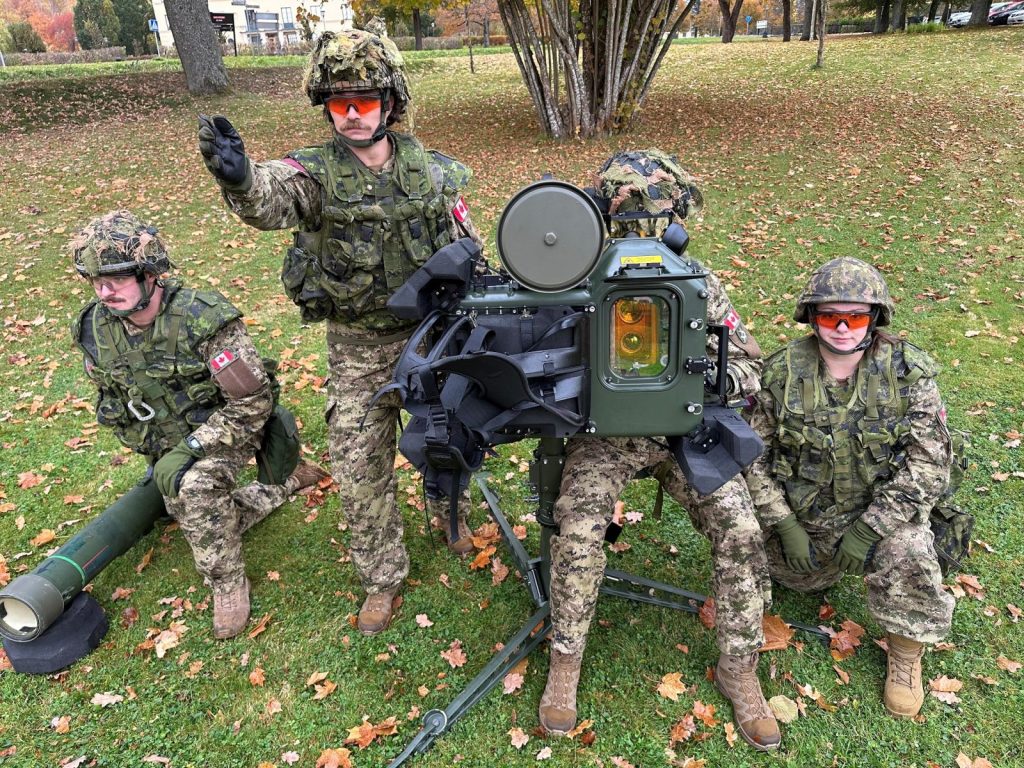
4th Artillery Regiment (General Support) initial cadre training on the RBS 70 NG. Photos: MWO Stephane Gauvreau
Mandatory Requirements
GBAD was underway well before Russia’s invasion of Ukraine in February 2022, but the lessons of that ongoing conflict have reaffirmed the importance of air defence. While the scope has changed with the addition of the Uplift battery, the mandatory requirements remain similar, said Becker, who has served in Director Land Requirements over multiple postings including on projects such as the AN/MPQ-504 Medium Range Radar (MRR) and the CU-172 Blackjack Uncrewed Aerial System (SUAS).
“We’re not changing what we’re looking to counter,” he said, “we’ve just changed the method for what we’re getting and when.
“The systems are quite complex, especially the SHORAD systems, but they usually consist of sensors paired with the weapons platforms that allow the operator to detect air targets, make informed decisions on whether to fire on the target, and if needed, release the weapon to intercept the hostile air threat in accordance with our threat set.”
The integrated system of sensors and effectors is intended to defend against threats from rockets, artillery, and mortar munitions, air-to-surface missiles and bombs, close-air-support aircraft, Class 1 small and 2 uncrewed aerial systems, as well as planes and helicopters.
It also carries a requirement for defence against cruise missiles that may be modified by industry feedback. “It might not necessarily be all cruise missiles, because that is a fairly large range of threats,” Becker admitted.
To ensure a high level of tactical mobility, the Enduring phase will need to lean on existing vehicle projects such as Logistics Vehicle Modernization as well as potentially additional platforms to equip a battery with a fire control unit, reconnaissance elements, support vehicles, and ammunition vehicles. The process for how all of that will be evaluated “is well into development,” he added.
A multi-million-dollar air defence system can seem like swatting flies with a sledgehammer, especially in a battlespace like Ukraine where modified low-cost drones are ubiquitous. Becker raised the cost-benefit analysis of munitions versus defended assets, and noted that the Army’s two counter-UAS projects, one an urgent operational requirement for Latvia, will contribute to a layered defence against aerial threats.
“Everyone is going to be bringing their own capabilities to the table, and they’ll be allocated and utilized in accordance with what the commanders on the ground and what the Army deems optimal,” he said.
The GBAD projects are not only a top priority of the Army Commander, but they are also a long overdue capability for gunners.
“We don’t have a lot of the old air defenders left,” Becker observed. Two members of his project team worked with ADATS, but for most, it will be a new weapon in the toolbox.
“The Army has made it a very high priority; there’s funding and the will behind it. So, we’re all excited, working hard to make the essential capability of air defence a reality again in the Canadian Forces.”

Sad that it takes the potential of actual war, for the Canadian military to get off its collective asses to purchase the proper equipment for our troops:((