

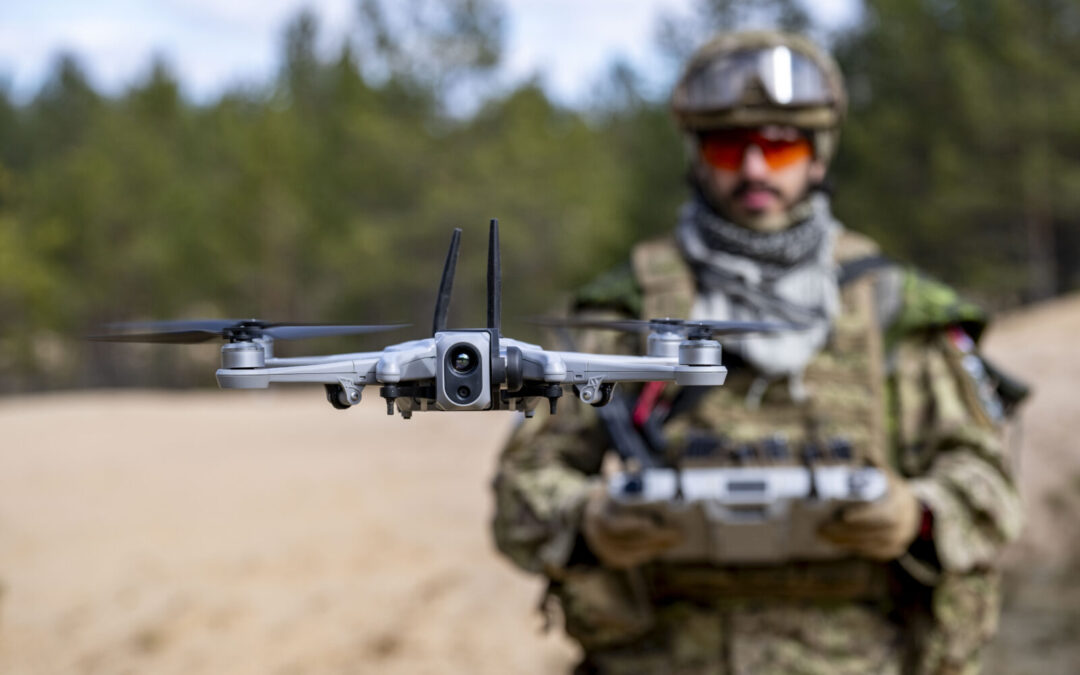
The United States’ war with Iran has underscored what Russia’s war with Ukraine made abundantly clear: the need for an array of simple, low cost, and attritable uncrewed systems. In short, drones able to perform a variety of tasks—precision strike, intelligence, surveillance and reconnaissance (ISR), logistics—in the air, on the ground, and over the littorals.
Last September, the Canadian Army launched the Minerva Initiative, a sweeping effort to identify realistic applications for autonomous uncrewed systems, experiment with options in operational-like conditions, and then spearhead integration into the land force.
Minerva is not a procurement project. But if it is successful in pulling together the experimentation and funding resources from across government and industry, it could help bridge a gap that currently leaves innovative technology just short of Canadian Armed Forces adoption.
Led by the Canadian Army Land Warfare Centre (CALWC), the initiative has held five engagements with industry since its September unveiling. The first two, in December and January, laid out the objectives and then how the Army intends to approach drone experimentation.
“The feedback we got was, there is a lot of industry desire to get after this,” said Lieutenant-Colonel D’Arcy Lemay, CALWC’s chief of Experimentation Services Centre. “They are looking for us [to deliver] collaboration between industry defence scientists and soldiers that is tied to relevant operational environments. It’s not [industry] testing stuff and [claiming] it works. We can provide some of that environment and use all the various elements that the Army can reach into.”
From that initial scene setter, CALWC has launched three working groups focused on distinct lines of effort: uncrewed aircraft systems (UAS); uncrewed ground and littoral systems; and enabling and supporting technology such as systems integration, communication and tracking capability integrated into battle management systems, and training.
Prior to the first meeting with industry, MINERVA brought together representatives from across the Army for a deep dive into drones. They identified 20 priority areas for investigation, which were presented to industry in December, and then refined to a first tranche of 10 by January.
“We can’t do everything all at once,” said Lemay, “so we’re choosing the highest priority ones, and then we’re going to turn those into challenges, leveraging existing programs such as the Innovation for Defence Excellence and Security (IDEaS) and the Innovative Solutions Canada programs.
The UAS list includes first-person view (FPV) strike, target acquisition, ISR, cargo, and Arctic-capable drones. For FPV systems, CALWC is leveraging an IDEaS contest called Drone Surge, which has already selected 30 innovators to compete in a second round of evaluations. And it will launch a Minerva-driven target acquisition drone challenge in May to give a tool to mortar fire controllers and forward observers.
“We’ve got things like the [CU173] Raven B and [CU172] Blackjack for target acquisition, but they’re older, they’re exquisite, you don’t really want to lose them,” said Lemay. “The idea of Minerva is simple and attritable.”
For ground systems, Minerva is prioritizing cargo drones for moving equipment, supplies and casualties, as well as surveillance and breaching systems. Lemay noted that a lot of work has already been done by industry in all three, “so we just need to refine this for Army specific [applications].”
The third line of effort will begin with two challenges: command-and-control and battle management system integration; and training simulation. The first will seek to address airspace deconfliction when hundreds, or even thousands, of drones share the air with tactical helicopters, and how to integrate with air defence and counter-UAS systems to avoid friendly fire. The second will tackle the challenge of training across a range of trades not normally operating drones.
“What underpins both of those, I would argue, is the modeling part of this,” said Lemay. “How do we get the digital twins [for] those kind of systems?”
The second tranche of projects will prioritize additional types of strike drones, which come with policy considerations for arming and fusing munitions, especially on domestic soil, as well as specialist applications such as electronic warfare and other payloads.
The 20 areas of focus were generated by representatives from various units, and “for each one of the Minerva efforts, we’re going to be working to identify a sponsor unit [to] be the principal test area, and to guide these along at the very tactical level,” said Lemay. “That way it’s integrated into their exercises.”
That process of consultation across the Army and with industry will be repeated as the initiative builds momentum.
“I don’t think Minerva has a distinct end point,” he said. “If we show success, this is going to become a way we do business. I hope Minerva is going to provide a real, useful pathway for rapid capability development within the Army.”