

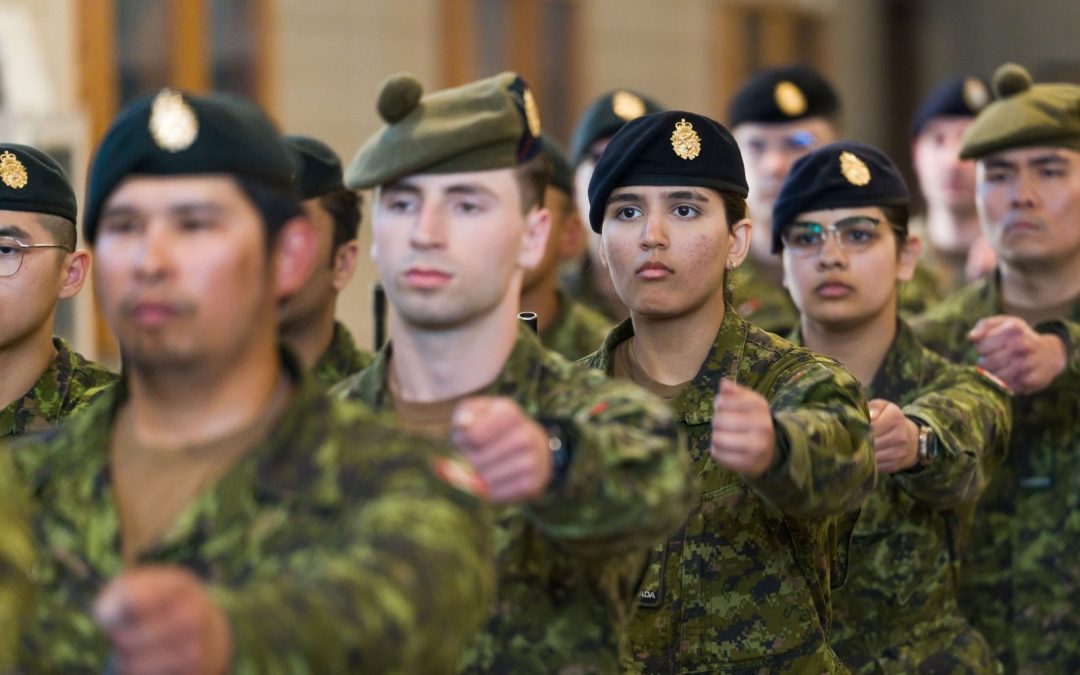
by Canadian Army Today Staff
For too many new recruits, the art of soldiering is a waiting game. After completing Basic Military Qualification (BMQ) at the Canadian Forces Leadership and Recruit School (CFLRS) in Saint-Jean-sur-Richelieu, Que., many find themselves in employment limbo, waiting for space in a Developmental Period 1 (DP1) course, the first stage of their occupational qualification for an Army trade.
With the Canadian Armed Forces (CAF) exceeding its recruitment target for the second consecutive year—7,310 new members enrolled in fiscal year 2025/26, well above the 6,957 objective—the Army needed a way to bridge that gap between BMQ and DP1.
The solution? The Canadian Army Soldier First Course (CASFC), a stepping stone to continue advancing soldiering skills and prepare new members for employment at a unit while they wait for more specialized training as infanteers, gunners, tankers, or engineers.
DP1 training to an occupational functional point (OFP) remains the goal, but CASFC provides flexibility to the training system and serves as a building block for soldier development. Where basic training provides a first experience with military discipline, culture, ethos, and rudimentary skills, the CASFC will deliver the “shoot, move, communicate” foundation of soldiering, explained Major-General John Errington, the commander of the Canadian Army Doctrine and Training Centre.
“It’s kind of like crawling with the CAF, walking with the Army, and then running into your trade.”
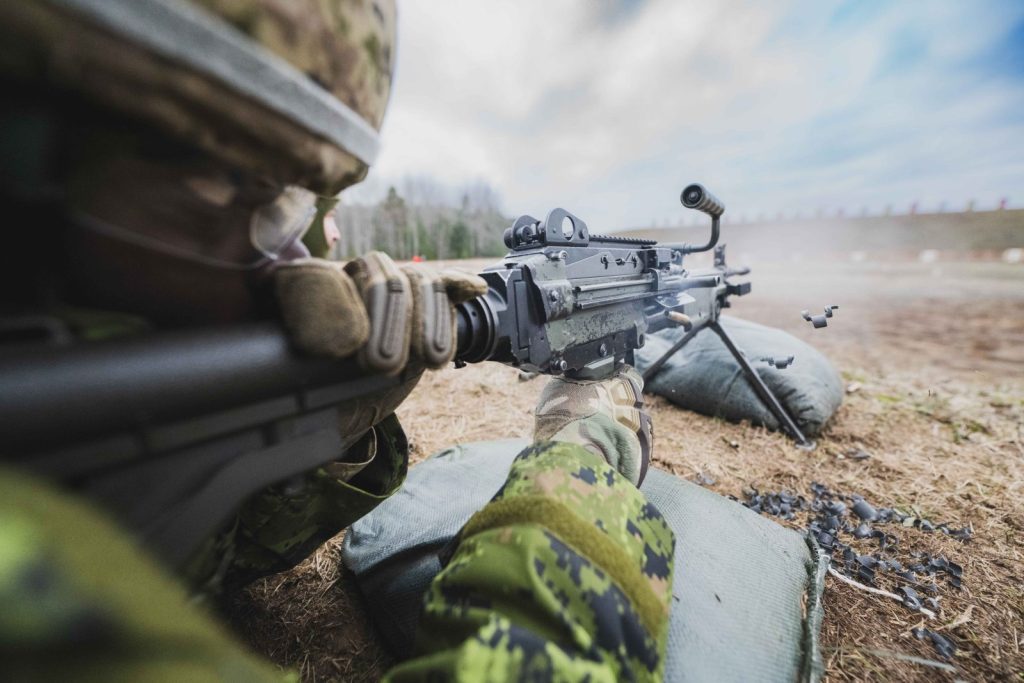
Candidates on the Canadian Army Soldier First Pilot Course train with the C6 General Purpose Machine Gun and C9 Light Machine Gun. Photo: DND
The four-week course is itself designed as a crawl-walk-run process, taking candidates from weapons handling and other weapons skills through tactics theory and into small-scale field operations.
The first week, called Soldier Foundation, serves as refresher for CAF ethos, use of personal kit and personal weapons, hot and cold weather injury prevention, and other basics. The second week builds on established individual skills with the C7 rifle, C9 light machine gun, fragmentation grenades, and other weapons. In the third week, candidates are exposed to tactical theory for offensive and defensive manoeuvres, patrolling, fieldcraft techniques, reports and returns, range firing, and a section attack demonstration. The course culminates with 10 days of field integration, applying new skills and theory to section attacks, patrolling, night navigation, use of pyrotechnics, counter improvised explosive device drills, among others.
All the training is conducted in what the Army calls a counter-uncrewed aerial system (C-UAS) environment, a way to build awareness and resiliency to the persistent threat of drones in operations.
Upon completion, soldiers are confirmed capable of operating within a defensive position, performing as a section member, and able to extract from an explosive threat area.
“The output of that course becomes the baseline for any soldier that wears an Army uniform in the future,” said Errington. “They can go on any common task, whether it’s security, driver, patrolling—there’s lots of tasks internationally and domestic that require that.”
The course, which launched in April, is delivered by the Army’s four Regular Force Army Training Centres, and its nine Reserve Force battle schools.
Soldiers completing the DP1 course reach an OFP where they can fire a unit’s weapons, operate most of its vehicles, integrate into its operational tactics, and participate in collective training. With Soldier First, Errington is introducing a new term—employment functional point (EFP)—that will allow graduates to be employed and trusted at a unit while they wait for a DP1 course.
The course is not a substitute for BMQ, he emphasized. Candidates still need that initial transition period from civilian to soldier, to appreciate the discipline, ethos, culture, and rank integral to the Army.
“I don’t want to have to deal with that in Soldier First,” he said. “We’re trying to teach them how to survive on a battlefield, not how to tie boots or make it to a launch on time. When you ramp up that level of training, there is a requirement for extra emotional support in padres, clothing stores, barracks and all those other things. I’m not setting up for that type of infrastructure. I’m setting up for warfighting shoot, move and communicate infrastructure. … I want to teach them how to be in the Army.”
With rapid growth likely to be a challenge for the next several years, the course relieves the pressure to shorten and degrade DP1 courses and push more training onto units to get recruits through the entry system faster.
“We don’t want to push everything onto the field force,” said Errington. “What we’re trying to do is make interim steps. Once they come out of basic training, then they’ll do Soldier First, and if they cannot go directly onto their trade training within [a certain period], then they’ll go to the unit and be employed.”
He noted that for new members stuck in the training pipeline, the lengthy wait can quickly become demoralizing.
“They’re excited about joining and a new career path, and then they spend six months just waiting for their next course, reporting every day, maybe doing some online courses or some [menial] tasks. This gets them to a unit where they feel like they’re contributing to the bigger picture.”

Pte (Recruit) Liam Morawiec and Sergeant Ryan Ramey plan a bearing over a map during a reservist Basic Military Qualification (BMQ) in March 2026. Photo: Avr Daniel Bartchouk
Graduates of CASFC could be used as drivers or to support training on the next course, serving as the demonstration soldiers for the cadre following them.
Errington suggested there may even be scope at some point to forego certain qualifications if a Soldier First graduate builds enough experience at a unit to take on broader functions. “If their sergeant says, ‘this person is one of my better soldiers,’ and they recommend through the chain of command to make them, say, an infantry soldier, maybe there’s scope for that.”
That combination of CASFC and on-the-job training also might improve the success rate of the DP1 courses.
“If you go to a unit and spend some time in a rifle section or a tank unit, or with the engineers, you’re starting to learn,” he noted. “By the time you go on your DP1, now our efficiency rate and our pass rate should be higher because you’ve seen what right looks like.”

Great out-of-the-box thinking! Hope it builds skills and raises morale.
Sending soldiers to a Battalion without a Regimental cap badge (earned in Battle School) is not going to be well received. This has the potential to create division amongst the troops (ie. YTEP program). Courses in conjunction with recruitment need to be planned strategically to ensure a smooth transition from each stage. The CASFC graduates should transition to DP1 with little if any wait time. Sending them with corn flakes to a Battalion is a mistake. The Army can do better.