

by Canadian Army Today Staff
As modern militaries confront increasingly dynamic logistical challenges, the ability to adapt quickly — often at the tactical edge — has become a decisive advantage. For the Canadian Army, additive manufacturing, more commonly known as 3D printing, is emerging as a practical tool to solve small but persistent problems on deployment.
While still in its early stages, the Army is testing and applying 3D printing on operations, most notably on Op Reassurance in Latvia and Op Unifier in Poland.
These efforts are modest compared to some allies’ experimentation, but they signal a growing recognition: When deployed units can design and manufacture solutions on the spot, they can reduce reliance on supply chains, accelerate innovation, and tailor equipment to operational needs.
As part of the Canadian-led multinational brigade in Latvia, the Army has established a small 3D printing capability to support mission planning and day-to-day staff functions. Although the technology is still limited in scope, it has already proven its value in several niche applications.
The printers are primarily used to create small accoutrements that improve planning, visualization, and quality of life for headquarters personnel. These include map holders, planning aids, and miniature model kits used in operational planning or command post tracking. In a headquarters environment where battlespace visualization is essential — and often specific to the terrain, force structure, or scenario — custom-built models provide planners with better situational understanding than improvised substitutes.
More importantly, the 3D printing capability empowers the Brigade’s staff to rapidly iterate. If a planner needs a new symbol, a unique terrain marker, or a modified piece of planning kit, the turnaround can be measured in hours rather than waiting days or weeks for supplies to arrive through the NATO support system.
On Op Unifier, where Canadian Armed Forces personnel are training members of the Security Forces of Ukraine, the Engineer Training Element (ETE) has integrated additive manufacturing directly into its curriculum.
The ETE employs 3D printing to produce realistic training aids for the Basic Sapper Course, a critical component in preparing Ukrainian combat engineers. The printers generate a variety of simulated munitions models, including mines, fuses, and other explosive devices. Designed to replicate operational equipment as closely as possible, these models allow instructors to run hands-on demonstrations and practical exercises without relying on actual munitions.
Where 3D printing truly enhances training value is in the integration of electronics. Many printed devices are fitted with buzzers and simple circuits that provide immediate feedback during drills. If a trainee triggers a device in a scenario — through incorrect handling, poor placement, or procedural errors — the buzzer activates loudly.
“The circuitry built into our 3D-printed aids give students instant feedback,” explained an ETE instructor, whose name is withheld for operational security. “They immediately know when their actions would have set off a device and can take steps to improve.”
The tool also enables instructors to design progressively more complex and unpredictable scenarios, reflecting the realities faced by engineers on the battlefield.
In addition, 3D printing’s affordability and adaptability allows the ETE to rapidly produce custom, lesson-specific models at minimal cost. When operational requirements evolve or training priorities shift, instructors can update designs, print replacements, or modify components within days. Although 3D-printed items are not highly durable, their low cost and ease of replacement make them ideal for high-use training contexts.
Army units have been experimenting with additive manufacturing since at least 2014, but the technology was first trialled in an operation when two 3D polymer printers were shipped to Latvia in September 2021.
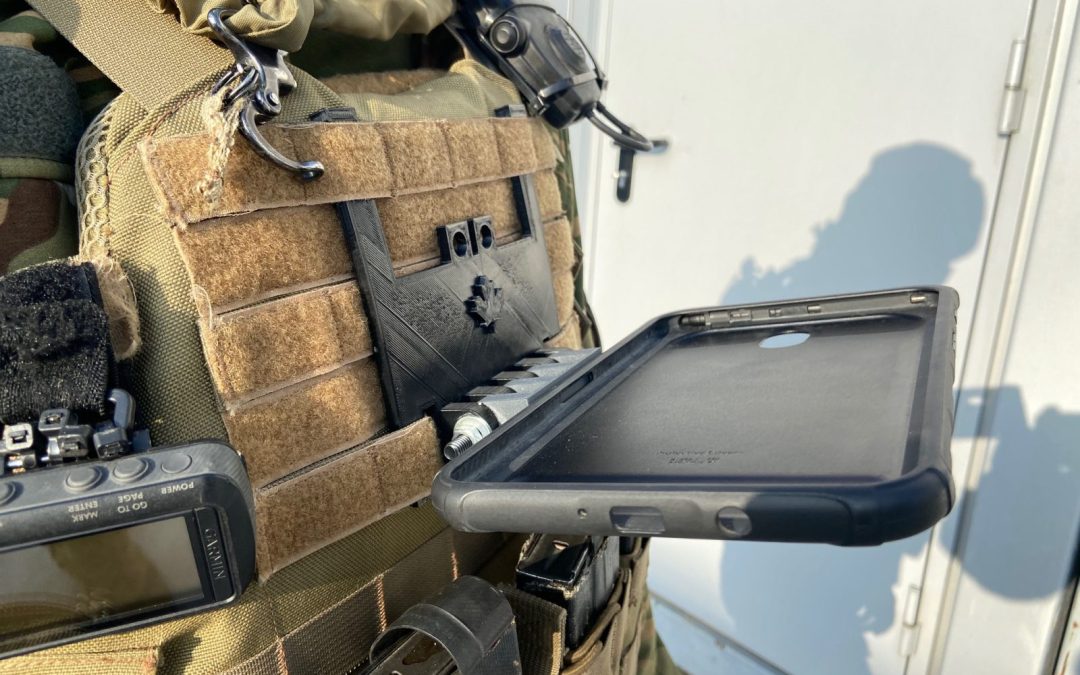
The first product printed on Op Reassurance was modest, a knob for crypto radios that otherwise would not have been serviceable. But in subsequent rotations, 3D printers were forward deployed with the battlegroup, and were used to make spare parts and other customized equipment. Significantly, the cadre of technicians in theatre able to operate the printers grew exponentially.
The continued evolution of the technology, though still modest, is an indication that 3D printing is gaining traction. Its use remains selective, but it is delivering niche items much more efficiently than would otherwise be the case.