


Though cyber has been a recognized military domain, on par with air, land, sea and space, for almost a decade, it has only recently cemented its place among the C’s of command, control, communications, and computers, that have long comprised the convoluted acronym C4ISR (the ISR being intelligence, surveillance and reconnaissance).
In an address to the defence industry at the CADSI Army Outlook last April, Lieutenant-General Michael Wright underscored the importance of cyber within a group of priority projects that will form the digital backbone of a modernized force, stating that the internal shortform would now recognize both cyber and the significance of targeting.
“We’ve added the additional C, recognizing that cyber, on both the offensive and the defensive side, is a key to the success of Land C5ISRT,” explained Lieutenant-Colonel Chris Stobbs, Director Land Requirements (DLR) section head in charge of the six Land C5ISRT projects, often referred to as SSE 4 for their position among recommendations in the government’s 2017 defence policy.
The six projects include Land Intelligence, Surveillance and Reconnaissance Modernization (Land ISR Mod), Tactical Communications Modernization (Tac Comms Mod), Tactical Command & Control Information Systems Modernization (TacC2IS Mod), Joint Deployable Headquarters and Signals Regiment Modernization (JDHQSRM), Combined Joint Intelligence Modernization (CJIM), and Canadian Forces Land Electronic Warfare Modernization (CFLEWM).
While cyber is now included in the acronym that underpins all six, it has not introduced new elements to the high-level requirements the Army is asking of industry. “Cyber is something that was not explicitly [stated] in the projects, but it is definitely part of the requirements of the program,” said Stobbs, a Signals officer, told Canadian Army today in October. “So, there’s no change to the program at large.”
Despite the setback of the COVID-19 pandemic and the challenge of meeting an urgent operational requirement (UOR) for a brigade command-and-control network in Latvia, all six Land C5ISRT projects are now in or nearing the definition phase of defence procurement.
Early in 2025, Tac Comms Mod, TacC2IS Mod, and CFLEW Mod entered definition, joining Land ISR Mod, which did so in July 2024. The remaining two, CJIM and JDHQSRM, are expected to transition from the options analysis phase by mid 2026. Both project schedules have slipped by about six months but won’t significantly affect delivery of the overall portfolio, Stobbs suggested.
“Definition is a huge milestone,” he said. “The [projects are] receiving resources and funding, and we’re able to really refine the requirements … and confirm what exactly is going to be delivered. It showcases that these projects are important and they’re getting the resources needed to move forward.”
He noted that while establishing the brigade network became the immediate priority in recent years, it was managed by a separate project team that did not draw significant resources from the core six. And although the UOR was specific to brigade operations in Latvia, it generated feedback that could help “de-risk” the Land C5ISRT projects.
“We won’t necessarily get the exact same capabilities that have been implemented there,” said Stobbs. “[But] we’re looking at the lessons learned with respect to procurement, with respect to pushing some of this equipment into theater and seeing how it works, to de-risk some of the work that we’ll have to do for Tac Comms and TacC2IS.”
The brigade network is expected to achieve initial operational capability this fall, and full operational capability (FOC) in 2027.
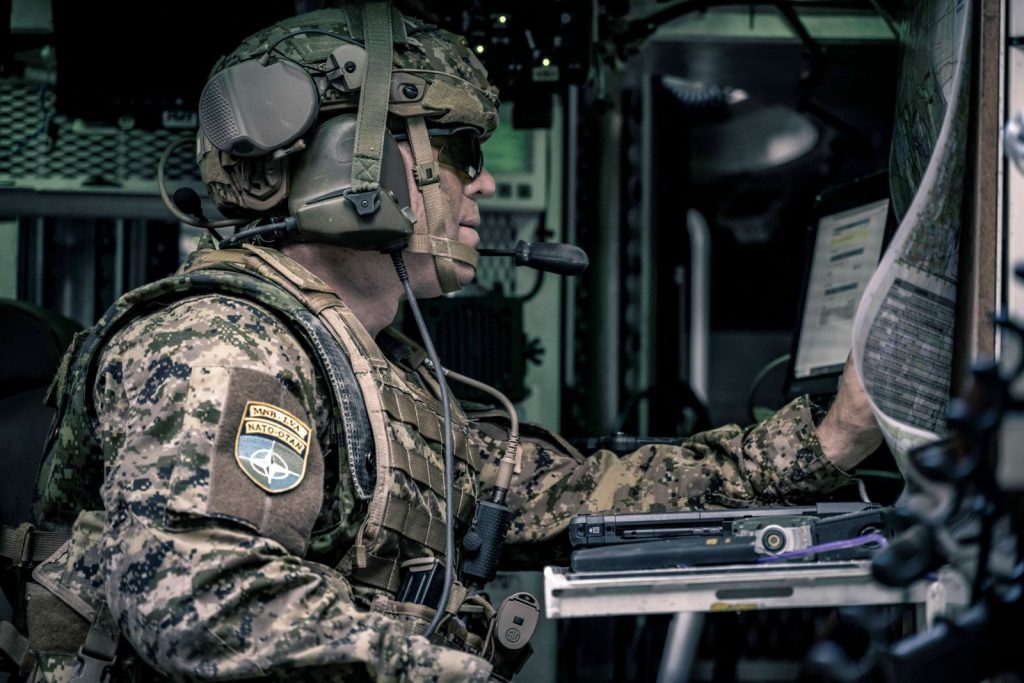
Multinational Brigade Latvia Commander, Colonel Kristopher Reeves, conducts command and control during Ex Oak Resolve in August 2025. Photo: Sgt Aydyn Neifer
It is too early in the process to share specific lessons, said Stobbs, but he was among a team from DLR, Director Land Command System Program Management (DLCSPM), and the Army G6 office to visit Latvia to assess the initial brigade capability, with the intent of using “that information to help feed into the subsequent projects, specifically Tac Comms and TacC2IS.”
That in turn could influence the Land C5ISRT schedule, he noted. As a priority project of the Army commander and a critical component to many of the divisional elements the Army is seeking to acquire, there is urgency to move faster if possible. Wargaming exercises to develop the Army’s action plan highlighted “that the Land C5ISRT suite of projects is a key enabler, so at each of the PMBs [Program Management Board], where we were briefing the projects, the biggest question was, ‘You provided us timelines; can you move quicker?’”
Stobbs noted that fast-tracking the program would be contingent on the procurement process, but also on industry capacity to deliver systems, software and equipment on an accelerated timeline.
As part of the development and sustainment of C5ISRT, DLCSPM has seconded personnel to a battle lab created by General Dynamics Mission Systems in Ottawa, to unearth and trial private sector technology.
“It allows us to test out some of the equipment that could potentially be included as part of the overall program,” said Stobbs. “The lab is a great venue to look at different [industry] equipment and see if it makes sense prior to being delivered.”
The venue could also provide the means to ensure continuous capability sustainment (CCS), a new approach to in-service support for which the Land C5ISRT program could be an early adopter.
“With the constant evolution of technology, it simply doesn’t make sense to use that old capital project model where it takes 10 to 20 years to inject new equipment,” he said. “The reality is, by the time that equipment is implemented with decades-old requirements, it is obsolete.”
The details of the CSS are still being fine tuned, he added, but it is “the key to upgrading technology in the future. It still needs to go through the hoops and hurdles confirming that it makes sense and it has the [high-level] buy-in.”

Members of the Multinational Brigade during Ex Oak Resole in September 2025. Photo: Cpl Michael Vandenbroek
Already across the six Land C5ISRT projects, the teams are developing a three-year rolling cycle that would see them begin technology upgrades of certain hardware such as radios, systems and software.
The initial requirements for each project were first circulated in 2017, following the release of the defence policy in July, and all are expected to reach FOC by 2037, a 20-year span.
“What we are doing to mitigate [technology obsolescence] within this program is using a cyclical approach to inject new capability,” Stobbs explained. “The initial implementation for our two main projects, Tac Comms and TacC2IS, is between 2028 and 2030. So, between now and 2028, we’re defining these projects; the implementation for that initial capability inject will be 2028 to 2031. Then, while we are implementing that initial capability in 2028 to 2031, we will define what will be implemented in 2031 to 2034. That way, we’re always looking at the latest technology for that next implementation.”
The General Dynamics battle lab will be a central feature of that technology identification and evaluation, he confirmed. “For that initial capability inject for TacC2IS, we’re looking at the battle management system, and on the Tac Comms side, we’re focused on our vehicle communications.”
Following the Army’s initial modernization wargaming exercises [see page 20] that made clear the necessity of a digital backbone, DLR began looking beyond the current Land C5ISRT portfolio to what might be needed on the horizon, including trying to understand the implications of artificial intelligence, quantum computing, and other emerging technology on the current five Cs, as well as a possible sixth — combat systems.
“I’ve already dedicated a project director with the task of looking at post-SSE 42,” said Stobbs. “That’s where we’re also engaging our allies and looking at some of their lessons learned as we look to implement these technologies.”
With much of the Land C5ISRT program now in definition, the project teams will be holding industry days to solicit input on the final capabilities and procurement approach, and perhaps some of the thinking about future upgrades.
Land C5ISRT consists of six projects:
- Tactical Communications Modernization (Tac Comms Mod) will deliver the operational and tactical bandwidth and acquire the radios and other communication tools for headquarters, vehicles and other platforms.
- Tactical Command & Control Information Systems Modernization (TacC2IS Mod) will provide the hardware and software that comprise the systems and networks in brigade and battle group headquarters, and the software in radios and other systems in vehicles.
- Intelligence, Surveillance and Reconnaissance Modernization (ISR Mod) will acquire or upgrade a range of sensors, many introduced under all the interconnected Land Force Intelligence, Surveillance, Target Acquisition, Reconnaissance (ISTAR) projects, and ensure they connect into the larger Land Command Support System (LCSS) network.
- Joint Deployable Headquarters and Signals Regiment Modernization (JDHQSRM) will upgrade the communications systems, including most of the secret level comms, that the Signals regiment employs when setting up a joint task force headquarters or when elements of 1st Canadian Division, such as the Disaster Assistance Response Team, deploy.
- Combined Joint Intelligence Modernization (CJIM) is focused on delivering facilities to enable access to top-secret networks for deployed forces. The project will acquire physical shelter systems and will include a facility to train the army intelligence teams of the future.
- Canadian Forces Land Electronic Warfare Modernization (CFLEWM) will modernize the Army’s ability to counter improvised explosive devices and improve its electronic warfare systems. Previously distinct capabilities, the two share a common interest in electronic countermeasures to sense and jam or exploit threats from electronic signals.