

by Chris Thatcher
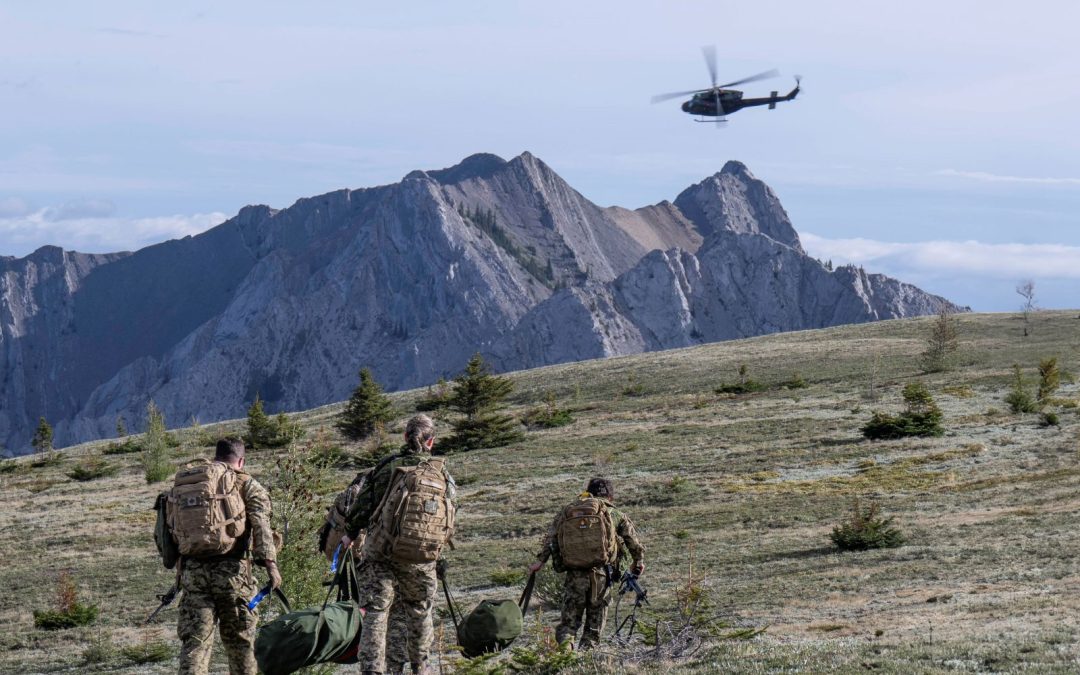
When Canada plays host to an event like the G7 Summit, it triggers a rare approval process within the Canadian Armed Forces (CAF) — use of force on domestic soil.
As Joint Task Force Cadence was standing up in the fall of 2024 to lead the CAF contingent providing security to world leaders attending the June Summit in Kananaskis, Alta., one of its first priorities was establishing the rules of engagement (ROE).
“It’s been a long time since a lot of the troops had lethal ROE with loaded rounds,” observed Brigadier-General Wade Rutland, the commander of 3rd Canadian Division and Joint Task Force (West), and by extension the commander of JTF Cadence.
“In all the lessons from previous events, [they] said, get your ROE signed early,” he noted. “Everyone had to know and be confident in their ability to use force, to understand [the difference] between hostile intent and lethal intent. For months, we were able to practice use of force procedures. We held a big rules-of-engagement symposium, down to battalion level, and then did tons of practices before the actual operation in Kananaskis.
“Thankfully, we didn’t have to use them on the ground. But [the training] certainly gave a lot of confidence to the soldiers.”
Lethal ROE as approved by Canadian Joint Operations Command (CJOC) are standard for missions such as Operation Reassurance in Latvia, where deterrence of a looming Russian threat is central. But for many members of 3rd Canadian Division, training in Canada with such rules was a new experience.
“When I looked around the room when we were doing this, the battalion commanders now are the last Afghan war veterans — they were platoon commanders in 2010-2011,” Rutland said. “We’re starting to get to a phase where [that experience] is gone.”
Operation Cadence became not only a first use of lethal ROEs for many in a division that will lead the multinational brigade in Latvia in 2027, but also a trial of technology gradually seeping across the Army, and a first “test” of structural changes that will see the Army reconfigure as three operational divisions focused on defence of Canada, manoeuvre, and support.
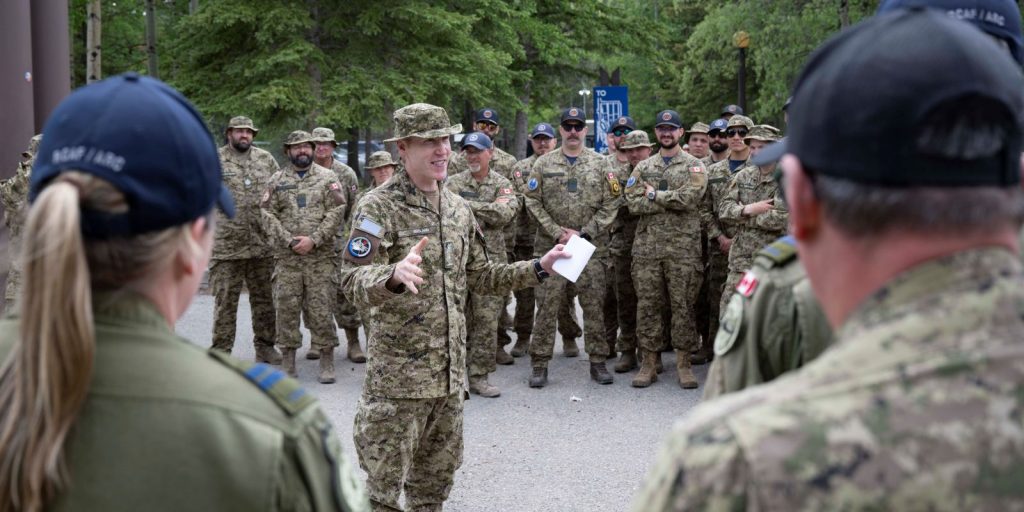
BGen Wade Rutland addressing members of the Air Task Force. Photo: MCpl Steve Picard
UNIFIED COMMAND
Though the land component of JTF Cadence was drawn primarily from across 3rd Division, particularly 1 Canadian Mechanized Brigade Group (1 CMBG), it was “true full, joint CAF,” said Rutland.
The Land Task Force (LTF), led by 1 CMBG under Colonel Sean French, included 1,400 soldiers from the first and third battalions of the Princess Patricia’s Canadian Light Infantry and 1 Combat Engineer Regiment.
The Air Task Force included a headquarters as well as six CH-147F Chinook and six CH-146 Griffon helicopters, aircrews, maintainers, and logistic support. A Joint Task Force Support Component of about 125 soldiers, drawn from the 3rd Canadian Division Support Group, not normally a deployable unit, provided overarching logistics. The JTF also included about 300 reservists, operating as a Reserve company.
The task force headquarters was co-located with the Royal Canadian Mounted Police in Calgary, a partnership in which the CAF was notionally “subcontracted” to the RCMP but reported directly to CJOC.
Poring over the performance reports and other documents from the 2002 G8 Summit, also held in Kananaskis, the 2018 G7 Summit in La Malbaie, Que., and the 2010 Olympics in Vancouver, the overriding theme was early integration among the security partners, and at all levels, said Rutland.
His office was located beside RCMP Chief Superintendent Dave Hall, the event security director and a former CAF member, near a joint operations cell that allowed for rapid communications across the task force.
“We called ourselves the unified command centre,” he explained. “It made it really seamless. The integration was easy because it happened early and went deep. At [almost] every level, [the Army unit] had a RCMP rep in their headquarters. Always integrated, which is why I think we had a lot of success, because the communication channels were tight.”
The partnership worked as a series of concentric circles. The centre circle, a relatively small, restricted access zone around the Pomeroy Kananaskis Mountain Lodge, was controlled primarily by the RCMP.
Surrounding that was a larger controlled access zone of the Kananaskis Valley and rising slopes of Mount Kidd and Mount McDougall, monitored by JTF Cadence through constant patrols and persistent observers and sensors.
The third ring, controlled primarily by the RCMP, focused on the major public roads and other access points. Throughout, Air Force and Army radars monitored the airspace while uncrewed aircraft systems (UAS) whirled overhead.
In fact, identifying the mostly off-the-shelf quadcopters, operated by both the Army and the RCMP, and deconflicting airspace as helicopters ferried world leaders to and from the Summit, presented one of the larger challenges, said Rutland.
“All these things were a lot to handle as the airspace got saturated with airframes. Managing who could be up and when took a long time to work through.”
To ensure possible conflicts were understood early in the planning, the RCMP created an Integrated Safety and Security Group. Among its many working groups was an air team that tackled not just the employment of drones, but also how best to deploy the RCMP’s counter-UAS systems.
“How do we make sure that we’re bringing down the right UAS and not a friendly one? What if a helicopter needs to fly through?” Rutland explained. “There was no manual on how to do interagency UAS and counter UAS. But by June, we’d had lots of experimentation, lots of discussion, and lots of impressive capability.”
The preparation included the National Exercise Program, run by the RCMP but contracted through Calian, that delivered numerous planning conferences and a series of exercises with a distinct military flavour.
“When we got to the final objective, it was not the first time we had worked together,” Rutland said of the training.
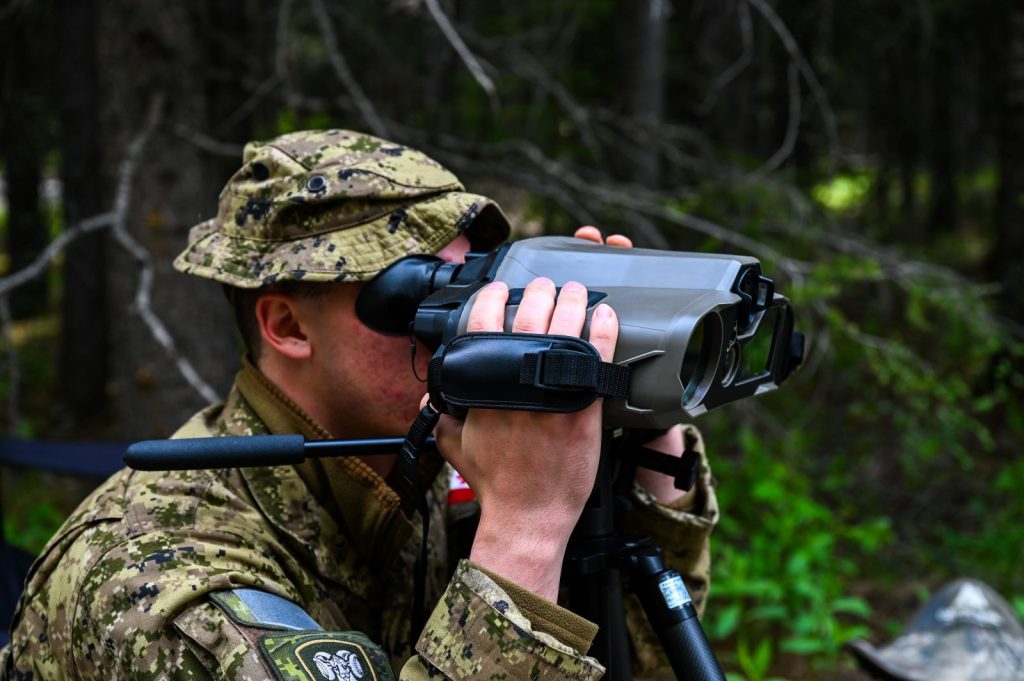
A member of the Land Task Force using the Thales Sophie Ultima handheld thermal imager. Photo: Lt(N) Joshua Ehnisz
INTEGRATED SENSE
While it was not a specific task for JTF Cadence, trialling some of the Army’s newly acquired capability became one of the operation’s noteworthy themes.
Throughout the event, soldiers conducted road and trail patrols and transported equipment with new lightweight, off-road tactical vehicles, a small part of a fleet of 90 platforms ordered from GM Defense Canada for the brigade in Latvia.
As part of enhanced surveillance capabilities, the Land JTF employed the Thales Sophie Ultima long-range handheld thermal imager, a new system acquired under the Night Vision Systems Modernization (NVSM) project.
“It was fantastic,” said Rutland. “[Looking] up on a mountain top about four kilometers away, you could see the troops walking around with thermal and non-thermal sensors.”
Though the adoption of Tactical Assault Kit (TAK) software has been gaining traction across the Army for several years — Cloud TAK became a deployable capability in 2024 and members have used CivTAK, a civilian variant, with provincial firefighters in domestic operations — it played a critical role supporting situational awareness in the unified command centre.
“I could walk into the UCC, and on the big screens … see a RCMP person, a CAF member, a helicopter,” said Rutland. “Every patrol that went out had someone with TAK on the phone. In the Ops Center in Calgary, they’d [be able to show me], that’s 3 PPCLI, A company, 1 Platoon, 3 Section on patrol. And I could see if there were RCMP with them.”
With so much data being passed in a small area, one of the surprising challenges at times was “saturation of signal” rather than limited bandwidth, he noted. That prompted discussions about information management in the modern battlespace.
“You want to get a picture on what’s going on … but do I want to see every single patrol out there? Do I want to see groupings and zones and then zero in? From a commander perspective, I don’t need to know what patrol is roaming around in the 3 PPCLI access zone. I just need to know roughly where in the zones they are. The [LTF] commander would want to know. But there’s some layers and filters you have to apply, otherwise you risk starting to plug in the thousand-yard screwdriver and move patrols around.”
The operation was supported by real-time, 3D terrain-aware command-and-control software developed by Calgary-based Tacteris. “It’s like project management software, but for military operations,” explained Sundeep Kharey, vice president of business development, adding that while TAK is good for positional tracking, it has limits as a planning tool.
“Before Tacteris, the state-of-the-art focused on positional awareness — ‘where is everyone?’ But the harder question for commanders is: ‘So what? How do we plan the next bound? Who is doing what, where, when, and why?’ Turning awareness into coordinated action — again and again, as quickly as possible — that’s the real challenge we solve.”
The most significant technology story, however, was the integration of the Air Force TPS-77 from 42 Radar Squadron in Wing Cold Lake, Alta., with the Army’s Iron Dome Multi-Role Radars (MRRs) from the 4th Artillery Regiment (General Support) in Gagetown, NB.
“I think we are going to see more and more of the Army and Air Force working together, because the MRR and the TPS-77 have different capabilities,” said Rutland. “The MRR was really good working around mountains and through the valley, whereas the TPS-77 was up on a huge hill in Cochrane. Together, they were able to create that overall picture — it was the fusion that made the difference.”
As the Army rebuilds its ground-based air defence in the coming years, and needs to “link sensor to decider to shooter” at a pace that matches the threat, determining how to most effectively and collaboratively deploy assets will be critical, he suggested.
“If you want to fight in a modern environment, you’d better be able to sense, and out deep. By linking three MRRs plus [with] TPS-77, we had that all [feeding] into our headquarters and into the JFAC. [This] was a good initial step.”
In the Army’s managed readiness plan, 3rd Canadian Division will enter the build phase in 2026, ramping up for deployment to Latvia in 2027. Trialling new equipment as part of JTF Cadence is an important marker, Rutland said.
“When [1 CMBG] goes in the field for all their big exercises, they’ll be able to leverage a lot of this technology. For example, in their command post, instead of having a bunch of maps, they had a giant [interactive] screen on their bird table. I think, conceptually, it put a lot of good ideas in the minds of all our folks … and they will spread around as an institution.”
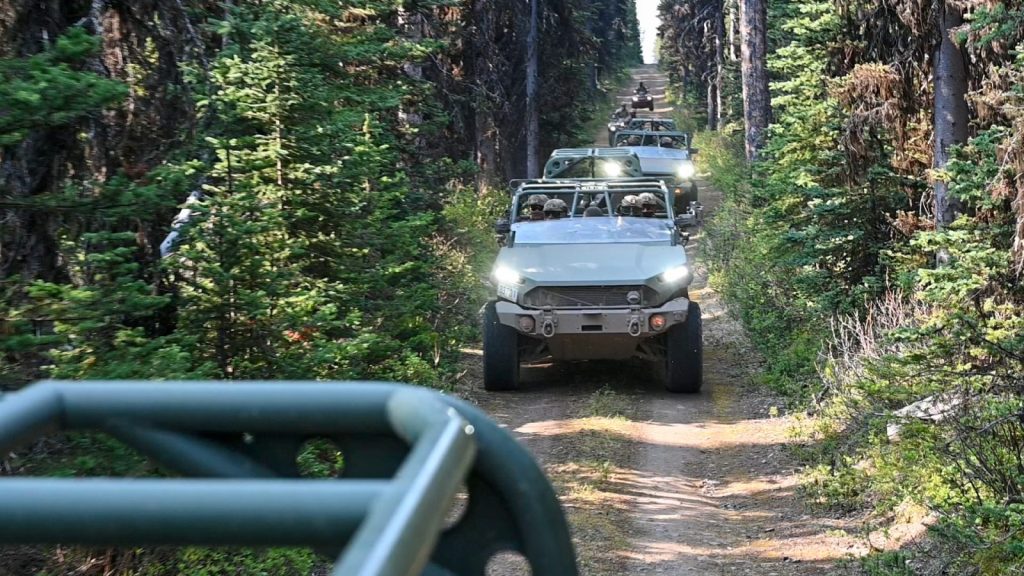
A convoy of Light Tactical Vehicles and ATVs conducting a patrol. Photo: MCpl Robert Mitchell
PROFESSIONAL DISPLAY
The only significant incursion into the control area occurred in the air, when a single engine plane flew into the restricted airspace on the opening morning of the summit, prompting NORAD’s Canadian Region to deploy CF-18 Hornets to intercept. The pilot initially failed to respond to multiple attempts to gain his attention, but eventually landed under his own power.
“From a ground perspective, there were lots of encounters, but [most] were accidental, [such as] hikers” unaware of the controlled access, said Rutland. “It was as we expected, and I think the reason for that is we had a robust presence. We had folks up in the mountains, we had folks up on the trails. It would have been tough to get in there.”
Among the lessons he is leaving for the next such joint task force are the ones he inherited — plan and integrate, “early, often and deep.” The JTF placed an emphasis on environmental stewardship — “leave the place as good as you found it” — which will also be a key point for a future commander.
“In the end, the Prime Minister and the Government of Canada were able to host that summit, get after big world problems, and not worry about security,” he said. “And this was the Prime Minister’s first real operational interaction with the CAF. I think we got to show the skills and professionalism of the Canadian Armed Forces, in which he is investing a lot.”