


by Ken Pole
With Canada’s northern flank increasingly seen as a strategic vulnerability, much of the focus has been on acquiring air defence and new sensors, and on creating northern operational support hubs in an area that accounts for nearly 40 percent of Canada’s land mass. For all that, there’s still the grunt work of getting around on the ground in an inhospitable environment that continues to evolve due to climate change.
Enter the Domestic Arctic Mobility Enhancement (DAME) project, a rapidly maturing Army venture that will procure up to 170 vehicles suited to the North’s always challenging topography and mix of taiga and tundra.
The project intends to replace the Army’s current Arctic workhorse, the Bandvagn 206, an articulated tracked all-terrain vehicle initially developed for the Swedish Army in the early 1970s by Hägglund & Söner, and later by BAE Systems Hägglunds. It consists of two linked units capable of carrying a total of 17 persons.
“We are looking good for entering definition this summer,” Major Bill Prince, DAME project director since last summer, told Canadian Army Today in early March. “All our internal governance pieces, different boards and panels that review projects and make sure we are asking for the right things,” are in place. “We have gained a lot of momentum.”
Delivery of the new vehicles, which will be strictly for domestic deployment, originally was expected to begin this year, but the global pandemic undermined the process by, among other things, disrupting supply chains and human resources. As the impact of the pandemic waned in 2023, the Directorate of Land Requirements (DLR) and Public Services and Procurement Canada issued a request for information (RFI) to reassess industry interest.
The goal is now a request for proposals by 2026, followed by contract award in 2027. Prince said there had been further discussion about the scope of the project, which initially envisaged up to 153 vehicles and full fleet operation by 2030.
The Army will account for the bulk of the fleet, but the Royal Canadian Air Force is receiving several to station in support of flight operations in forward locations such as CFB Alert in the High Arctic.
“This is a high priority for the Army Commander and for the government at large,” said Prince, a member of the Royal Canadian Dragoons, the Army’s senior armoured regiment by precedence. “That brings a lot of light to moving this project forward.”
With the implementation phase now pushed back to 2028, he said the Army is looking at initial delivery in early 2030, initial operational capacity the following spring, and full operational status in early 2032.
“We’re trying to move as fast as we can to get this capability into the hands of our soldiers,” he said. “But we don’t want to move so fast that we fail or trip ourselves up. We want to advance with purpose, to achieve all our gateways.”
While the schedule is progressing, the Army is still working on how the new fleet would be distributed.
“Each Division will get a company’s worth of vehicles—a number that’s still in flux,” said Prince. “Arctic Response Company groups will be one of the main users and Immediate Response Units in each division may use those vehicles.”
The Global Response Task Force, when they have an Arctic remit, would also be using these vehicles. In addition to the Divisions, a couple of schools are going to be getting them to be able to train maintainers and operators, and train the Advanced Warfare School on being able to train Arctic warfare tactics. As well, the Arctic Training Centre will get a company’s worth in Resolute Bay.
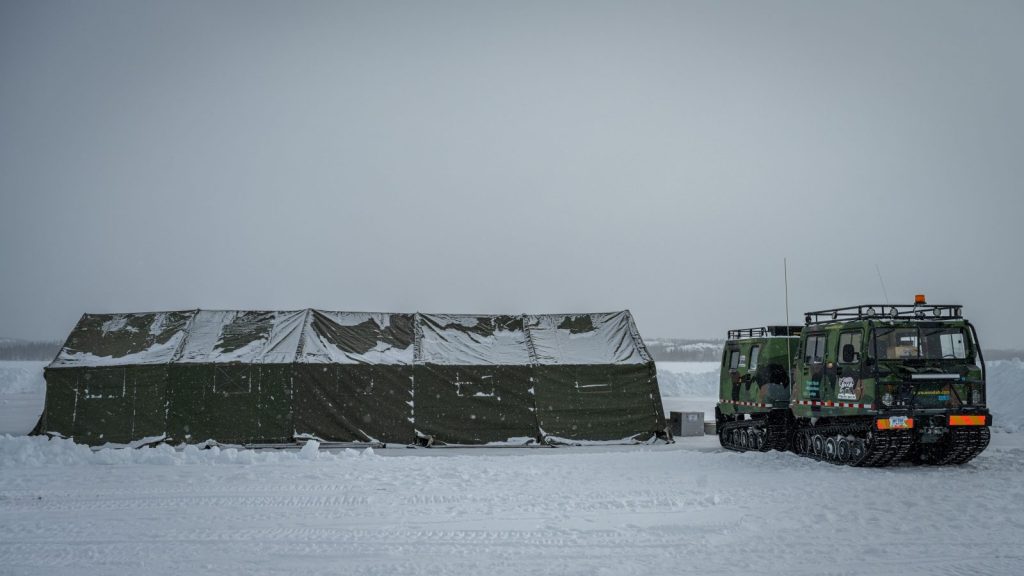
Photo: S1 Bryan Underwood
Several potential vendors have expressed interest, but Prince would not go into specifics, except to say that three manufacturers responded to the RFI. BAE Systems Hägglunds is understood to be interested in supplying its similarly configured BvS 10 Beowulf. Although BAE could cite its history with the Canadian Army and others, Singapore-based ST Engineering Land Systems (formerly ST kinetics) could offer its Bronco 3, which is in service with a number of countries, including Ukraine. As well, Montreal-based UTV International has for several years displayed its Voyager D12 Personnel Carrier, a rugged amphibious, articulated, hybrid-electric off-road transport vehicle, at CANSEC.
“We are looking at a competitive process,” Prince stressed. “We have been communicating with RFI’s. They have been updating us on what their capability is and what they offer. We have been using that to refine our requirements, scope, and budget.”
While the core vehicle, like the legacy Bv 206 platform, would be powered in both halves, the Army also is contemplating the addition of an unpowered trailer. Each would have a driver and crew commander, with the troop carrier variant able to accommodate up to eight troops kitted out for winter warfare.
Prince emphasized that the new platform will not be a fighting vehicle, “where we drop the ramp and the troops dismount and fighting through to an objective.” It will be neither armoured nor armed because “we wouldn’t necessarily be that close that we need to dismount and fight right off that vehicle. We would have some time and space to shake out and be able to do our tasks. I believe some of our allies have armored vehicles and potentially weapon systems mounted on similar vehicles, but that is not a capability that we are looking at.
“This is a support vehicle, a mobility vehicle. It is to get the troops to where they need to do their tasks, supply them with the stores and supplies they need to be able to do that, but not a fighting vehicle. Armour and weaponry certainly would increase its weight and cost.”
Command, cargo and ambulance variants also are in the works, the latter capable of carrying at least two stretchers or four walking wounded and a medic.
Increasingly important in a fiscally constrained environment, the Army is looking for “an off-the-shelf product because we don’t want to do any development,” Prince said.
“We want to pick something that has a proven track record in service with our allies, so there is less development work, and less time spent doing testing. We can just pick the winning bidder and be confident that we have a successful product.”
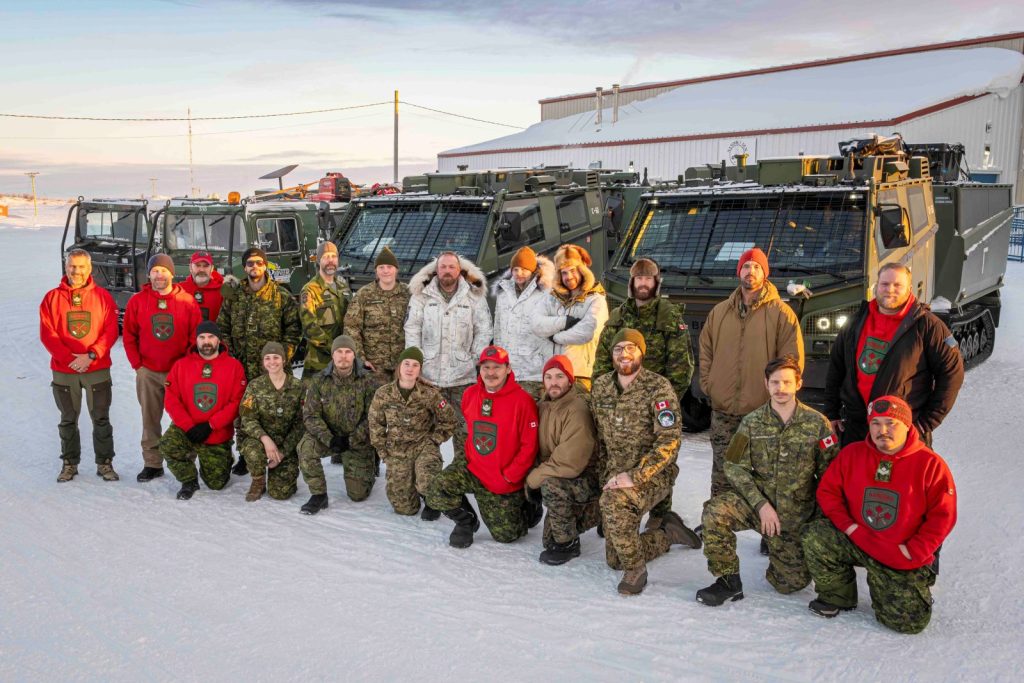
Members of 1 Canadian Ranger Patrol Group and the International Cooperative Engagement Program for Polar Research (ICE-PPR) in front of a row of BVS10 Beowulfs in front of the Kitti Hall Community Centre during a static display as part of Operation Nanook-Nunalivut in Tuktoyaktuk, Northwest Territories in February 2025. Photo: MCpl Alana Morin
Whatever the DAME project yields, it must be amphibious. “That is something the Army hasn’t had in some time,” he said. “That’s going to be a little bit of a change, especially for some of our younger soldiers. They may not remember that we had amphibious vehicles in the past, so there will be a bit of education on how to safely swim in an amphibious vehicle and how to enter and exit the water.
“This reflects the way things are evolving in the Arctic and the North generally. It’s not so much that it’s going to be an ocean-going vehicle.”
Water operations wouldn’t be a priority, but survival is should the vehicle break through ice.
“We also would use this vehicle in the South for supporting floods and that kind of thing.”
And what about the environmental footprint of a two-tonne vehicle in such vulnerable terrain with permafrost?
“We haven’t … done any studies on the environmental impacts,” Prince noted, but by design, “[a new vehicle] is going to have very low ground pressure.” Diesel power will mean it can operate on NATO common fuel and ultra-low sulphur, which is generally what’s found in North America.

The pandemic was literally years ago. This should be an easy issue to solve; get it done!
Assuming that UTV’s newly upgraded Voyager D12 carrier meets the army’s requirements, then it should be chosen. We need to support Canadian industry.