

by Chris Thatcher
Fit and functionality have not always been features of military clothing and body armour. It can seem one size fits all is the rule rather than the exception.
Under the Soldier Operational Clothing and Equipment Modernization (SOCEM) program, however, there has been a concerted effort to account for a range of body shapes and sizes as the Army seeks to procure the next generation of footwear, all-weather gear, gloves, clothing, ballistic helmets, rucksacks, and other equipment.
And it has done so through a series of data-collecting trials under operational conditions to understand how performance of common and specialized tasks is affected by the fit of new clothing and equipment.
In late 2020, the Directorate of Land Requirements (DLR), working with the Assistant Deputy Minster (Materiel) Branch (ADM (Mat)) and Defence Research and Development Canada (DRDC), launched a series of trials with light infantry for two of the SOCEM projects—ballistic helmets and modular load carriage or fighting rigs.
Known as Dismounted Infantry Capability Enhancement (DICE), the novel approach held controlled trials with the dismounted light infantry battalions to evaluate options for helmets and load carriage for one community while gathering soldier feedback to inform larger SOCEM projects for the wider Army.
The first assessment was conducted in 2022 with the 3rd Battalion, Princess Patricia’s Canadian Light Infantry to evaluate three options for ballistic helmets. As a result of the rigorous trial, a contract was awarded in February 2023 to Galvion for 2,100 of its Batlskin Caiman, the highest rated by 3 PPCLI. That led to a subsequent trial of the Batlskin Caiman with mechanized infantry and, in July 2024, ADM (Mat) exercised an option for an additional 8,400 helmets.
A similar evaluation process followed for competing load carriage systems, including ballistic plates, fragmentation armour, vests, pouches and packs. In fall 2024, members of 3e Battalion, Royal 22e Regiment put several systems though their paces to assess weight load and mobility, completing the Combat Force test and a ruck march and then conducting section attacks, advanced to contact, and patrolling.
They also fired the 84mm Carl Gustaf M4 recoilless rifle, M72 light anti-tank weapon, C9A2 light machine gun, C6 medium machine gun, and C-7 automatic rifle from various positions.
That led to a $19.7 million contract to Logistik Unicorp in March 2025 for 3,000 units of load carriage equipment—ballistic armour layers, tactical vests, pack systems, and associated pouches—for the light infantry. Delivery is expected late this year or early 2027.
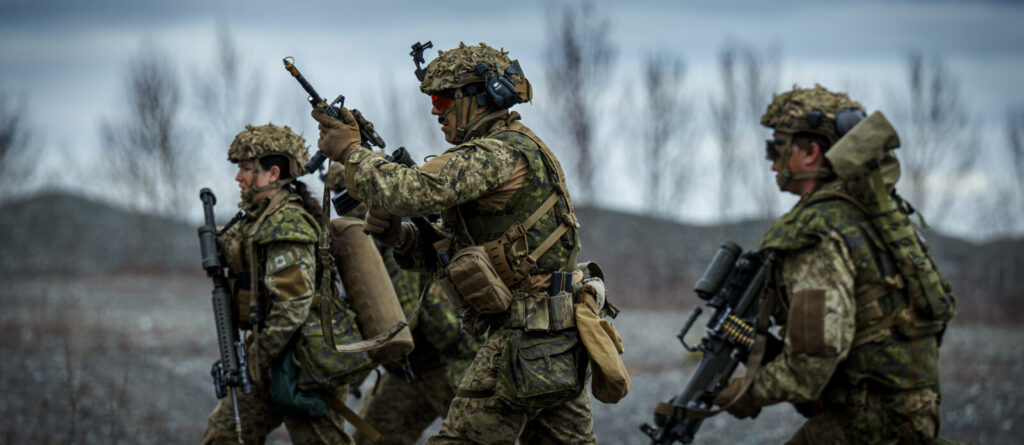
Members of Charlie Company, 1st Battalion, Royal 22nd Regiment, during Ex Maple Resolve at Thetford Mines, April 2026. Photo: Cpl Liam Stagg
Before the Army opts to provide a similar solution to the entire land force, it wanted to ensure the design was a good fit for all combat arms trades. The modular system includes some 65 components, including over 30 pouches, and there were questions about how well it would function beyond the dismounted light infantry.
In November 2025, the Canadian Army Trials and Evaluation Unit (CATEU) in Gagetown, N.B., led an assessment of the body armour and pack system with instructors from the Combat Training Centre’s infantry, armour, and artillery schools.
Around 40 participants drawn from the Royal Canadian Armoured Corps School, the Royal Regiment of Canadian Artillery School, 4th Artillery Regiment (General Support), 4 Engineer Support Regiment, the Infantry School and 2nd Battalion, The Royal Canadian Regiment tested the DICE system against the legacy Clothe-the-Soldier (CTS) and a general-purpose rucksack slightly smaller than the current pack.
“We were not evaluating specifically the DICE equipment, we were evaluating more the concept of DICE,” emphasized Captain Ryan Drake, DLR’s deputy project director for Soldier Systems.
“The main concept of the trial was to take the baseline—the tac vest, frag vest, and rucksack soldiers are using now—and compare it to DICE. You are going from CTS, which is a fixed one-piece system, to DICE, which is completely modular and flexible. We wanted to see [if] this concept of a modular system meets the needs of the other combat arms trades, or does something simpler like the CTS or the general-purpose rucksack meet their requirements?”
The DICE system features a complex mix of a one-piece tactical vest, ballistic plates, training plates, chest rig, battle belt, 30 to 40 pouches, and a modular pack with two bags that can detach to allow a soldier to attach unconventional loads between the pack and the frame, such as heavy equipment, jerry cans, or weapon systems.
The initial tests focused on sizing for each soldier and building familiarity with the many components. All participants then conducted range of motion and mobility tests, including the Combat Force test and a ruck march, swapping in the general-purpose bag for part of the evaluation. That was followed by weapons handling and firing in a Small Arms Training range.
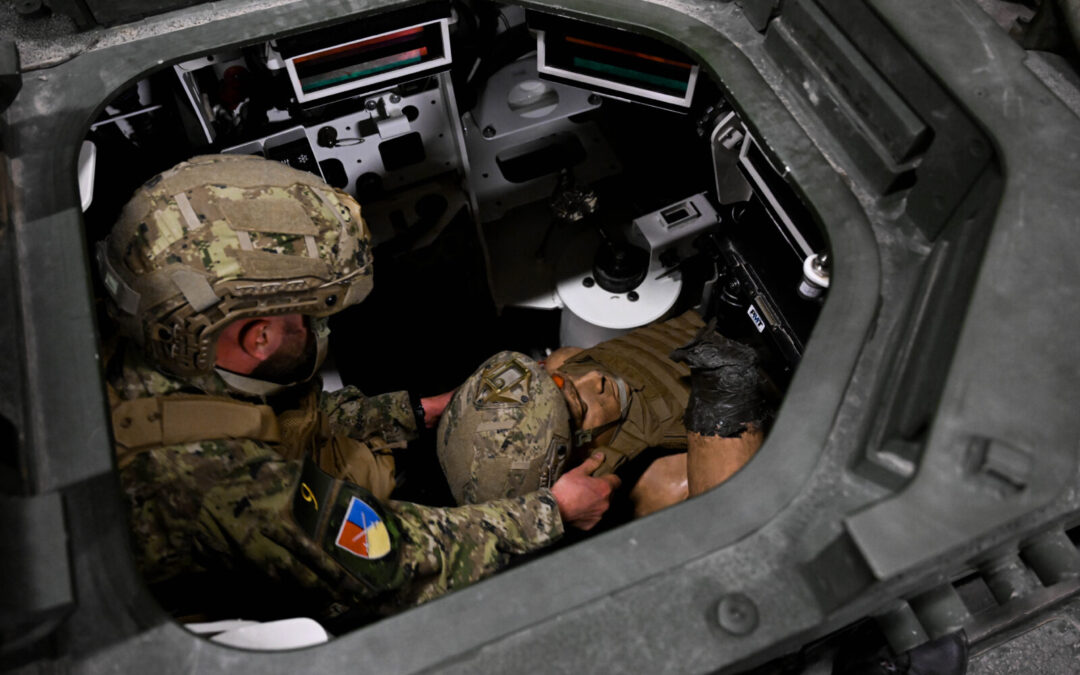
Each trade then conducted specific trials with platforms such as the LAV 6, Armoured Combat Support Vehicle (ACSV), Engineer LAV, and Leopard 2 main battle tank, quickly getting in and out of vehicles, performing various drills in the turrets, and extracting casualties, especially from the hatches of the ACSV. Gunners worked around an LG1 105mm howitzer while combat engineers were asked to attach Bangalores, mines and other equipment to their packs and perform various functions.
While soldiers were appreciative of the modular concept of the body armour and the ability to modify their pack and pouches for specific tasks, there were obvious challenges getting into turrets and through hatches with the pouches as part of a single system.
Drake noted that with the two-piece CTS system, the armoured corps typically wear their frag vest inside the Leopard 2 turret and their pouches are attached to the tac vest, which they leave in the back or up on the turret basket. If they dismount, they’re just throwing on their tac vest. The one-piece DICE body armour and tac vest system was a tighter fit.
“They had difficulty in the turret if there were pouches on the system,” he said. “That was something we noticed. The armour corps clearly needs to have a battle belt they can leave in the basket; they can’t have any pouches on their body armour. They will need those supplementary accessories to have the real estate to add those pouches.
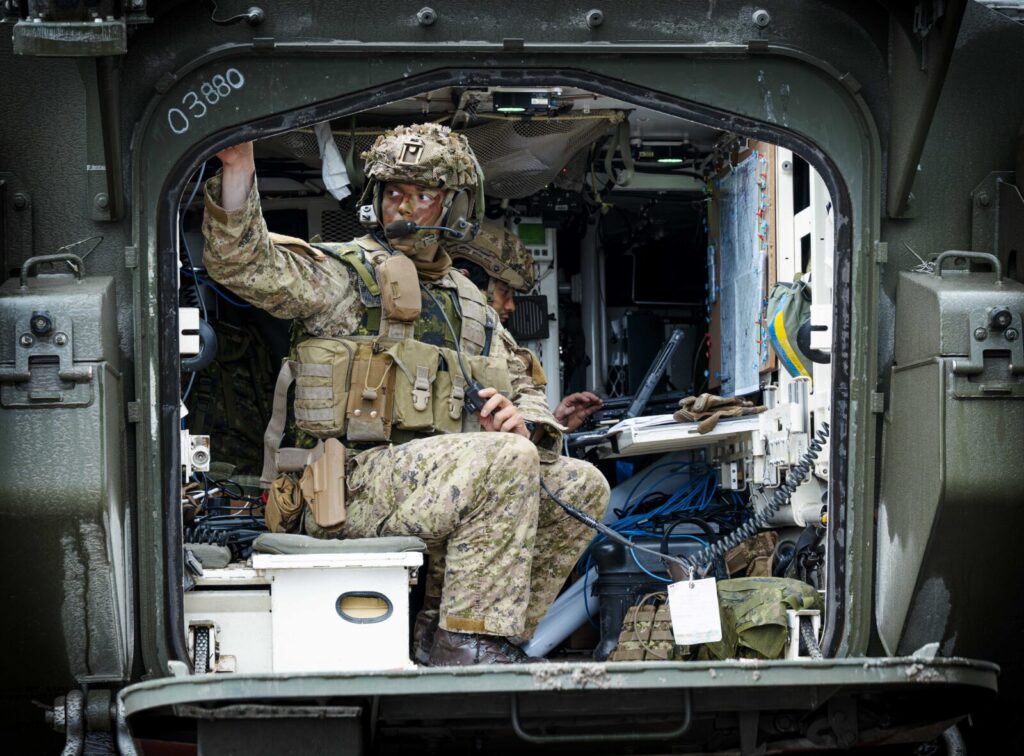
A member of C Company, 1st Battalion, Royal 22nd Regiment, exiting a LAV during Ex Maple Resolve, April 2026. Photo: Cpl Liam Stagg
Throughout the trial, soldiers were reminded, “if you have something that’s not working, or there’s something that would be better, this is the time to tell,” said Drake. “This was the moment to provide feedback. That will allow us to transform it into requirements for the equipment that they’re eventually going to receive.”
Drake said DLR recently received CATEU’s detailed 100-page report capturing the subjective feedback of trial participants, the objective results of each test, and a series of observations and recommendations.
The report will inform not only the acquisition of DICE or a similar system for the combat arms, but also the SOCEM program writ large, which is now working on two projects, contoured body armored carriage system (CBACS) and body armor carriage system (BACS), to procure new systems for the remainder of the Army.
CBACS will target primarily female soldiers while BACS will encompass the rest of the force. Delivery of the CBACS solution is expected in 2028, followed by BACS by around 2030, said Drake. “BACS is a much larger project, so it is going to take a bit more time, but we are trying to find ways to accelerate this project to deliver sooner.”
With some foresight, the project team has been visiting Canadian Armed Forces clothing stores to discuss DICE. While it’s only a system for the light infantry, it could become a logistical challenge if a similar system is adopted by the wider Army.
“DICE is complex to store and definitely a lot more complicated for returns,” said Drake. “If we have a similar system, with four different sizes of vests, with 65 different components that need to be outfitted to 45,000 soldiers—the logistical side is going to be complicated.”