

by Treena Hein
A “sorely-needed, super-positive reinvestment in people” that will lead the Canadian military and its affiliated service members into its best future—that’s how Colonel John Summerfield sees the Canadian Army Mentoring Platform (CAMP).
The voluntary program, which launched in January 2025 after years of development, is anticipated to spread to all Canadian Armed Forces (CAF) branches in the future.
The program is the product of its founder’s early life and career experiences.
“I didn’t have a lot of personal mentoring growing up and that wasn’t a part of the Army culture in my early years,” said Summerfield. “You received some mentoring, but it was always through our chain of command. Going outside of that for guidance or even to talk a situation over was taboo.”
“As I became more and more senior, I started to reflect, and I realized that changing this situation was what I wanted to be the final purpose in my career. I wanted to ensure that others have a better learned experience than I did.”
In his free time, Summerfield started digging into the best way to create an effective mentoring program. He was soon joined by a friend, Colonel Aaron Luhning of the Directorate of Digital and Army Combat Systems Integration.
“It was a large part of our free time for about a year,” Summerfield explained. “Then we started to get more people on board and got all the CAF branches involved. It became an unofficial program under development, and then official. Everyone has been extremely supportive.”
Mentoring is a powerful tool for personal and professional development. It is a partnership between two people (mentor and mentee) who usually work in a similar field or at least have similar challenges. A mentor sharing his or her hard-won wisdom and experience not only benefits individual mentees, but also the entire organization, with better leaders, teams and a more positive culture emerging over time. Lessons learned along the way are passed on rather than lost, and both mentors and mentees tend to see enhanced professional and personal competencies, with better engagement and job satisfaction to boot.
Not all mentor programs are alike. The best ones do as described, but poorly executed ones are worse than useless.
“As we looked into how to build this program, we looked into those used in other militaries and in the business world, and we learned that trust must be the foundation,” Summerfield shared. “If trust is eroded, willingness to participate wanes and it becomes ineffective.”
“This is why we went with a total digital construct. There are no other people involved, in the matching or any other aspect of the program. Just the mentee and mentor. It’s voluntary to apply and it’s up to mentees to reach out. Every step of the process is about empowering mentees. They control how their own self-development unfolds.”
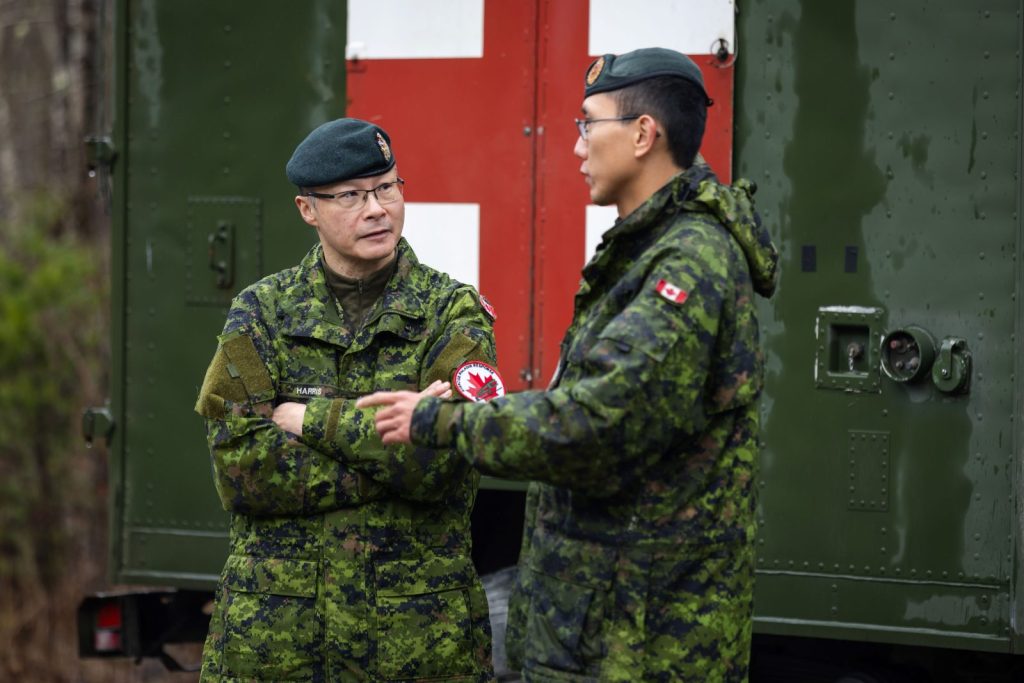
CWO Harris of 39 Canadian Brigade Group listens to a member of 39 Combat Engineer Regiment on Ex Paladin Response in December 2024. Photo: Cpl Brandon Lin
Building better leaders
At its core, Summerfield and his colleagues consider CAMP a decision-making and leadership-building tool. The first step is for interested mentors and mentees to fill out surveys, with mentors describing their experiences and mentees describing what they want to gain. An algorithm produces a list of potential matches, with percentage alignments in various areas.
“Mentees can also read a summary of potential mentors, and then decide to make contact,” he said. “We also have resources available to get them started on the right foot, to have a good foundation, as the experience is likely new to both parties.”
The intent is to empower junior members.
“They have to take initiative, analyze, make a decision,” he said. “Taking responsibility for your own growth, your own actions, the development of your abilities—this is what builds a leader.”
Trust is baked into CAMP because it’s outside the chain of command. Mentees can feel free to ask questions that they wouldn’t want to ask their supervisor.
As Summerfield explained, one’s boss is, of course, responsible for assessing competencies. But there can be a tendency for bosses to mould underlings into what they want them to be (usually similar to the boss), and to promote them or not promote them on that basis. That “mentorship” might not focus on what the mentee needs or wants in the development of their competencies and experience.
CAMP avoids this entirely. By having the program outside the chain of command, it means that no matter where a soldier is posted and who their supervisor is, they can form a long-term partnership with a senior leader who gets to know them and provides a steady presence through the years.
CAMP mentors can take up to three mentees if they wish. Summerfield himself is mentoring two already.
“One is currently in the area, and we are just getting to know each other,” he said. “We’re going to have coffee in person once a month and may have contact in other ways. With the other, this mentee is out West, so we are meeting virtually. This junior member wanted someone who was not in the West, to gain a differing regional perspective, among other things. It’s beneficial for me, too, to gain some geographical perspective.”
Early CAMP interest is stronger than expected, with dozens of mentors signing up. With mentees, uptake has been a bit slower, and that makes sense to Summerfield.
“It’s not easy to trust and make yourself vulnerable to people who are more senior, especially in the military,” he said. “We’re going to focus on showing potential mentees that this program makes it not only possible to [trust], but there are so many benefits to gain from it. We’ll stay flexible and dynamic with how to promote CAMP. We have a chain of command but that’s not necessarily the best way to talk about a program that’s outside the chain of command, so we’ll look at other ways.”
“Most of all, we want junior members to know they are in control of the CAMP process, and that it’s a great way to learn and be more successful. We will let the program grow at its own pace, and we expect that down the road, participants will pass on their positive experiences to others.”
Along with strong enrollment, Summerfield and his team have a goal of expanding CAMP across the CAF and National Defence, to both military and civilians.
“You could be matched with a mentor who is a civilian, and it might be of great benefit to you to have that perspective,” he said. “I have an informal relationship, for example, with a civilian who has human resources insight at a high level. She is a wealth of knowledge, and I often think back to how I could have used all this advice years ago and been better at my job in many ways. I do plan on getting a mentor officially through CAMP when I have some more free time—after this program is really rolling.”
Seeing to fruition
Whenever someone works hard to get a project up and running, there is usually a small sense of disbelief that the dream is now reality. Summerfield is no exception.
“It’s really remarkable to have now launched something that will make such a positive difference to so many, and to be able to participate in it down the line will also be remarkable,” he said. “I’m very happy to be bringing this to fruition and to see the participation already.”
As the world becomes more complex, future leaders will need to keep pace, he noted.
“Our new people need to be better than we are. Those who become colonels will need to be better than I am now. In a basic sense, it’s out of necessity that we have to offer this program. I believe it’s validating and positive on many levels, and very practical. But it also embodies all the ideals and tenets of the military, like service, honour, duty. It brings into reality the idea that it’s not just about what you do during your career and what you achieve, but what you help others achieve. It’s about making a difference in a positive cascade of investment.”