


by Treena Hein
During the early hours of September 18, 2024, a significant attack was carried out employing uncrewed aerial systems (UAS) or drones, further highlighting the need to defend effectively against these types of attacks. Ukrainian drones struck a large Russian depot that housed Iskander and Tochka-U missiles, as well as glide bombs and artillery shells. The “swarm” attack, according to the Associated Press, caused “burning across an area six kilometers wide.”
The headline-grabbing event was just one of numerous drone strikes in the recent past, from Kyiv to Tel Aviv.
This summer, Canada became the fifth NATO country to test above-the-horizon lasers to defeat drone threats (scenarios with no mountain or other geographic backdrop to stop the laser).
The tests were conducted during the third Innovation for Defence Excellence and Security (IDEaS) Counter Uncrewed Aerial Systems sandbox in June at the Defence Research and Development Canada (DRDC) Suffield Research Centre in Alberta. The IDEAaS program previously hosted sandboxes in 2019 and 2022 to evaluate detect-and-defeat technologies and then to assess how well those could be integrated into Canadian Armed Forces (CAF) command-and-control systems.
At over 500 square kilometres, the experimental proving ground is one of the world’s largest instrumented outdoor laboratories and an ideal place to safely conduct iterative testing of counter-drone technologies.
For the third iteration of the sandbox, a variety of “hostile” drones were used as targets to imitate real-world threats. To safely conduct the tests, DRDC coordinated with air traffic control, space operations, and the International Space Station. Feedback was provided by the CAF, the U.S. Department of Defense Irregular Warfare Technical Support Directorate, Royal Canadian Mounted Police, and various scientific experts.
Drones are becoming faster, smaller, less detectable — and as recently shown in Russia, being used in innovative ways.
“We’re seeing UAS proliferate in number and capability at an exponential rate,” explained Ron Dauk, program manager of Boeing’s Laser & Electro-Optical Systems. “Examples include swarms and high-performance first-person-view drones.”

AIM Defence representatives demonstrate their tactical CUAS concept. Photo: Steve Berry
Acoustic counter-drone technology
The IDEaS program awarded three “diamond in the rough” prizes. AIM Defence of Vancouver, B.C., received $1 million for its tactical C-UAS solution using artificial intelligence (AI) tracking and ultra-compact laser technology.
Second place honours, worth $375,000, were awarded to DARIT Technologies of Sherbrooke, Que., and Prandtl Dynamics of Toronto, Ont.
Prandtl Dynamics, a startup formed in September 2023 by University of Toronto undergrads, demonstrated directed acoustic technology. When directed at drones at specific amplitudes and frequencies, Prandtl’s ultrasonic beams disrupt onboard electronics to cause flight disruption issues.
“It was a fantastic opportunity to test on a relatively large number of drones of different types, which is difficult for a startup like us to do on our own,” said CEO Parth Mahendru. “We were able to demonstrate our abilities to solve problems on the spot. Our power outputs were low at first due to extreme wind conditions, for example, and within 12 hours we had shielding in place and had boosted our power level substantially. That was appreciated.”
The company got insights into what’s most important to stakeholders, such as inexpensive solutions that can take down cheap, smaller drones.
“We were also able to speak with unbiased observers, a lot of experts in different fields, about other topics,” said Mahendru. “In the future, we want to explore how our safe, non-kinetic drone neutralization technology can be used to make concerts, airports and other public spaces safe from random drone attacks.”
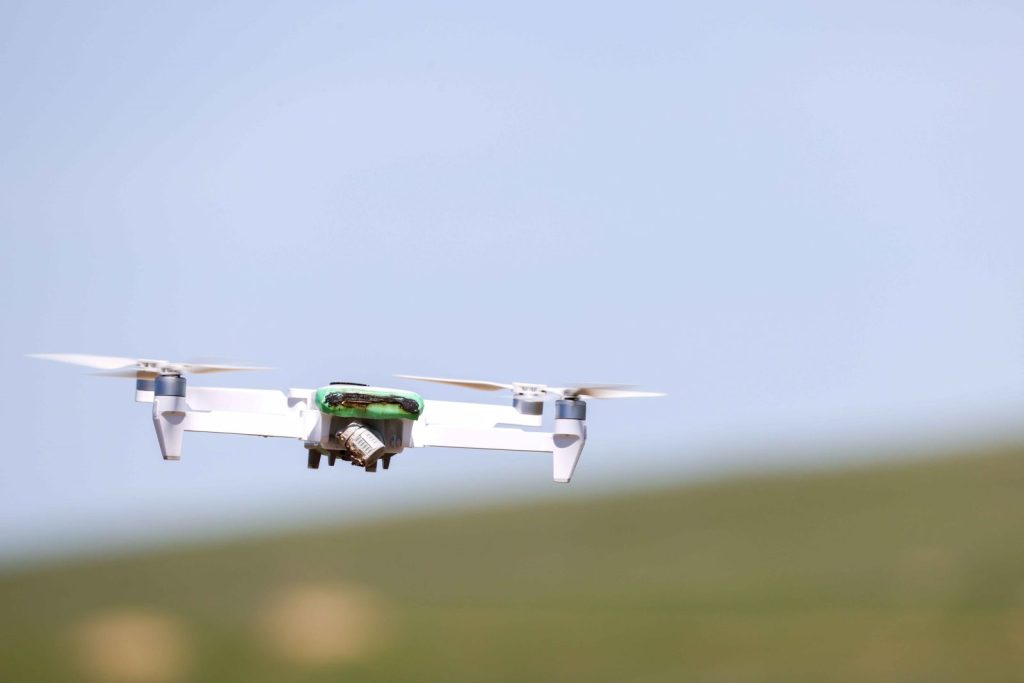
Photo: Steve Berry
Laser defence
Lasers (directed energy systems) are also a potentially cost-effective and expedient way of defeating drones, with the ability to minimize collateral damage.
Indeed, Dauk explains that cost savings are a major driver for development of lasers. “Once systems are operational, the cost per shot is roughly equivalent to a cup of diesel fuel,” he noted. “In a nutshell, using high-energy lasers offers a solution for pennies on the dollar compared to expensive kinetic interceptors.”
While cost, minimizing collateral damage, and other benefits were a focus of the sandbox tests, potential detractions of laser-based counter-drone technology were also investigated, such as the potential risk of reflections off a target.
Boeing’s Compact Laser Weapon System (CLWS) supported a range of counter-UAS tests during the evaluations. Boeing successfully operated two CLWS units — one in a fixed containerized configuration and one integrated with a military-grade Polaris RZR — side by side to cooperatively detect and defeat both single targets and multiple targets simultaneously. These included high-performance, first-person view drones, stationary mortars, and a swarm of five UAS.
Boeing configured the units with a radar system to detect targets before automatically “handing over” control to the compact lasers to identify, track, engage and defeat them. This demonstrated the full counter-UAS kill chain at distances ranging from 200 metres to 2.5 kilometres.
Some of the operational scenarios simulated at the event included forward operating base defence, mobile force, and dismounted personnel protection, as well as urban and naval operation scenarios.
The CLWS performed as expected in eliminating the threats in each scenario, Dauk explained. “We see the benefits of CLWS and high-energy laser defence as overwhelmingly positive in countering the growing UAS threat. This has also been proven by CLWS during a recent multi-year overseas deployment with the U.S. Marine Corps and in defeating more than 400 drones in dozens of demonstrations, scenarios and environments in the hands of military operators with as little as one hour of training.”
Looking at the top lessons learned from these tests, Dauk said that overall, it was a great opportunity for everyone at the event to learn what CLWS could do reliably, as well as the benefit of multiple lower-power, lower-cost systems engaging the same target at the same time.
“It also confirmed that CLWS is capable of meeting Canada’s integrated command-and-control (C2) requirements,” he added.
Looking ahead at how the test results will impact further laser-based counter-drone tech development, Dauk said the CLWS testing this summer demonstrated the benefits of having multiple, low-cost systems as part of a layered defence capability.
“Our future development will focus on continuing to improve in areas such as automation and autonomy,” he noted, “allowing a single operator from the C2 system to task multiple CLWS units to address the expanding threat, especially with swarm engagements.”
Boeing recently collaborated with the U.S. Army in a hard kill demonstration at Fort Drum, NY, he said, and future trials will continue to demonstrate system maturity and effectiveness in a range of counter-UAS scenarios.
Lasers and microwaves
According to Scientific American, since 1960 the U.S. government has spent $6 billion USD to develop “directed energy technologies” like lasers and high-power microwaves (a form of electromagnetic radiation with wavelengths that range from about 30 centimetres to a single millimetre). Aside from microwave ovens, microwaves are used in communications, medicine, industrial settings and now, in drone defence.
Indeed, Major-General Sean Gainey, head of the U.S. Army’s Joint Counter-Small Unmanned Aircraft Systems Office (JCO), has said, “we believe that high-power microwave technology is critical to help us mitigate the threat of swarming small drones.”
In July, the Pentagon’s drone defence program tested lasers and microwave tech in its largest field demonstration yet, with up to 50 UAS of different types swarming a single target. Colonel Michael Parent of JCO noted at the time that the vendors’ prototype systems all showed a “greater level of maturity” and offered “much better solutions” to the threat than those at previous demos.
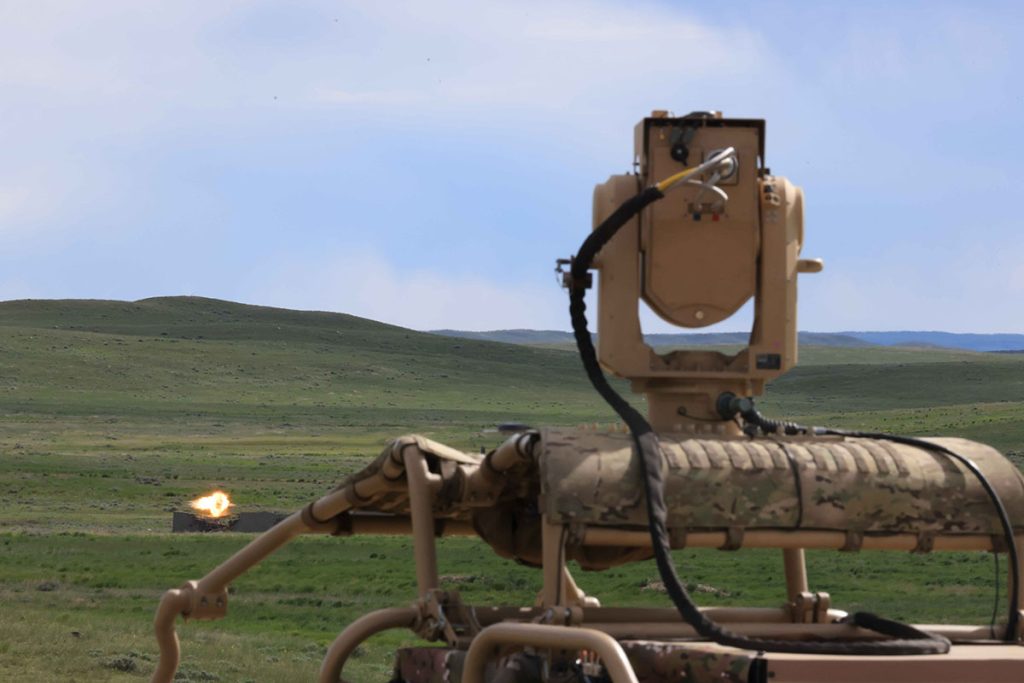
Photo: Steve Berry
Transfer to the Army
Andrée-Anne Poulin, media relations officer at National Defence (DND), explained that for the Canadian Army, innovation at the IDEaS sandbox serves as a demonstration of what is in the realm of the possible in terms of showcased technology, readiness levels, and to further understanding of the industry. The sandbox plays a strategic role in nurturing emerging technologies, ensuring they are well-aligned with defence and security requirements before they reach the procurement stage.
Because a number of technologies were demonstrated, not specific vendor equipment, at different readiness levels, Army staff now have an appreciation for how those technologies could be incorporated into future planning for counter-drone systems, said Poulin, who also noted that not all tech may culminate in a purchase by DND/CAF.
“The information learned can serve as a foundation for our understanding how technology or equipment can enable capabilities,” she explained. “From there, our staff incorporate the learned information as concepts or requirements into our statements of operational requirements, which form the requirements elaborated in a request for proposals.”
Looking forward, she noted that, given that the IDEaS program is still maturing, and many solutions are nearing a readiness-level that can transition into capabilities, DND/CAF will continue to explore options for the direct acquisition of fleet-size solutions from Canadian innovators.
In addition, the sandbox program has lined up off-ramping opportunities that can suit the needs of late-stage solutions that are not selected for continued support by IDEaS, she noted. “For instance, since 2022, the program has hosted an annual IDEaS Marketplace event, creating new opportunities for innovators funded through the IDEaS program by showcasing their advanced technologies to other potential users in the federal government and the defence industry.”

The CA is in the midst of procuring a ground-based air defence system whose target set includes Class 1 and 2 UAVs. I hope the project staff take note of the developments in this article. The last thing we need is a GBAD system based, exclusively, on very expensive guided missiles when a large portion of the engagements will likely involve comparatively inexpensive weaponized drones. If it is, the loss-exchange ratio will not be in our favour. It’s a matter of simple arithmetic.
If a portion of the GBAD program involves leading-edge tech like this, and if the technology readiness level is approaching 7 or 8, we should definitely examine the feasibility of making mobile and static CLWS part of the acquisition – at least for short-range engagements. The hardware may be pricey but the price per shot seems attractive.
DND/CAF must work harder and quicker on these projects. There is simply not enough time to dither. Purchase the kit now! War is approaching and 2,3,5 and 10 year timelines simply do not work! Fix procurement now! Hire more people now! Purchase modern equipment now!