

by Allan Joyner
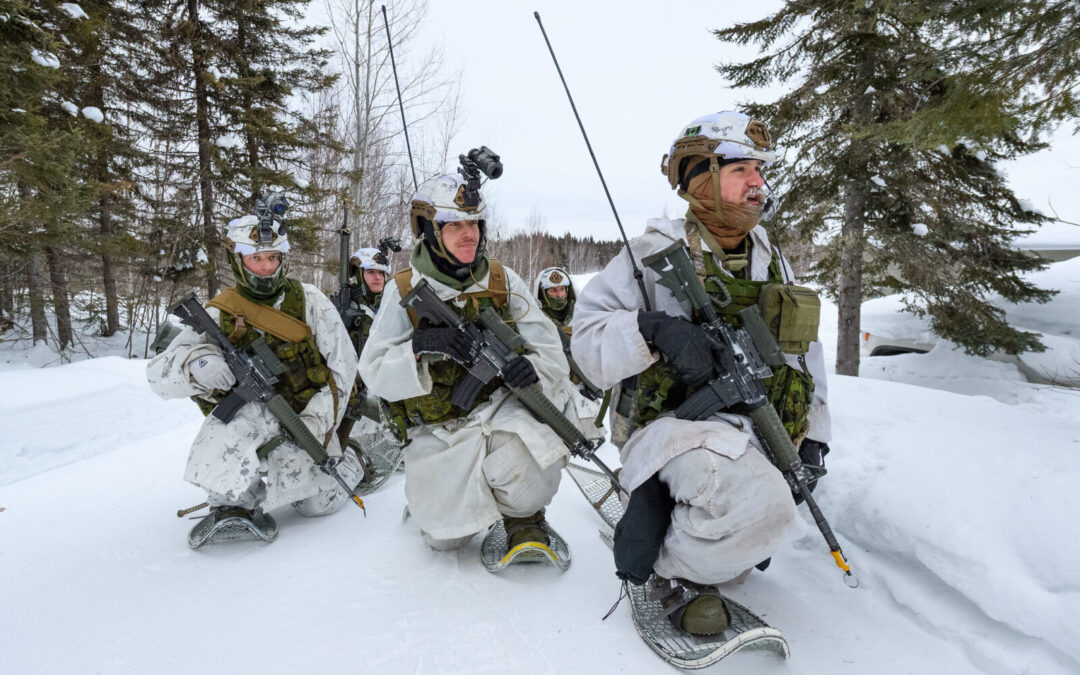
Warrant Officer Thomas Hughes has the Arctic operations advisor patch on his sleeve, which in the world of the Canadian Army’s Arctic Response Company Group (ARGC) means something. The Royal Winnipeg Rifles non-commissioned officer (NCO) has been with the ARCG since 2012, operated from Tuktoyaktuk to Cambridge Bay to Resolute, and approaches every exercise the same way.
He keeps running notes as he goes, building an after-action list of what worked, what failed, and what incremental improvements he can drive before the next rotation. In the unusually extreme cold of Operation Nanook-Nunalivut 2026, in wind chills approaching minus 60 Celsius outside Cambridge Bay, that list got longer.
The snowmobiles needed lighter-grade extreme-cold oil. The radios needed to stay closer to the body. And the new merino wool base layers the troops were wearing needed to hold up better to field conditions, because the concept was right, but the fabric was too delicate.
That last piece of feedback found its way to Major Chris Blencowe almost immediately. It usually does. Blencowe is the Army clothing requirements officer at the Directorate of Land Requirements, and Hughes is one of his former students from the Arctic Operations Advisor course, when Blencowe was the course director. Hughes is now a long-term collaborator and technical advisor on items of clothing and equipment. Two or three times a year, they talk directly about equipment, field conditions, what the ARCG actually needs versus what it currently has. It is exactly the kind of feedback loop that, for most of the past two decades, simply did not exist.
That it exists now is the story of how the cold-weather clothing system is changing, who drove that change, and what soldiers going north can expect in the years ahead.
A SYSTEM WITH ROOTS IN THE WINTER WAR
The current extreme cold system, the familiar parka and bib pants that have kept soldiers alive from Yellowknife to Resolute for a generation, is roughly 30 years old. The design underneath it is older still, rooted in a lineage most soldiers carrying it never knew about.
In 1945 and 1946, 12 Finnish Army officers were recruited by the Americans and tasked with writing a joint Canadian-American winter training manual. These were men who had just fought the Soviet Union through four years of Winter War, who understood cold-weather warfare at a level no army in North America had ever encountered. The manual they produced became the doctrinal foundation for virtually everything both nations have since done in cold-weather warfare: the 10-person Arctic tent; the heated shelter rotation cycle; the layering philosophy; the drill of getting soldiers in, getting them fed, getting them warm, then putting them back out. All of it traces to those 12 officers and what they wrote in the late 1940s.
Blencowe knows this history intimately, because he studied it. He spent four years in Trenton as the course director who finalized the Arctic Operations Advisor course, evolving the program into a broad experience-based course, to train students in the diverse conditions found across the Arctic Region.
This began by working with JTFN in Yellowknife as the force employer, where they experienced below-the-treeline (Sub-Arctic) conditions with First Nations. They later moved to the Canadian Armed Forces (CAF) Arctic Training Centre in Resolute, exposed to above-the-treeline (High Arctic) and Inuit cultural distinctions, all while working to overcome the tyranny of isolation in a domestic operations environment.
In addition, integrating Ranger NCOs into the course staff and regularly including guest instructors from Norway and Denmark, while sending instructors overseas in exchange, ensured all staff were subject matter experts. That exposure to how Nordic armies approach cold-weather operations gave him a useful and sometimes uncomfortable point of comparison.
“The Canadian Army expects our young southern-based soldiers to do things that in a European army take special forces,” he said. Denmark’s Sirius Dog Patrol in Greenland deploys six men at a time for two years, soldiers Blencowe describes with admiration as “special forces park rangers,” trained to a level of Arctic proficiency that takes years to develop.
The Army, by contrast, routinely sends 20-something reservists from Winnipeg or Barrie into the Canadian High Arctic, one of the most demanding environments on earth, and expects them to function effectively. The Nordic countries have a name for the adversary those soldiers face: General January.
That is not a criticism of Canadian soldiers. Hughes makes the point from a different angle when he describes the ARCG’s mentality: “You join this organization to solve problems, to overcome challenges, and the Arctic is the hardest version of that.”
His ARCG soldiers are volunteers, attracted precisely because the work is difficult and the stakes are real. But Blencowe’s observation frames the requirement clearly: If we are asking soldiers to operate at that level, the clothing system underneath them has to be the very best it can be.
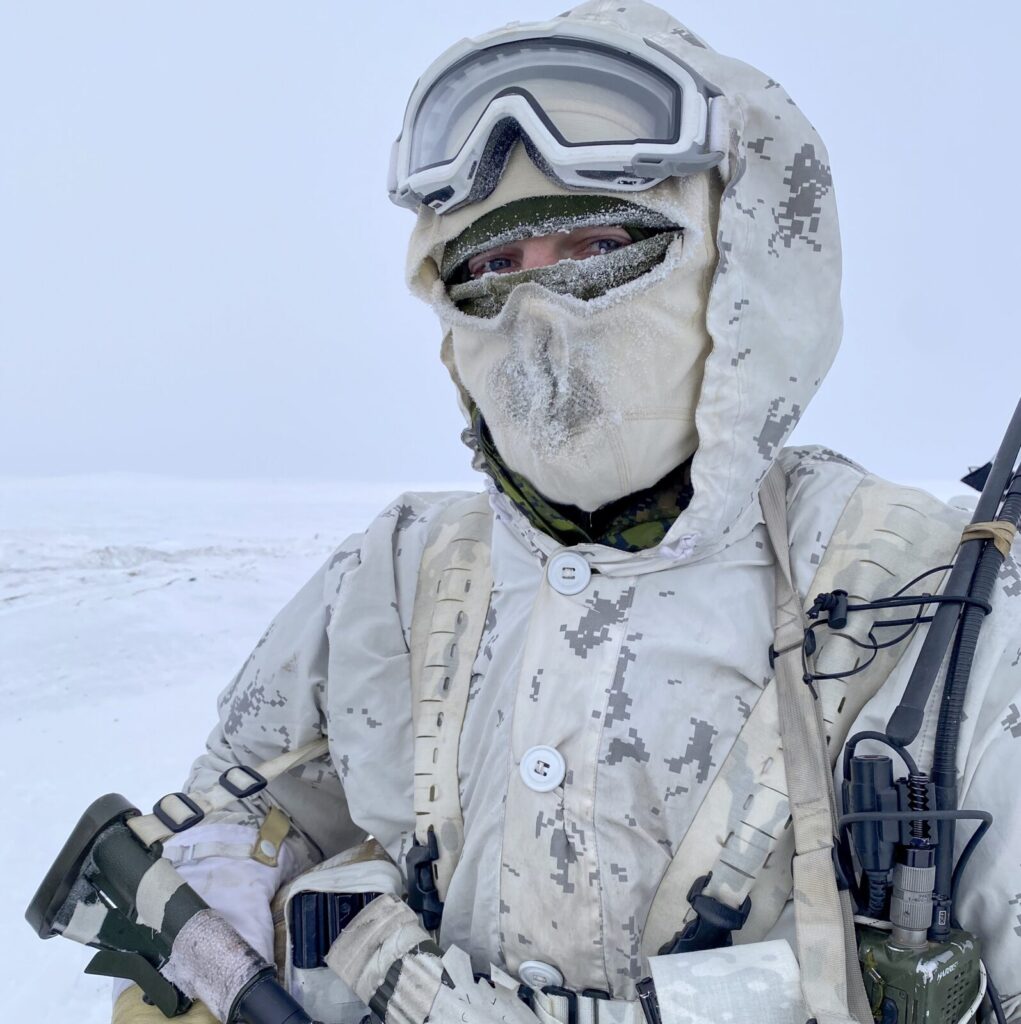
A member of the Arctic Response Company Group during Op Nanook. Photo: Allan Joyner
WHY NOTHING CHANGED FOR 20 YEARS
For most of Blencowe’s career, the challenge of improving that clothing system felt insurmountable. The impediment was not indifference. It was procurement architecture.
Under the old policy, clothing was treated as a capital asset, the same category as vehicles and weapons systems. Any significant change to the parka or combat uniform required running a major project: formal requirements definition, multiple governance gateways, staffing up a project team, and timelines measured in years or decades. The program that had last reclothed the Army from the ground up, Clothe-the-Soldier, had a large staff and dedicated funding. Once the project was complete, this staff dwindled to one, with no capacity for any real improvement or means to address key deficiencies identified in user feedback and Gender-Based Analysis Plus (GBA+) of the current clothing. It took significant intervention from senior leadership to confirm this was unacceptable, and ensure change was to be implemented.
“My first five years here, there was no discussion of change,” said Blencowe. “The idea of changing just didn’t exist.”
The most significant improvement he managed in that period was adding a pocket and some fleece lining to a piece of kit. On a handshake, not even a formal product improvement.
The shift came when Treasury Board reclassified clothing as a non-capital item. Clothing, by this reasoning, instead of running a whole new project when it wears out, could be replaced directly. The colour of money changed, meaning the Army could use Vote 1 funding rather than capital expenditure to procure and improve clothing.
That change, combined with a new long-term supply contract under the Operational Clothing and Footwear Consolidated Contract, (OCFC2), effectively rewired the entire system. Where Blencowe once needed to stand up a major project to change pocket designs, National Defence can now task the contractor directly. There is no new contracting process. The work can begin almost immediately.
WHAT’S BEING BUILT: THE CCUE
The Canadian Combat Uniform Ensemble (CCUE) is not a product improvement on the existing clothing system. It is a new system built to fill the gap that has historically caused the most casualties: the cold-wet environment.
Blencowe’s historical study of cold-weather warfare identified the danger zone precisely. It is not the minus-45 conditions Hughes was managing in Cambridge Bay, where the risks are immediate and the extreme cold system—parka and bib pants—performs the job it was designed for. The more dangerous zone is the middle ground, the plus-two and raining day that drops to minus 10 after dark, the freezing rain and wet snow of Northern Europe or a Canadian exercise in the shoulder seasons, where a soldier soaked in sweat from exertion can be in serious trouble before anyone recognizes what is happening.
The CCUE is designed to address that gap directly, while enhancing the severe and extreme cold weather layers currently in use.
The system is merino wool at its foundation, base layers in three weights: mesh, lightweight, and medium, all interchangeable. On top of that, two puffy jacket options, a lightweight version and a medium-weight designed specifically to fill the layering gap that has long existed between the fleece mid-layer and the parka. Soldiers have been solving that problem informally for years, wearing civilian puffy jackets under their issued kit. The CCUE formalizes the solution. Windproof layers, waterproof shells, and a dedicated combat uniform designed for dismounted close-combat operations under body armour in temperate cold conditions round out the ensemble.
The CCUE does not replace the parka and bib pants. Those outer garments remain in service as they are still good clothing. They are, as Blencowe says, “perfectly functional,” and the concept behind the heated shelter rotation cycle that Finnish doctrine gave the Army still works, with the extreme cold outer shell it was designed around still performing its role.
The parka will eventually be updated, likely within a few years of CCUE completing its rollout, but that work is deliberately sequenced. The Army could not do everything at once with the resources available, and the CCUE addresses the more immediately pressing gap. When funding and bandwidth allow, the outer system will get its own examination and improvement.
Late 2027 is the current target for CCUE delivery, with development and initial issue valued over $500 million under the Operational Clothing contract. The CADPAT camouflage pattern alone takes roughly a year to apply to a new fabric for the first time, a complicated formula that Canadian industry is working through now.
Photo: Allam Joyner
THE MERINO BASE LAYER: ALREADY IMPROVING
The first piece of the CCUE has already begun reaching soldiers. The merino wool base layers were in the field at Op Nanook, worn by many in the ARCG on the ice outside Cambridge Bay. The feedback on it was direct and consistent, that the concept was right, with improved warmth, but the fabric was delicate for field conditions.
The concern was specific. The merino garments required careful handling in conditions where clothing gets ground into snowmobile engines, pressed against stove grates, and worn continuously for days. The ARCG found the base layer excellent for thermal performance and for the natural antimicrobial properties of wool, which matter when you cannot wash in the field for extended periods. But durability was an issue.
Blencowe and especially the Assistant Deputy Minister (Materiel) team are actioning feedback on this initial rollout, even before it has been distributed across the Army. The product improvement is already underway. The next iteration of the base layer will use a blended fibre, merino mixed with nylon, to maintain the warmth and wicking properties of wool while adding the durability and washability that field use demands. The design refinement began before the after-action reports from Op Nanook were even finalized.
“We had few improvements for nearly 20 years,” Blencowe said. “Now we’re going to have the ability to make small changes regularly, and every couple of years, a more significant change based on soldier feedback.”
The generation cycle for combat clothing is moving from 30 years to roughly three. Whether it holds is another question. The merino base layer revision is the first real indication of whether that’s true.
THE FEEDBACK LOOP
That revision exists because Blencowe heard about the durability concern from people like Hughes, from the ARCG and other officers who filled out feedback surveys, and from a network of field contacts he has maintained since his years in Trenton. Major Christian Doucet, his counterpart at DLR, who manages the broader soldier system, from helmet to knee, runs a parallel feedback architecture at exercises, with QR codes linked to equipment surveys and DLR personnel embedded in major exercises to capture what soldiers experience in the moment, including the kind of detail that rarely makes it into formal after-action reports.
A down-booty incident from Op Nanook captures why that granular feedback matters. A soldier went briefly outside her tent in the middle of the night, in socking feet, because putting on mukluks in a crowded tent in extreme cold in the dark is genuinely difficult. Had she been able to use the small, insulated camp booties that many Arctic operators carry, it would have been safer. That information reaches the people who can write it into a requirement, but only if the feedback loop is working.
Unit regimental sergeant majors and commanding officers have a role in that loop. Blencowe’s approach, when he reaches out to field units, is to ask them to collect feedback collectively from their members and send it back, so that any given deficiency can be validated across multiple organizations before becoming a procurement signal. The system works better when leadership understands what it is for and enables it.
The merino base layers Hughes and his soldiers wore on the ice this year will be better because they wore them and reported on them. For most of the past two decades, that sentence would not have been true.
Hughes, characteristically, put it in terms any Arctic operator would recognize. He keeps a running tally every time he goes north, what worked, what failed, what he would change. “I really believe in incremental improvements every single year,” he said. He has been doing it for years. The Army is catching up.