

by Treena Hein
Overnight March 22-23, Ukrainian drones struck the port of Primorsk in Russia, the largest crude oil loading port in the Baltic Sea. Some of the 249 drones were intercepted, but many got through. The damage to the port suspended the daily shipment of around 1.5 million barrels of crude—adding another major pressure point to the impending global energy crisis emanating at the time from the Strait of Hormuz off the coast of Iran.
This attack underscored the importance of counter-uncrewed aircraft system (CUAS) technology in global conflict, and the parallel importance of the Department of National Defence’s (DND) ‘sandbox’ trials.
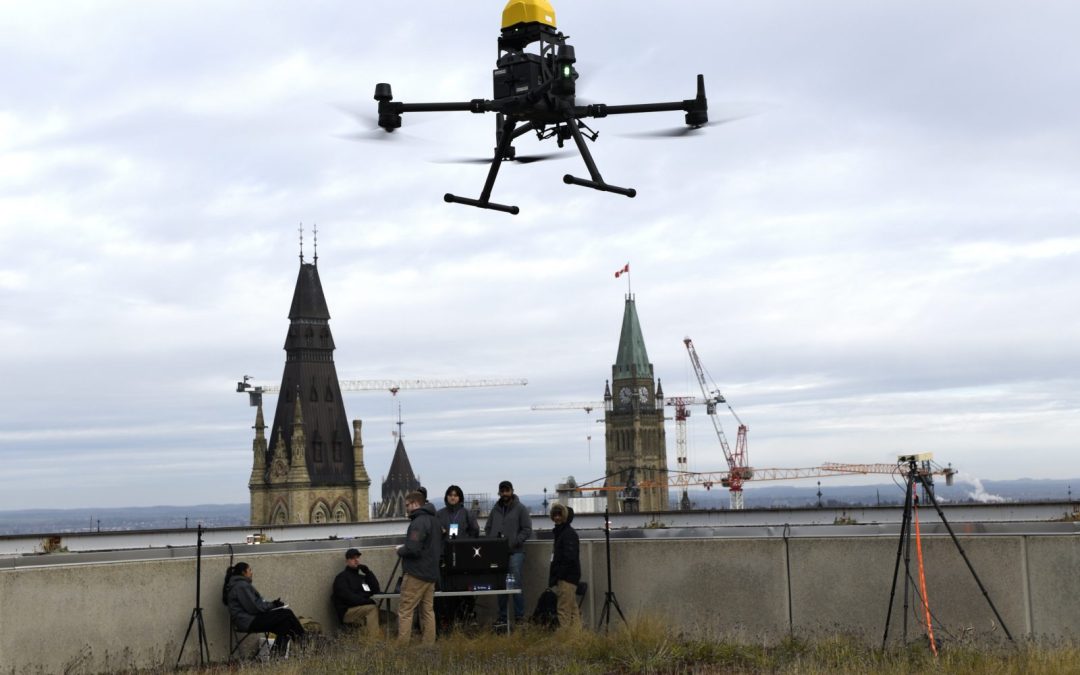
In late November 2025, the Innovation for Defence Excellence and Security (IDEaS) program hosted 19 innovators from Canada and three other countries for a drone detection trial over downtown Ottawa.
The four-day sandbox was a battled for ‘Diamond in the Rough’ prizes totalling $1.75 million, but it was also an opportunity for hands‑on support from members of the Canadian Armed Forces, the Royal Canadian Mounted Police (RCMP), and other personnel as the 19 companies demonstrated their technologies in a realistic scenario and setting.
Previous IDEaS CUAS sandboxes in 2019, 2022 and 2024 were conducted over several weeks in the wide-open space of Defence Research and Development Canada’s (DRDC) Suffield Research Centre in Alberta.
To fully address the potential of drone threats, Canada must understand how countermeasures perform across the full spectrum of conditions and environments, explained Andrée-Anne Poulin of DND’s media relations. Ergo, the shift “from [the] usual remote setting in Suffield to a complex urban location to test technologies in a realistic urban environment.”
Operating in an urban environment has always been part of the broader CUAS challenge, she added.
“Urban settings present unique obstacles. Buildings and electromagnetic noise found in an urban environment present a very different operating environment from the open military test range in previous sandboxes. Drone testing for this event took place at ground level, on mid-level and high-level balconies of high-rise buildings, and on rooftops. This demonstration hoped to identify technology that can be used safely around people, including in public gatherings, without putting bystanders or crowds at risk.”
To minimize risk and avoid interference with public activity, including traffic, pedestrians or access to services, the event was organized with the support of the RCMP, Transport Canada, Parliamentary Protective Services, the City of Ottawa, and the Ottawa Police Service.
And unlike CUAS sandboxes in Suffield, all of which included drone destruction, the event was limited to demonstrations of drone detection.
Over 240 observers from eight countries as well as the Canadian Armed Forces (CAF), DRDC, RCMP, and the U.S. Capability Development and Innovation group took in the trials.
Feedback from end users and defence scientists indicated no single solution currently provides a complete, standalone CUAS capability suitable for all operational contexts, said Poulin.
“Instead, the sandbox reinforced the necessity of layered, integration-centric architectures, combining multiple sensing modalities and robust command and control (C2) systems.”
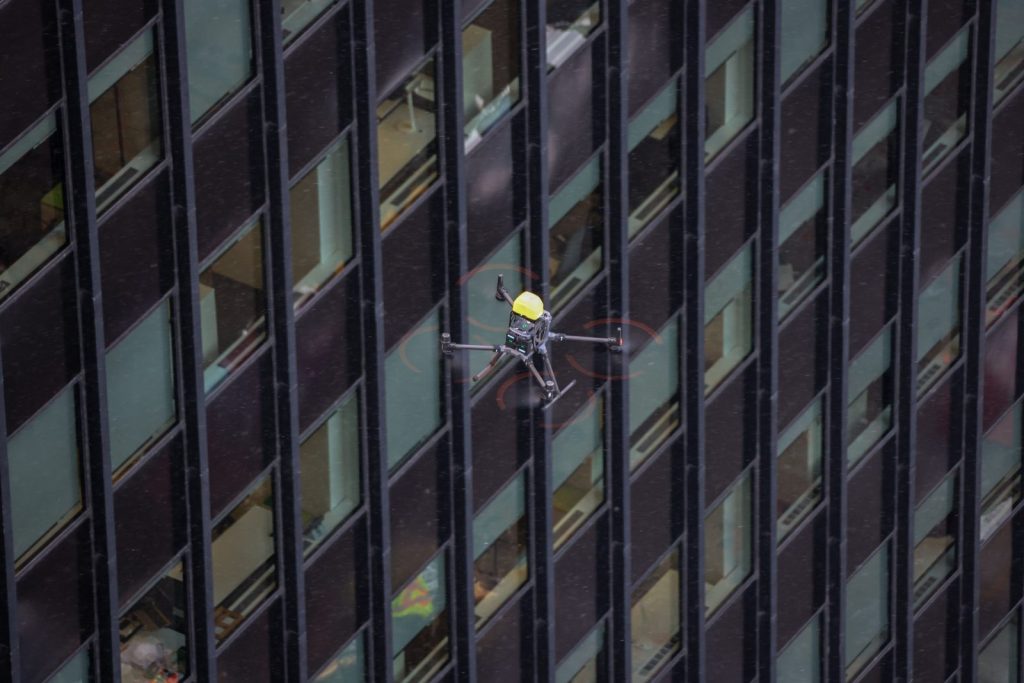
Photo: DND
Sandbox success
OBJEXIS of Oakville, Ont. and Prandtl Dynamics of Toronto tied for second place and each received $375,000. OBJEXIS AI offers FIXAIT, an AI-powered visual detection and classification engine that transforms any video stream into a real-time CUAS detection platform. Prandtl Dynamics has developed Oscura, which combines advanced acoustic sensing with interrogation methodologies to detect, confirm, and locate drones in urban environments.
The top solution and recipient of $1 million came from DARIT Technologies of Sherbrooke, Que. REMPART is an autonomous intrusion detection system designed for both CUAS and ground‑perimeter protection. REMPART employs DARIT’s proprietary FusionCore software suite and distributed sensor technologies (vision, acoustic, radar, LiDAR) to monitor air and ground activities within a C2 system.
For the 2025 sandbox, REMPART was integrated with the systems of several DARIT sensor technology partners. One was Echodyne’s EchoShield, a next-generation, software-defined, medium-range, pulse-Doppler, cognitive 4D radar. The others were the IRIS Radar from Robin Radar Systems, the Vision Flex EO/IR camera from OpenWorks Engineering, and the ARC Camera from Infiniti Electro Optics.
Among REMPART’s benefits are the ability of its AI to track multiple targets simultaneously and conduct ‘intelligent tracking’ of various types of intrusions such as drones, humans, vehicles, robots and animals. Target paths are tracked in real time and recorded in a database for analysis. Data processing is performed locally for maximum confidentiality and cybersecurity—no cloud use. The system is fully autonomous and minimizes false alarms. It’s also lightweight, portable, and weather resistant.
“Our product provides a unified architecture that generates a rich and shared operational picture, enabling organizations to detect, track, analyze and neutralize threats more rapidly and easily in complex environments,” explained Jonathan Vincent, DARIT’s chief executive officer. “REMPART is sensor and effector agnostic, meaning it can interface with any type of device.”
The ability to integrate into existing CUAS architectures and to leverage existing hardware makes it highly attractive as a platform, he noted.
Through its mesh network architecture, DARIT deploys a network of autonomous ground stations equipped with diverse sensors, all connected to a central server, which allows it to integrate data from the distributed sensors.
“These stations can operate independently or collaboratively, while a unified control interface ensures seamless system integration,” he said. “The result is a distributed, resilient, and scalable environment that delivers wide area coverage, operational continuity and critical redundancy, even under the most demanding conditions.”
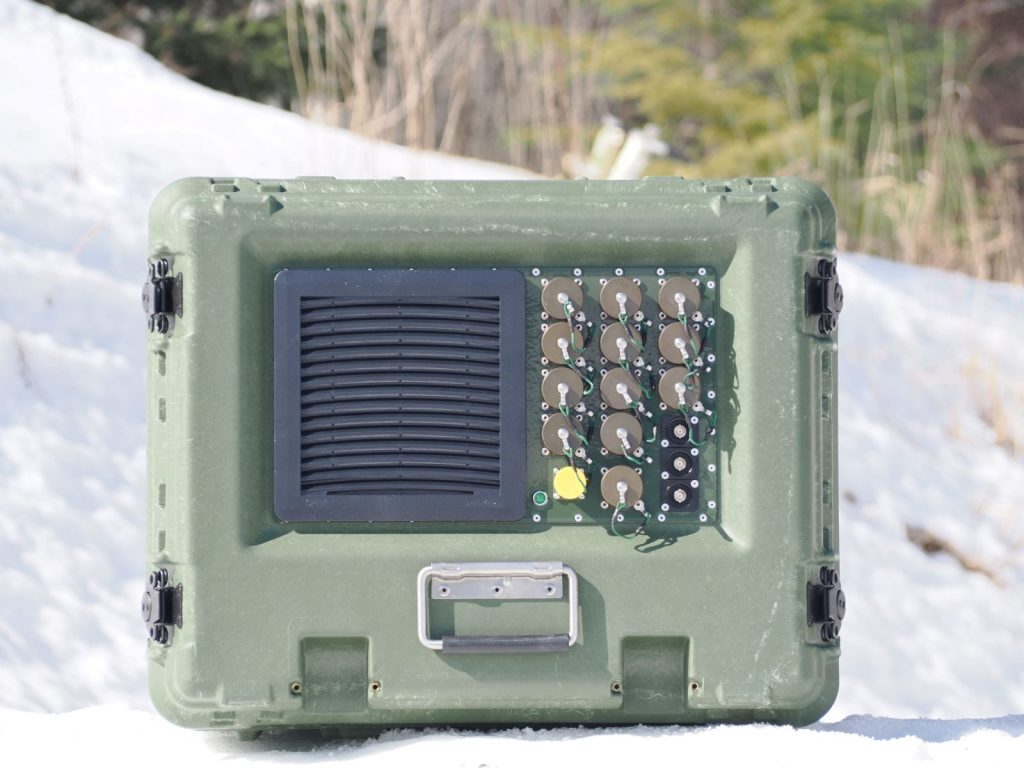
DARIT Technologies’ REMPART autonomous intrusion detection system.
Further testing
The solutions showcased at each sandbox are aimed to help the CAF keep pace with rapidly evolving technologies and emerging operational threats, Poulin explained, so the focus is on both current developments in drone technology and the future trajectory of UAS and CUAS capabilities.
“The IDEaS program supports the development of innovative technologies through progressive stages of research, testing, and evaluation, ultimately bringing many solutions close to commercial readiness,” she said. Indeed, at this stage, “several IDEaS‑funded technologies are now approaching the maturity level required for real‑world assessment by the CAF.”
Some may be procured in limited quantities for operational trials, but Poulin said any broader acquisition would follow established government procurement processes and subject to separate budgetary authorities and approvals. However, the program is collaborating with procurement officials within DND and Public Services and Procurement Canada to streamline the process of acquiring and integrating these innovative solutions.
The next CUAS sandbox returns to its roots in Suffield over a more traditional month-long period, September 14 to October 9. As was the case with past events, both drone detection and defeat solutions will again be evaluated. However, Poulin noted IDEaS plans to build on the success of the urban trials in Ottawa by hosting a second event focused on detection‑only solutions in an urban environment, as early as next year.