

by Ken Pole
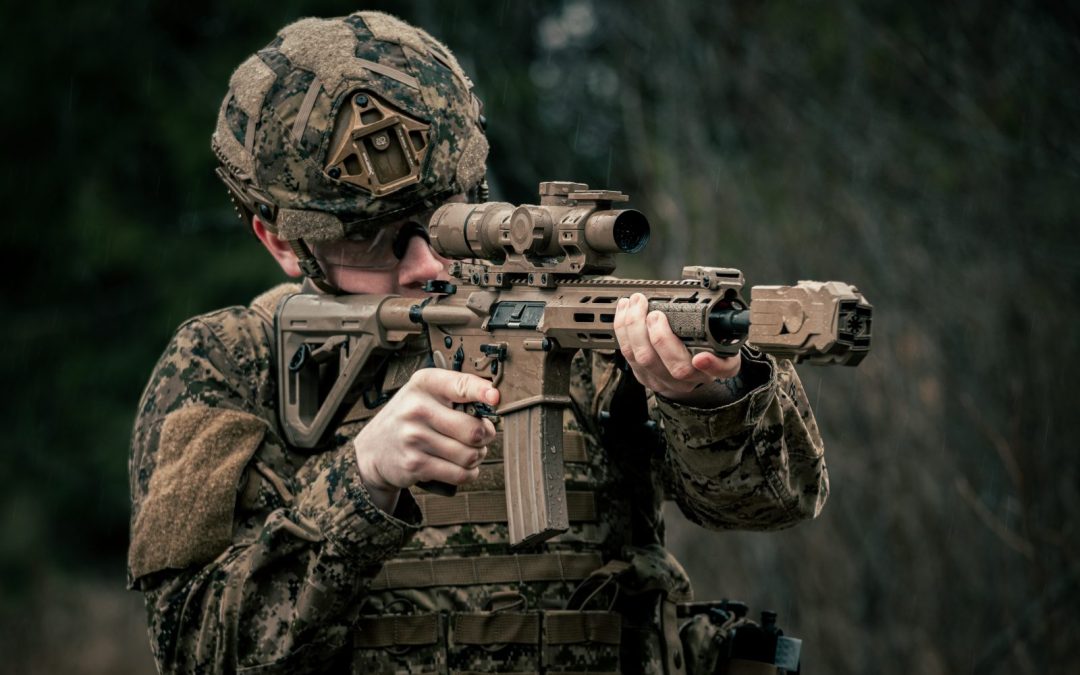
About this time next year, soldiers should begin getting hands on a long-awaited replacement for the combat-proven Colt Canada C7 rifle and C8 carbine, which were introduced 42 years ago and are now well past their prime, despite ongoing modifications.
The Canadian Modular Assault Rifle (CMAR)—its Department of National Defence (DND) designation is the C25 General Service (GS) Weapon System—is based on Colt Canada’s Modular Rail Rifle (MRR).
“CMAR can reasonably be seen as both evolutionary and revolutionary,” Colt Canada told Canadian Army Today. “While the Canadian small arms fleet had not seen major changes in approximately 20 years since the C7A2 and C8A3 upgrades, there have been meaningful advances in the C7/C8 platform over that same period.”
A $307-million contract for the first 30,000 C25 systems, along with a full engineering and support package, including lifecycle management, was announced in mid-March at Colt Canada’s manufacturing centre in Kitchener, Ont. That first phase of the procurement will be completed over a three-year period. A second phase to procure 19,207 more C25s is expected to begin in the fourth year.
The first-phase weapon is designed for frontline combat with priority delivery likely to deployed forces. Optimized for operations in urban and open terrain, it brings an array of new capabilities to Regular infantry units. The second-phase weapon is intended for broader use across the Canadian Armed Forces (CAF) in personal protection and deterrence for personnel who are not in primary combat roles.
“Rifles remain foundational to soldier effectiveness in the field,” said Army commander Lieutenant-General Michael Wright. “This development brings over 40 years of technology evolution to Canada’s fighting forces.”
Colt Canada is the federal government’s Centre of Excellence for Small Arms. Sean Congdon, president and chief executive officer, called the CMAR program “a cornerstone investment” in Canada’s defence readiness and industrial capability.
“The C25 General Service Weapon System reflects decades of experience supporting the [CAF], while delivering a modern, adaptable platform built in Canada for Canada.”
Defence Minister David McGuinty echoed that. “By investing in modern, reliable tools and working with a trusted Canadian partner, we are supporting the operational readiness of our armed forces while strengthening Canada’s defence industry and the skilled workforce behind it.”
Photos: Colt Canada
Much of the improvement flows from discussions through the company’s Technical Investigative Engineering Services (TIES) contracts with DND about evolving operational and performance requirements. The main points involved enhancing mature and proven technologies to improve barrel life, precision, performance and reliability, as well as evaluating suppressor technologies as they evolved.
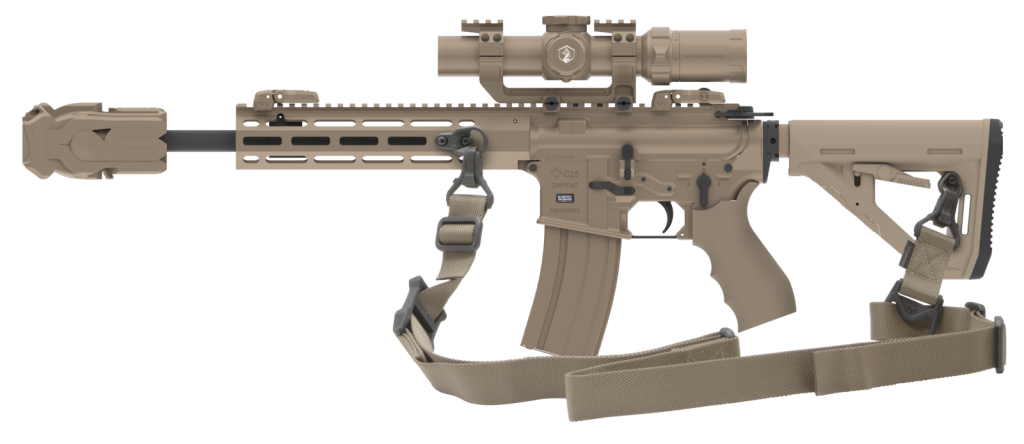
A five-slot MRR Upper Receiver with an integrated STANAG 4694 NATO accessory top rail is fundamental to the new weapon’s effectiveness, accommodating a Low Power Variable Optic with 1–6x magnification; this facilitates rapid target acquisition and engagement at a wide range of distances.
Once a target is identified and/or acquired, a two-stage trigger provides for a lighter initial “take-up” first stage pull to an initial stop point, followed by an additional stage to fire.
New features developed in close consultation with CAF operators include fully ambidextrous lower receiver controls, including bolt catch and release, magazine release, and fire selection. These enhance frontline troops’ adaptability in complex environments, as will a 3D-printed suppressor designed as an integral component of the system.
Other advances include an Integrated Upper Receiver and free-floating barrel that does not touch the stock or handguard except where it connects to the receiver. This prevents stock pressure, which is when the receiver interfacing with the barrel can cause harmonic vibrations that can compromise long-range accuracy. The free-floating barrel also reduces the amount of heat transferring from the barrel to the upper receiver where the shooter holds the weapon.
Also, the C-25 barrel is only as thick as is necessary to permit the rifle’s gas block to trap the gas from a fired round and direct it through a tube to the bolt carrier, which uses the pressure to eject the spent casing and chamber the next round.
The outgoing C7/C8 fleets, scheduled to be replaced on a one-for-one basis, can cycle at 750-950 rounds per minute (RPM) in fully automatic mode, but are limited to 15 RPM at a sustained rate of fire, albeit in quick repeatable bursts. In semi-auto mode, depending on how rapidly a shooter can pull the trigger, it’s up to 65 RPM. The new 34.8-centimetre (13.7-inch) cold hammer-forged barrel, optimized for durability and sustained performance, potentially could permit longer bursts.
All key components are finished with a sandy-coloured Cerakote ceramic polymer that not only improves corrosion resistance, but also can reduce a weapon’s infrared signature. Weapon furniture, including the buttstock, hand grip and backup sights, are finished in Flat Dark Earth (FDE). In addition, the tactical sling can be converted to a one-point attachment from two to suit operators’ preferences.
The design process yielded “reduced material and machining requirements,” important factors for cost control. Colt Canada declined to go into detail, saying only that, “at a high level, the program reflects the disciplined integration of enhanced performance requirements while retaining a robust and proven operating system.”
Ammunition for the new weapons, a 5.56×45-millimetre NATO round, will be manufactured by General Dynamics Ordnance and Tactical Systems-Canada, another federal government centre of excellence, in Repentigny, Que.
While Colt Canada declined to comment on market competition, an expansion of its Kitchener facility signals its optimism about export potential. It already has a track record with “other elite armed forces” such as the Dutch and Danish armies—the latter recently ordered more than 50,000 assault rifles—and the Special Air Service of the British Army.
A subsidiary of Connecticut-based Colt’s Manufacturing Company—itself acquired in 2021 by Colt CZ Group SE in Prague, Czech Republic—Colt Canada sees a “strong opportunity,” working through the new Defence Investment Agency, to promote its domestic small arms capability. It said that in addition to reinforcing domestic security of supply and strengthening Canada’s defence industrial base, “there are also interoperability benefits among allied forces, particularly NATO partners, operating common or closely aligned platforms.”
The C25 procurement was a first for the new Defence Investment Agency announced by Prime Minister Mark Carney in October 2025, setting the stage for a new Defence Industrial Strategy. The agency is tasked with modernizing an historically complex procurement apparatus and accelerating mission-critical equipment by centralizing expertise and streamlining decisions.

“The first-phase weapon is designed for frontline combat with priority delivery likely to deployed forces. Optimized for operations in urban and open terrain, it brings an array of new capabilities to Regular infantry units. The second-phase weapon is intended for broader use across the Canadian Armed Forces (CAF) in personal protection and deterrence for personnel who are not in primary combat roles.”
Editor: I think Ken got it backwards. The first phase of the program will see 30,000 general service (GS) rifle (designed for non-infantry types) issued. It will be another four years before close combat branches receive 16K copies of the full spectrum (FS) variant.
https://www.cbc.ca/news/politics/army-rifles-defence-procurement-canada-9.7134518
Perhaps the infantry will get the GS rifles first – as any improvement over the C7/C8 is welcome – and then be re-issued with the FS version later on. The troops deployed to Latvia would undoubtedly welcome that.