
by Chris Thatcher
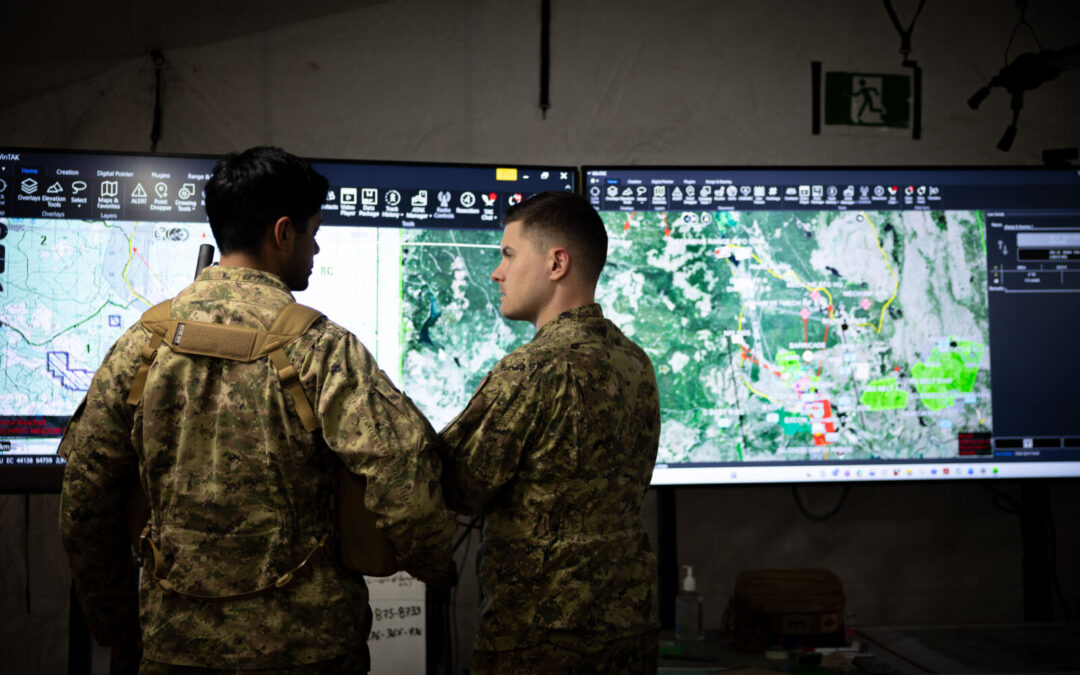
As part of Army modernization and the emerging Defence of Canada Division concept, interoperability will be a critical enabler. Beginning this May, first responders across the federal and provincial governments will have access to a cloud-based version of Team Awareness Kit (TAK), a suite of software applications for situational awareness, personnel and platform tracking, geospatial mapping, and command and control.
Known as GUARD, or Government Unified Architecture for Response and Defence, the system will help connect military and public safety partners through a shared digital capability. Through a partnership with National Defence, Shared Services Canada will maintain and deliver GUARD as a service, enabling shared development of the capability and broader availability for domestic response partners.
GUARD is based on the same core capability as Cloud TAK, a software solution launched by the Army as a trial edge network for the opposition force in a brigade exercise in 2023. It has since become a deployed capability on domestic operations, providing a common operating picture to Canadian Armed Forces (CAF) members and provincial firefighters on Operation Lentus. And it is poised to become an additional tool for the Canadian-led multinational brigade in Latvia.
Cloud TAK is now a readily available service and has been widely adopted across the Army. But its use is “asymmetrical,” observed Major Martin Simard, product leader with the Directorate of Digital and Army Combat Systems Integration (DDACSI), who has doggedly driven its development and acceptance since that first exercise in Alberta with the 12 Regiment blinde du Canada.
“Even though it is widespread, there’s still a huge asymmetry, and it depends on the operational tempo,” he said. “We’ve been available to users for three years now and there are still units that are not aware of it. I’m trying to over communicate, but even then, the message doesn’t get down to the end users.”
Units like 1 Canadian Mechanized Brigade Group and 39 Canadian Brigade Group have become Regular and Reserve force champions of Cloud TAK; others have had less time to test the capability as they prepare for deployment to Latvia.
But since members of 2 Canadian Division used Cloud TAK on cellphones and tablets with provincial firefighters and police as they battled a series of wildfires across Quebec in the summer of 2023, Simard has been breaking silos—with the Air Force and its digital hub, with the Navy, and with other government departments—to encourage its adoption and expansion.
The software solves the problem of information sharing among different services and agencies, an interoperability issue that is often addressed with liaison officers to bridge technical gaps. Even though he’s approached it as a start-up company, breaking old paradigms and forging new relations, he’s still trying to convince some how Cloud TAK can integrate sources of data across organizations and share situational awareness.
Not so, Shared Services Canada. SSC was among those intrigued by the initial use of Cloud TAK in 2023. In December, the department launched GUARD as a service following months of collaboration between its cloud team and Simard’s small group within DDACSI.
The submission of a joint cloud business requirement “happened really quickly,” said Simard. “The way Cloud TAK is built, we can share it easily. We were able to get it within two weeks. We need to give credit to the work that Shared Services is doing. They are fast moving and a great partner.”
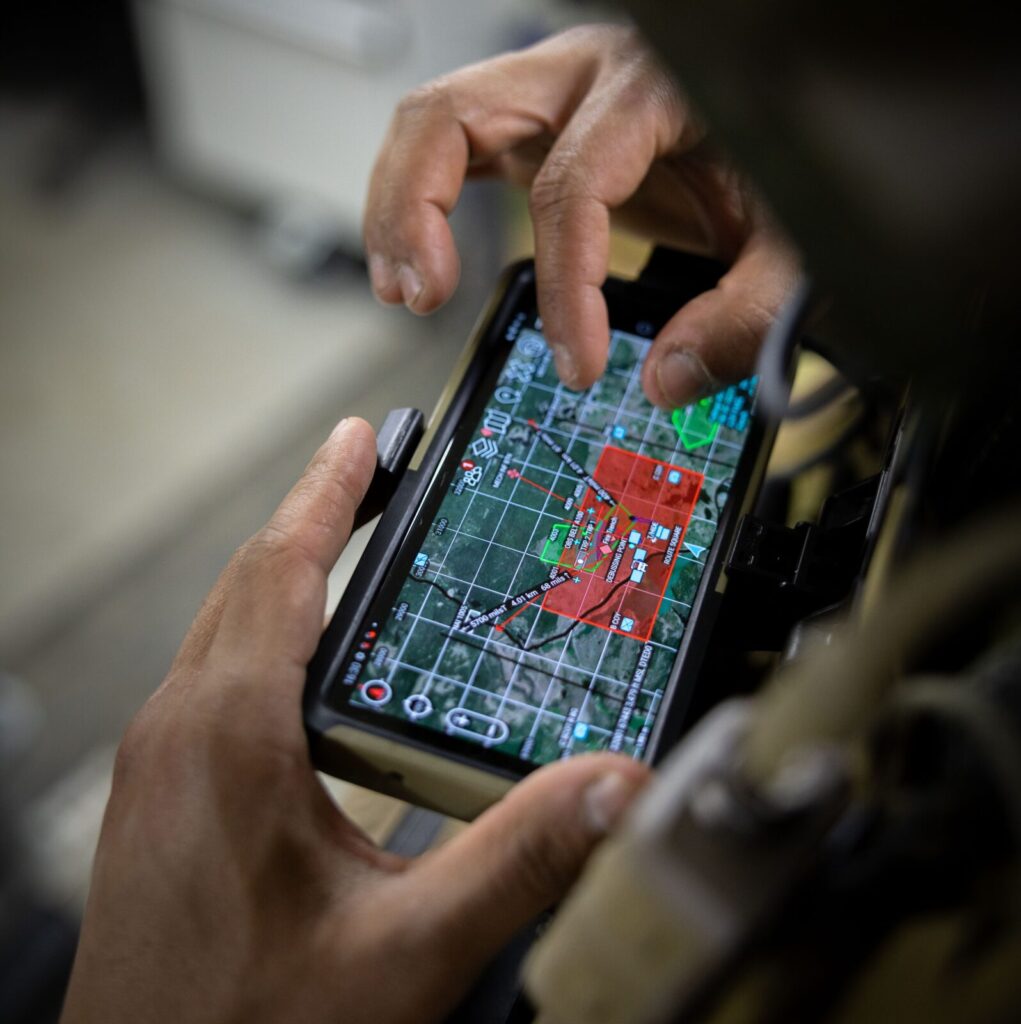
Photo: Cpl Daniel Pereira
The rebranded Cloud TAK means not only seamless interoperability between the CAF and first responders, but also among federal and provincial agencies when the CAF is not a participant in an exercise or operation.
Moreover, the collaboration with Shared Services “allows us to develop a capability jointly at a much faster pace,” he said. “We’re still developing the core of Cloud TAK, so the networking and functionality to make it scalable infinitely. But the code base is the same, so they can reuse it. Whatever we build on the Cloud TAK side, they enter it on the GUARD side.
Simard noted that “SSC is going through their own process with authorization to operate, making sure all the security controls are there. And we’re finishing a few things on the refactoring—because Cloud TAK grew so quickly, we had to do a refactoring on the code base. But it is the same architecture, the same devices, the same message going directly from Cloud TAK to SSC GUARD.”
Cloud TAK was built from the outset to be interoperable with other government departments, so the process for onboarding other organizations is relatively straightforward. Encouraging other departments to embrace the software for operations and contribute to its development might be tougher, but “it is just a question of time,” he said.
“It is about educating people about the capability, educating people about modern software development. We are used to procuring software from industry and then depending on the industry. We’re not used to building our own capability and maintaining our own capability. But if we want to survive in 2026, we need to innovate, we need to break things.”
The Joint Cloud
Another organization paying close attention to the first uses of Cloud TAK in 2023 was the Director, Joint Defence Cloud Program (DJDCP), created in 2019 to accelerate digital modernization for the Department of National Defence and CAF by acting as the single gateway for public cloud hosting capabilities. Consequently, it serves as an engine behind the Army’s digital agility and currently supports over 170 unique public cloud projects.
One of its top priorities is the operationalization of a Defence Cloud Mission Systems (DCMS) framework.
“As a result of the early operational use [of Cloud TAK], we immediately recognized the need to adjust the Joint Defence Cloud Program to meet round‑the‑clock operational demands, including implementing 24/7 on‑call support and re‑architecting cloud and networking capabilities to ensure greater resilience and redundancy in support of mission-critical operations,” said Julia Scouten of the DJDCP.
“Cloud TAK has been one of the key catalysts in reshaping both the DJDCP and the evolution of the DCMS framework by driving a clear shift toward a more mission‑focused posture. Its early operational use highlighted the need for cloud capabilities that operate at the speed of mission, directly shaping the development of the DCMS framework from its initial design in winter 2024 through to approval in spring 2026.”
Where GUARD has clear enterprise and civil response applications, DCMS is approaching digital systems as weapon systems, and is prioritizing digital services that can directly affect the fight.
“Cloud TAK for the Canadian Army proved unequivocally that cloud technology is a critical warfighting enabler, not just a back-office administrative tool,” said Scouten. “Its success in delivering real-time command and control at the tactical edge served as a powerful, real-world use-case and proof of concept for a mission focused public cloud program supporting the CAF.”
As an enabler to improve decision-making, Cloud TAK has been hardened against cyber threats for possible overseas deployment this year, said Simard, and it is designed to work when connectivity is disrupted.
“We build everything to deploy at the tactical edge, because we will lose connectivity to the cloud,” he said. “We have a way to automatically deploy spoke kits. Building a server from scratch at the edge, something that can take weeks and months to do, now takes us five minutes. If we lose connectivity because we’re jammed, we can maintain local command and control. And once the connection is reestablished, then we have more services available. The intent is always to be able to work disconnected.”
While Cloud TAK’s influence on the wider Defence Cloud Mission System is rewarding, seeing its adoption by SSC was “a huge win personally,” said Simard. It validated the value of sharing work and encouraging use beyond the Army and CAF—a message he’s been preaching since Cloud TAK was first deployed with soldiers and Quebec provincial firefighters in 2023.