

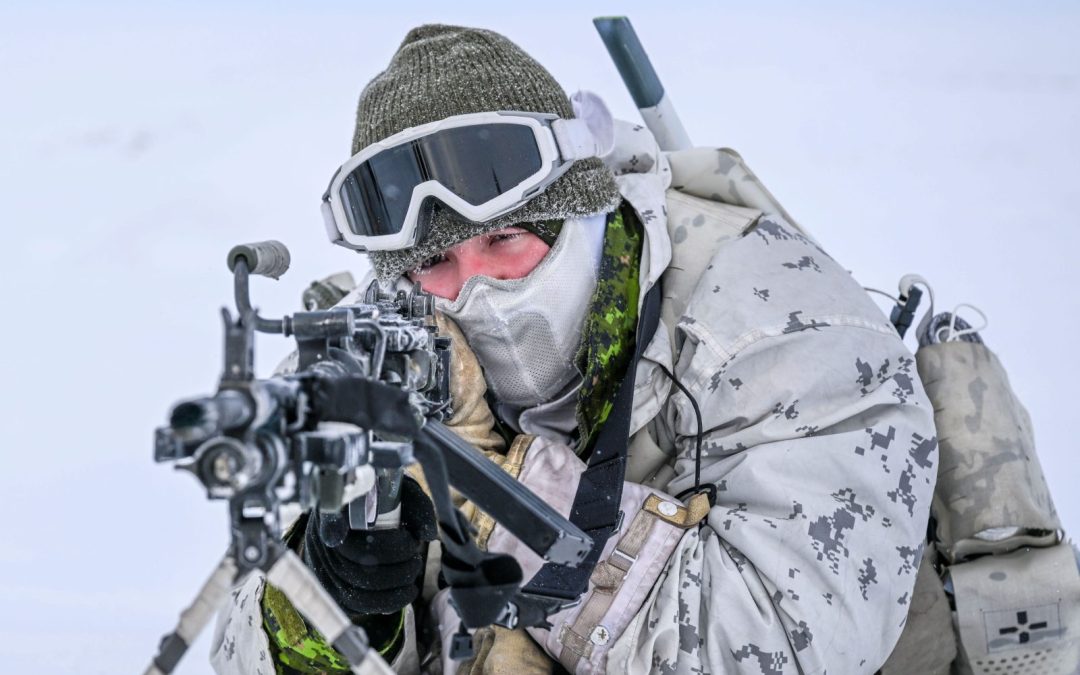
The largest Arctic operation in nearly two decades unfolded across three territories this winter. At the centre of it were the Canadian Rangers.
by Allan Joyner
In the winter of 1946, a small Canadian Army expedition set out to answer a question that had never been tested: Could a modern military force actually move across the Canadian Arctic?
Exercise Muskox took tracked vehicles, snow-capable carriers, and a handful of determined soldiers across the central Arctic mainland to Hudson Bay and back, relying on dead reckoning, compass work, and sheer will. It was less a military operation than a proof of concept, and its conclusion was sobering. The North was vast, unforgiving, and it did not reward the unprepared.
Eighty years later, the question has changed. Getting there is no longer the hard part. Operation Nanook-Nunalivut 2026 (NA-NU 2026), running from February 14 to April 15 across all three northern territories, was Canada’s most emphatic answer yet.
It was the largest Canadian Armed Forces (CAF) contribution to Op NA-NU since the broader Nanook series began in 2007: up to 1,300 CAF members, roughly 750 troops drawn from 3rd Canadian Division alone, nearly 200 vehicles and pieces of equipment, and allied participation from the United States, Belgium, France, and Denmark. The operation spanned Yellowknife, Behchoko and Inuvik in the Northwest Territories, Cambridge Bay in Nunavut, and Whitehorse in the Yukon, and it sent a long-range patrol on snowmobiles across the entire breadth of the Canadian Arctic.
That patrol was conducted by the 1st Canadian Ranger Patrol Group. They not only supported the operation. At every node, along every bound, they were indispensable to it.
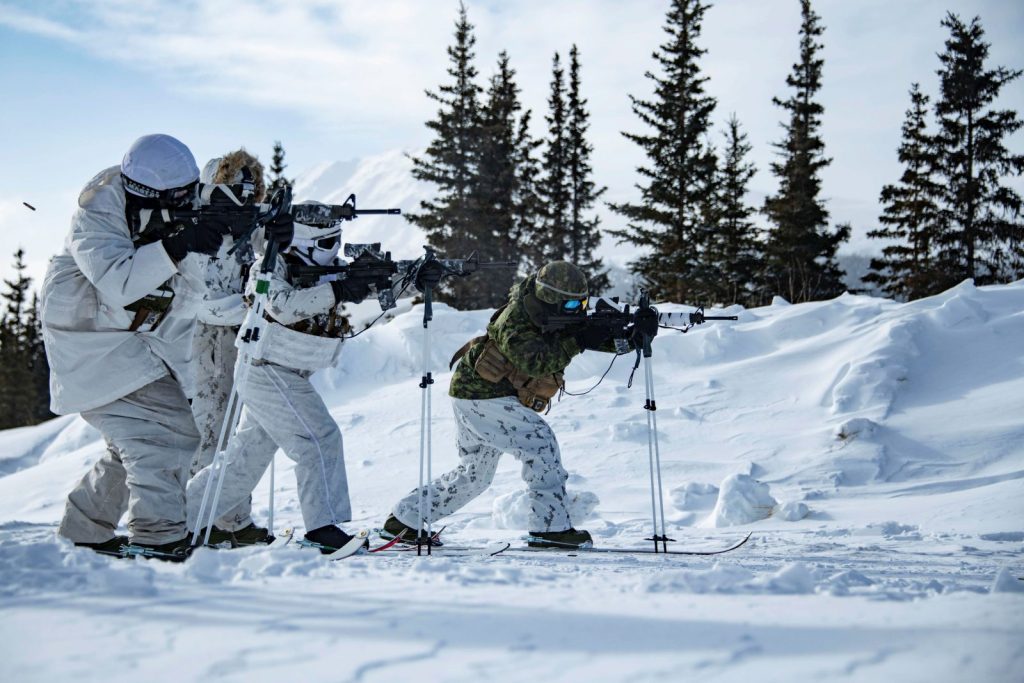
Members of the Quick Reaction Force, deployed with Joint Task Force (North) Headquarters, participate in a ski shooting event. Photo: Cpl Amelie Graveline
A Different Kind of Urgency
Op NA-NU 2026 was shaped by a world that had shifted under Canada’s feet. U.S. statements challenging Canadian sovereignty in the Arctic had sharpened the politics of northern defence. Russian air activity in North American identification zones was increasing. A growing international scramble for Arctic access was no longer a future scenario. The North had become a matter of urgent political attention in a way it had not been in decades.
Inflection Point 2025, released by Army Commander Lieutenant-General Michael Wright in August 2025, had already named the problem. “The Army we have is not the Army we need.” The document identified the Arctic as a region of increasing geopolitical vulnerability and listed Long Range Precision Strike-Land capability as a priority investment, one that would, in Wright’s own framing, “enable us to conduct area denial in the Arctic.”
Getting M777 howitzers to Cambridge Bay was a first, imperfect step toward proving the Army could begin to close that gap. Signals from Canada to friends and foes alike became concrete during the operation itself, with the federal government announcing new funding for northern operational support hubs and infrastructure nodes while troops were still on the ground.
Lieutenant-Colonel Jordan Beatty, commanding officer of 1st Regiment, Royal Canadian Horse Artillery (1 RCHA) and the Land Task Force commander in Cambridge Bay, Nunavut, was direct in his assessment: “We need to continue to invest in sustainment hubs in the north. We need to invest in the infrastructure to be able to stage in the north, and we need multiple locations to do that, because it’s so vast.”
The announcement, he said, was exactly aligned with what the operation had demonstrated. The timing was not coincidental.
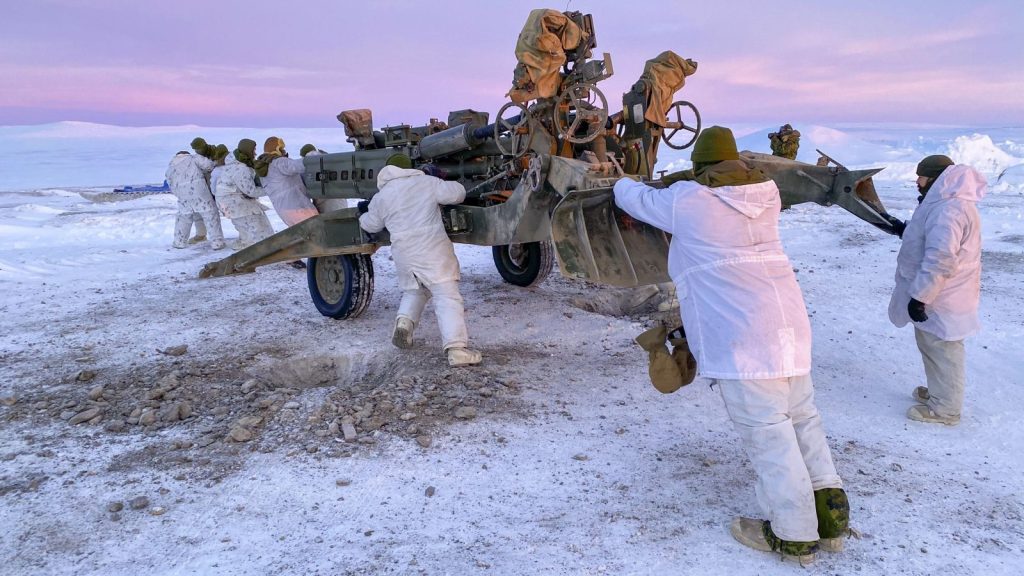
1 RCHA positioning the M777 at -38C near Cambridge Bay. Photo: Allan Joyner
Structure of the Mission
Op NA-NU 26 was led by Joint Task Force North (JTFN), the Yellowknife-based headquarters responsible for all CAF continental operations in Canada’s vast Arctic region, an area covering approximately 40 percent of Canada’s landmass. The sheer scale of 2026’s operation required 3rd Canadian Division to force-generate a Joint Task Force Nunalivut headquarters and a distinct Land Task Force (LTF). 1st Canadian Mechanized Brigade Group provided the joint HQ and 1 RCHA commanded the LTF.
The Arctic Response Company Group (ARCG), drawn from 38 Canadian Brigade Group in Winnipeg, fell under Beatty’s Land Task Force and deployed to Cambridge Bay alongside the gunners from 1 RCHA. Task Force Grizzly, built around 41 Canadian Brigade Group from Calgary, operated as a subunit of the joint task force headquarters and established a camp near Long Lake outside Yellowknife. 1 CRPG’s Canadian Rangers were present throughout.
The Cambridge Bay hub was the operational centre of gravity for the LTF. Victoria Island sits north of the Arctic Circle at 69°N, and getting there required moving the M777 155-mm howitzers by road from Canadian Forces Base Shilo to Yellowknife in the dead of winter, then by air aboard a CC-130 Hercules for the final bound into Cambridge Bay, the heaviest lift of the operation and a logistics challenge spanning thousands of kilometres—an expeditionary undertaking conducted entirely within Canada’s own borders.
As Beatty put it: “Although domestic, it feels expeditionary, because it’s so far. It feels like the same kind of distances when we go overseas.”
The first two weeks of Op NA-NU 26 subjected every element of the operation to conditions that tested the outer limits of what soldiers and equipment could endure. Wind chills regularly reached minus 60 Celsius across the Cambridge Bay area, grounding aircraft, freezing machinery, and demanding constant cold-weather discipline from troops drawn largely from prairie and southern garrisons. The Rangers were most visible in exactly these conditions. Inuit men and women who have operated in this environment their entire lives, they guided movement, assessed ice conditions, and kept the force oriented. The cold was not a variable to be managed. It was the operating environment, and the Rangers understood it in ways that troops from the south take years of experience to begin to match.
The M777s marked another milestone. Canadian military records indicate this was the first time the weapon had been deployed north of the 60th parallel. The operation aimed to establish that Canada could position, prepare, and fire long-range artillery in the High Arctic. A frozen hangar door, extreme temperatures, and blizzard-induced airspace coordination challenges with Transport Canada ultimately prevented a live-fire shot from going downrange.
Beatty was measured in his assessment of what that meant. The guns had been transported, positioned, and made ready for action. Fuses had been set on shells. The force had worked through extreme cold without a single serious cold-weather casualty.
“We demonstrated we could do that,” he said. “What is stopping us from scaling it up more is just synchronizing with other operations?”
The lesson he took from the hangar door, a technical detail with cascading operational effects that included grounding the 450 Tactical Helicopter Squadron CH-147F Chinooks and cutting short an ARCG patrol, was more pointed: “We need to be in the Arctic more, to learn all these details and see the unknown stuff that we don’t consider unless you are getting firsthand experience in the Arctic.”
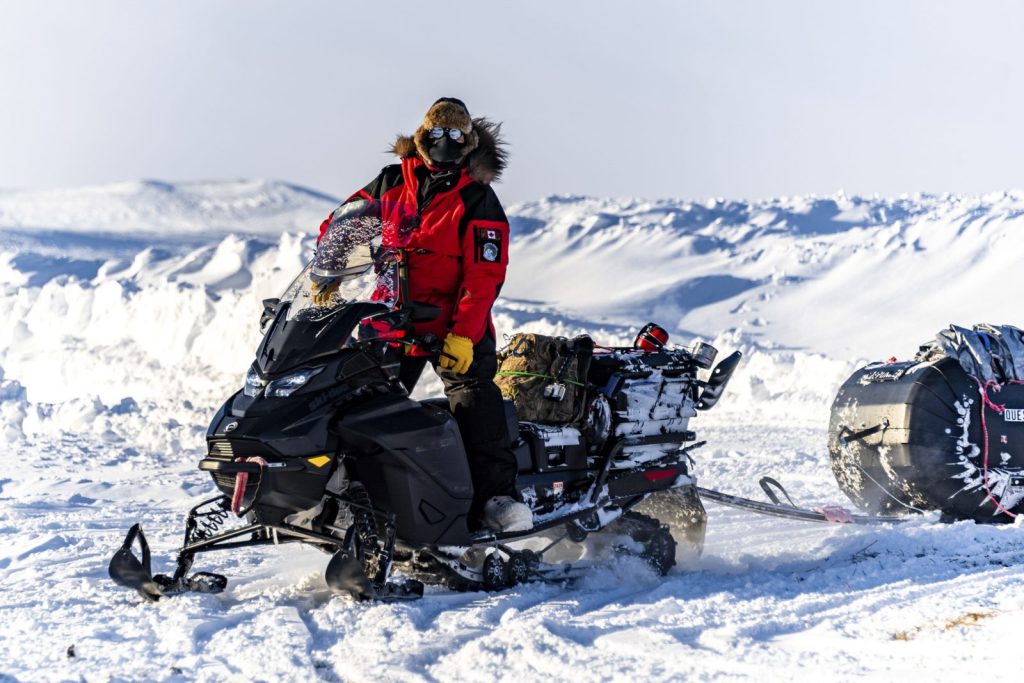
A member of 1st Canadian Ranger Patrol Group as the long-range patrol departs Paulatuk, Northwest Territories, on March 7, 2026. Photo: MCpl Antoine Brochu
The Rangers: The Thread That Holds It Together
The Canadian Rangers of 1 CRPG are, structurally and operationally, the permanent military presence in 65 northern communities stretching across Nunavut, the Northwest Territories, the Yukon, and the northern tip of British Columbia. Their 2,000 part-time members, drawn overwhelmingly from Inuit and other Indigenous communities, hold knowledge of this land that no amount of southern training can replicate.
The long-range patrol tasked to 1 CRPG was the most ambitious screening patrol Canada’s military has ever attempted on the Arctic mainland. Starting at the Yukon-Alaska border, the patrol covered almost 5,000 kilometres by snowmobile, finishing at Churchill, Man. The route followed the southern shore of the Northwest Passage east through or near Tuktoyaktuk, Paulatuk, Cambridge Bay, Gjoa Haven, and Rankin Inlet, past multiple North Warning System sites, across Coronation Gulf, down the Kivalliq coast, and eventually to the shores of Hudson Bay.
Consider the comparison with Muskox. That 1946 expedition was celebrated as a foundational act of Arctic sovereign reach, proof that Canadians could move and survive on that terrain at all. The 2026 long-range patrol exceeded it in distance and ambition, conducted not by experimental military detachments but by Canadian Rangers who live on and know this land.
The patrol was not without friction. The Inuvialuit Rangers, who opened the route from Herschel Island, judged early conditions unsafe and held for three days at Shingle Point on the Yukon’s north slope. That judgment, the kind of ground-truth assessment no headquarters map can replicate, is precisely the value the Rangers bring. When conditions allowed, they moved. When they didn’t, they waited.
The 440 Transport Squadron Twin Otters and CH-146 Griffon helicopters of the Air Task Force provided resupply and reconnaissance support through the early stages, scouting sea ice conditions ahead of the patrol and delivering food and fuel. When one Ranger developed Stage 2 frostbite, two Griffons launched within an hour of the alert, extracted the affected member, and inserted a replacement. The patrol did not leave an empty sled behind.
Rangers were equally present in Cambridge Bay, where expertise from men and women in the local company guided the ARCG’s 400-kilometre Victoria Island patrol through the realities of sustained Arctic operations.
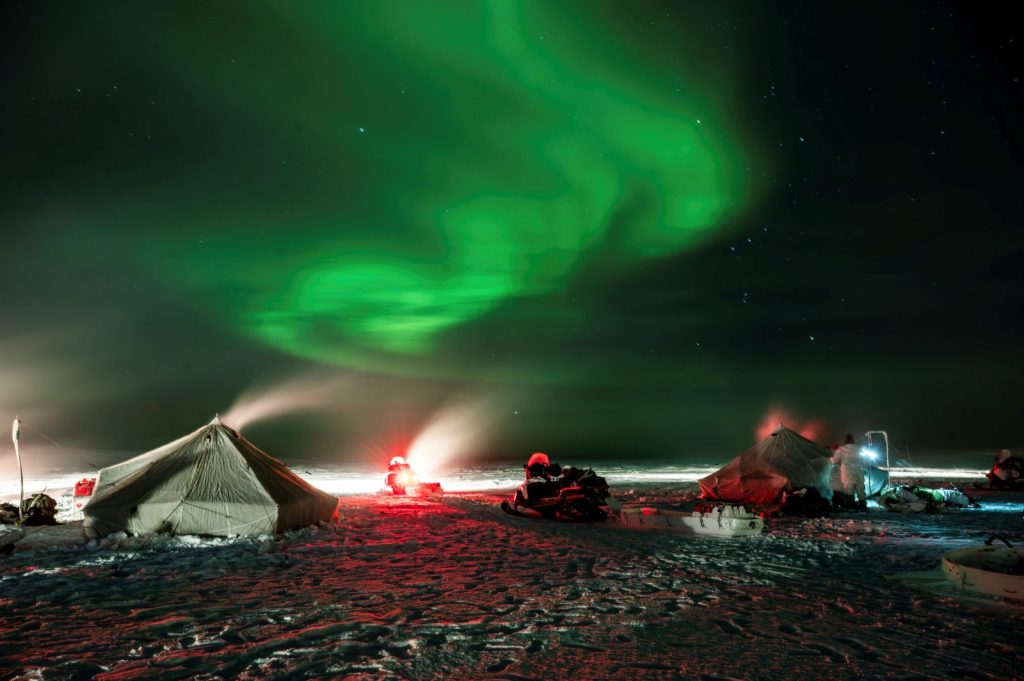
Photo: MCpl Sarah Morley
Muskox and the Long Arc
The legacy of Ex Muskox is often framed as a founding moment for Canadian Arctic doctrine, the point at which Canada first treated the North as a theatre of operations rather than a distant frontier. But Muskox also exposed how unprepared Canada was: threadbare infrastructure, limited integration with northern communities, a wide gap between intent and capacity.
Eighty years later, the Op Nanook exercises have closed the gap. Op NA-NU 26 put more troops on the ground, over a wider area, with heavier equipment, in tighter coordination with allied nations, and with the deepest possible integration of Indigenous expertise. Rangers are embedded in every element of the mission—not borrowed expertise but a permanent presence.
Muskox asked whether Canada could get to the Arctic. Op NA-NU 2026 was answering something harder: whether we can hold it. The snowmobile tracks fade. Presence has to be earned again, every year, and the North does not award it based on intention.