


by Chris Thatcher
One of the long-standing challenges with the Army’s Land Command Support System is its ad hoc nature. Sometimes called a network backbone for command and control (C2), it more often resembles a patchwork of multiple networks than a unified spine, and requires creative construction to connect users on exercises and operations.
With the stand up of a Canadian-led multinational brigade headquarters in Latvia, commanding a Canadian-led multinational battlegroup and a Swedish battalion, working alongside a Latvian brigade, all under a Danish-led multinational division, an improved configuration for C2 quickly became an urgent operational requirement (UOR).
Last fall, Major Jonathan Holsworth, the commanding officer of 5 Canadian Mechanized Brigade Group Headquarters and Signals Squadron (5 CMBG HQ & Sig Sqn), laid the foundation for that brigade tactical network, drawing on the experimentation and industry partnerships developed over the past two years by counterparts with 2 Canadian Mechanized Brigade Group Headquarters and Signals Squadron (2 CMBG HQ & Sig Sqn).
The Signals squadron of over 100 personnel arrived to “a lot of equipment and CIS (communications and information systems) interoperability issues with all the nations,” Holsworth recalled in a recent interview. After more than a dozen rotations since the battlegroup stood up in 2017, and the inclusion of 10 other nations in the framework, CIS had become “a beast.”
“It was kind of the island of good ideas and experimentation,” he said of the small Signals teams that had supported the equivalent of a small brigade in recent years. “But interoperability at the sub, sub-unit level and even lower is very difficult from a (voice and data) perspective. It had evolved a bit, some of the CIS equipment went left and right, and TAK (Tactical Assault Kit) was the primary battle management system that they were using, but it was not properly configured or integrated in the vehicles.”
“Experimentation was rampant, which is good, we want innovation and experimentation. But I don’t think the CIS evolved a lot because it didn’t have [the necessary] buy-in or any capital projects that provided support.”
Configuring the brigade tactical network. Photo: MNB-Latvia Imagery Technician
A fresh approach
Before deploying, Holsworth and the incoming battlegroup commander from 5 CBMG spent months mapping out a plan to streamline and scale the C4ISR (command, control, communications, computers, intelligence, surveillance, and reconnaissance) apparatus, in synch with the expanding brigade structure. While not officially a first rotation for C4ISR, they treated it like a “Roto Zero because we were creating a whole bunch of new units.”
The first order of business was articulating the battlegroup’s needs, and then standing up the brigade headquarters and signals squadron with an overarching C2 structure. That meant meetings not only with the deploying Canadian units, which kept expanding as a tactical aviation detachment of CH-146 Griffon helicopters arrived, the CU-172 Blackjack small uncrewed aerial system began operations, and the first air defence capabilities were delivered; but also with the Latvian command team and the contributing nations to the battlegroup: Albania, Czechia, Iceland, Italy, Montenegro, North Macedonia, Poland, Slovakia, Slovenia, Spain and Sweden.
“Creating the overall structure for the two brigades, the division above us, and then establishing ourselves with Task Force Latvia, which provides Canadian support, took time,” said Holsworth.
“A lot of the energy was spent establishing the structures and the command relationships with the NATO chain of command. We did a lot of planning at the secret level just on host nation defence planning, as well as integrating with NATO.”
That included securing land use agreements and movement control when conducting exercises outside the Adazi military base, such as the new 25-hectare training area, Selonia.
Some of the squadron’s equipment was pulled from existing Army stocks prioritized for Latvia. But the CIS UOR project, to be delivered over the next three years, included an initial “surge of new equipment” worth about $300 million.
That included hundreds of laptops and various CIS equipment that had to be configured, as well as masts, small form factor servers, licenses for Systematic’s SitaWare blue force tracking suite, and TrellisWare and Persistent Systems TSM waveform radios.
Much of it arrived in multiple shipping containers and not always in logical bundles. Batteries for example, are classified as dangerous goods and were removed from the laptops; they had to be located and installed before the computers could be distributed.
“We had mountains of equipment in the battlegroup to fix and lifecycle, and then we had a whole bunch of equipment existing in theater that was on the shelf, ready for us to start deploying, like 100 deployable printers,” said Holsworth.
Then there were the more basic problems of securing accommodations, workspace, and parking for around 80 LAV II Bisons and LAV 6, as well as the first Command Post variants of the new Armoured Combat Support Vehicles.
“A lot of it was just the logistics of theater activation, deploying our basic equipment and vehicles,” he said.

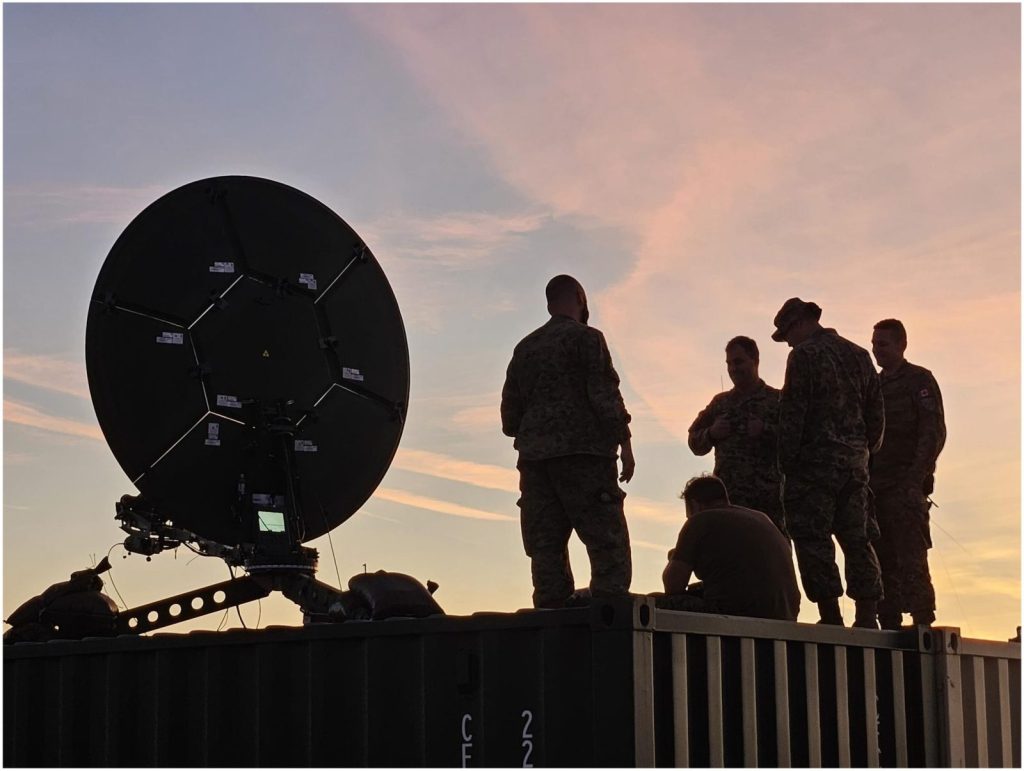
Exercise Silver Arrow in September 2024. Photo: MNB-Latvia Imagery Technician
Tactically survivable C2
The Army’s operating concept is premised on being adaptive and dispersed. Part of 5 CMBG HQ & Sig Sqn’s initial role was to configure the brigade headquarters for remaining connected and able to command while segregated.
The groundwork for tactically survivable C2 was laid by 2 CMBG HQ & Sig Sqn through a series of exercises in Petawawa over the past two years. Led by the then commanding officer, Major Nicolas Gonthier, the squadron proved a scalable concept for a digitized and dispersed command post, integrating edge computing and resilient communications bearers on its vehicles.
The experimentation allowed the squadron to develop its own operating procedures for dispersed C2 while trialing new systems and software from companies already supporting the Army, including General Dynamics Mission Systems Canada, Interop, Ultra Communications, Persistent Systems, Hoverfly, Trellisware, Systematic, Allen Vanguard, L3Harris, Base Camp Connect, and Rheinmetall.
Holsworth, too, drew on some of that expertise through technical assistance visits that included company field representatives, technical liaison officers from Assistant Deputy Minister (Materiel), and industry support from Latvia. “And there was some remote support from Ottawa, especially on the SitaWare suite and how to properly deploy that software,” he added.
“SitaWare is the bread and butter. I got to initiate that with the existing resources we had in theater for the first six months. That battle management system is something our allies are using. We [focused] on rolling that out at the headquarters level for a culminating exercise in November called Resolute Warrior.”
While not all the technology trialed in Petawawa has been brought forward to Latvia, capabilities such as a variable height antenna—a Hoverfly tethered drone—have been incorporated to support beyond-line-of-sight communications that are challenged by the high forest canopy in parts of the country. “The pine trees literally eat all comms,” said Holsworth.
Integrating the additional artillery capability, such as the Blackjack and air defence, as well as uncrewed systems, in a network was “another realm of complexity,” he said. What works for the brigade in garrison with existing structures and lined networks, and what works in the field can be two different things. The squadron had to bridge “air gaps” where often “a lot of these systems didn’t speak to each other.”
“That applied to all the ISR capabilities,” he said. “You have to think about the brigade being a combat ready brigade. We have to divorce ourselves from working from our comfortable areas or our buildings to be able to integrate those systems with our vehicles.”
By the start of Resolute Warrior, the brigade had a working tactical network to communicate with the battlegroup and with higher headquarters, using “the Canadian provided systems and laptops,” Holsworth said.
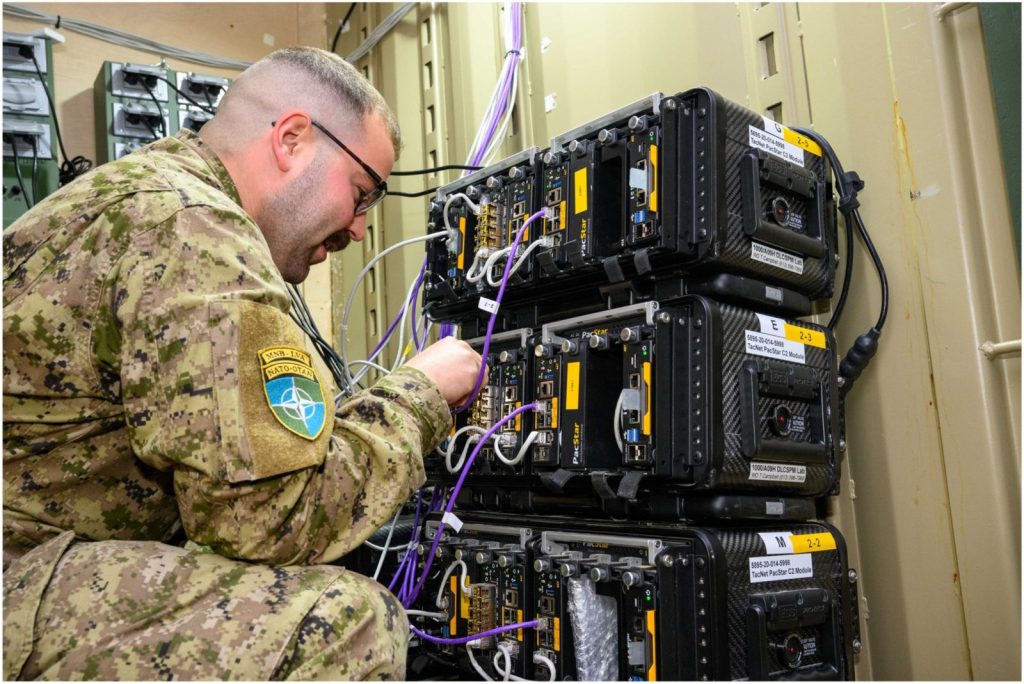
Photo: MNB-Latvia Imagery Technician
The next step for the current rotation from (5 CMBG HQ & Sig Sqn) is connecting the battlegroup to dismounted soldiers through the Integrated Soldier System (ISS) suite. The Army is still in the process of introducing the Baseline 23 communications suite, formerly known as CP TOPAZ, into the LAVs. Once completed, it will connect vehicles to soldiers’ ISS.
Building a tactical network a few hundred kilometres from a border with an adversary generates its own challenges, Holsworth acknowledged.
“We were aware that we were being observed. We constantly had drone sightings, and drone control in the area is high.”
Holsworth previously worked with the Directorate of Cyber Operations Force Development, helping design the workforce and overall structure that in September 2024 became Canadian Armed Forces Cyber Command, so the squadron emphasized security protocols, cyber hygiene, and best practices with the use of cell phones.
“It’s a different environment,” he observed, “and a lot of our leaders are from the Afghanistan era … It’s not the same reality as in Afghanistan. It’s a way different counter [to threats] and a different level of stress on soldiers.”
That required a change in mindset about security, something Ukrainian soldiers have readily shared. “Ukrainian soldiers have the discipline now to not take their cell phones to the frontline, they keep them in the back or on airplane mode. We’re trying to instill that culture in Canadians.”