

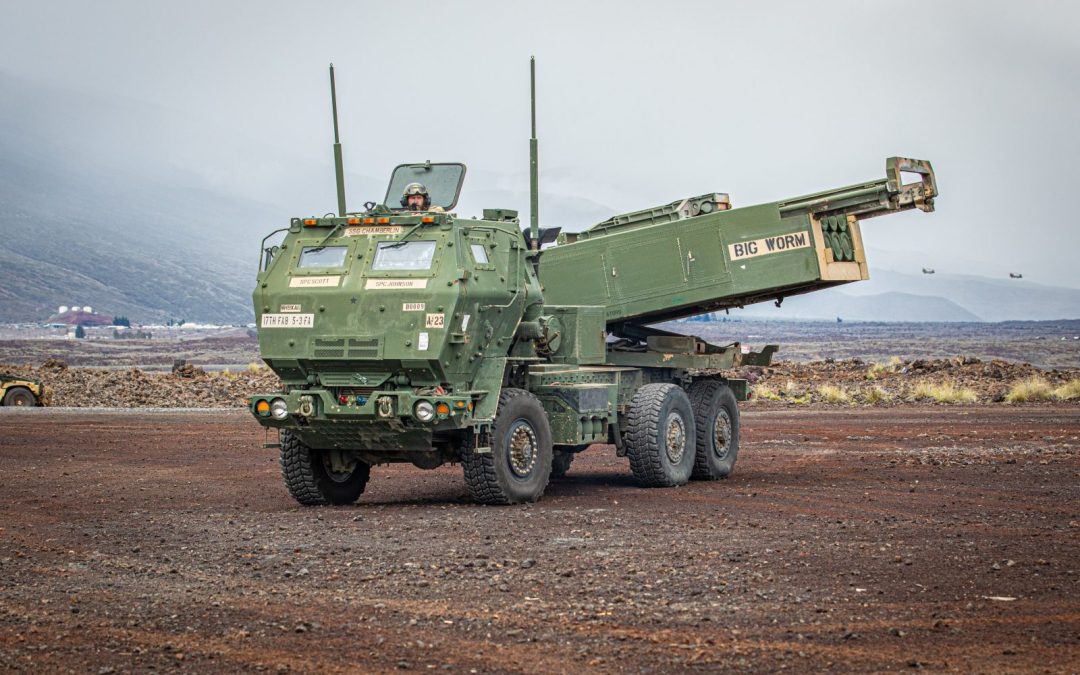
The Canadian government on June 2 confirmed it has finalized a government-to-government agreement for 26 Lockheed Martin High Mobility Artillery Rocket System (HIMARS) launchers, a preliminary operational stock of munitions, spare parts, training, and support services.
The agreement was reached in January 2026, and will be completed under the U.S. Foreign Military Sales (FMS) program.
First deliveries expected to begin in 2029.
The acquisition is part of Long-Range Precision Strike-Land, a project estimated at $2.6 billion that includes project management, infrastructure, contracts, and contingency. The project was launched in 2024 with government’s defence policy update, Our North, Strong and Free.
“This capability marks a major step forward in modernizing the Canadian Army,” said Army commander Lieutenant-General Michael Wright. “High Mobility Artillery Rocket System will give the Army a mobile, long-range precision strike capability that can be deployed across Canada, including the Arctic, and abroad using existing Royal Canadian Air Force aircraft.
“When integrated with other modern capabilities—such as self-propelled artillery systems, sensors, and command and control—it will strengthen Canada’s ability to deter aggression, safeguard our sovereignty, and protect Canadians.”
Following an evaluation, “HIMARS was identified as the only solution that best met Canada’s operational and technical requirements,” the Department of National Defence (DND) said in a press release.
“There is currently no Canadian manufacturer for the HIMARS launcher system or associated long-range missile capability. HIMARS is not commercially available, the capability is only available through the United States Foreign Military Sales program. In support of this acquisition, the Congressional Notification process was completed in Fall 2025.”
DND stated the launcher systems would be paired with long-range munitions capable of precisely engaging targets at distances of more than 300 kilometres, “revolutionizing how the Canadian Army conducts operations and supports joint forces on future missions.”
The systems are designed to integrate future land-based anti-ship missile capabilities to support the defence of Canada’s coasts, including the Arctic, the department stated.
“Canada’s Armed Forces must have the capabilities required to meet today’s threats and tomorrow’s challenges,” said David McGuinty, minister of national defence. “The long-range missile capability is a critical step in supporting our military, so it remains ready and equipped to protect Canadians and support our allies and partners when needed.”
To fulfil Industrial and Technological Benefits obligations, Lockheed Martin Missiles and Fire Control will invest in Canadian industry, DND added. “Lockheed Martin plans to integrate Canadian companies into global supply chains, invest in Canadian research and development, and support the development of small and medium-sized businesses.”
“Our government will always use our purchasing power to advance Canada’s economic interests and support the workers and companies that keep our country strong,” said Mélanie Joly, minister of industry and minister responsible for economic development for Quebec regions.”
“As part of this procurement, Canada’s Industrial and Technological Benefits Policy will be applied, which will require the company to invest directly in Canada’s economy by strengthening our industrial base, integrating Canadian firms into global supply chains, and supporting the research, innovation, and small businesses that drive our growth.”
While the acquisition covers the procurement of equipment and some short-term in-service support (ISS) elements, the long-term ISS solution will be acquired separately.

great, so when is the army going to get this – 2029? Manufacture is currently backlogged for years to come…. 4 years according to this article: https://asiapacificdefencereporter.com/from-the-magazine-himars-production-being-increased-to-meet-demand/
It says it in the article.
If they had ordered Chunmoo K239 3.0 HPMLRS from South Korea or Foudres from France they likely would have them all before the first HIMARS couple be delivered and we probably won’t have right to repair for HIMARS
Chunmoo can’t fit into a C-130, which was a requirement. Foudre is only at the prototype stage.