


by Chris Thatcher
In late October, 129 Battery, 4th Artillery Regiment (General Support), launched a CU-172 Blackjack in Latvia, marking the first operational flight of the small uncrewed aerial system (SUAS).
The Army acquired the Boeing Insitu RQ-21A system in 2017, and the battery had been building to the milestone ever since it declared full operationally capability in May 2023.
Consisting of five aircraft, launch and recovery platforms, and ground control stations, it’s a system likely to be in high demand as the Canadian-led multinational brigade ramps up. The drone and sensor payloads offer commanders a communication range of over 170 kilometres and a flying duration of around 15 hours. In fact, shortly before the first flight, 4th Artillery Regiment (General Support) (4 Regt (GS)) sent a second chalk of SUAS operators to provide 24/7 continuous support to intelligence, surveillance and reconnaissance (ISR) operations if needed.
The Blackjack is one of several maturing or new capabilities that the Regiment is supporting in Latvia, and it’s doing so under a novel command-and-control (C2) construct. 129 Battery is part of an ISR Company, which is nested within a Multinational Artillery Battalion Group (MN Arty Bn Gp) that also includes a multinational Air Defence Battery comprised of a Medium Range Radar (MRR) detachment and, shortly, a very short-range air defence (VSHORAD) troop, which will be operating the Saab RBS 70 NG, acquired as an urgent operational requirement (UOR) in February.
“We’re pushing over 100 people right now overseas,” said Lieutenant-Colonel Natasha Skidmore, commanding officer of the Regiment.
The MN Arty Bn Gp is the outcome of a three-year experiment, conducted on successive iterations of exercises Unified Resolve and Maple Resolve, to explore how best to integrate effects like SUAS, intelligence, electronic warfare (EW) and other division-level capabilities into a brigade’s decision cycle.
“This is completely new, and based on the lessons from that experimentation,” said Skidmore. The proposal for the C2 structure was drawn up by the gunner community and approved by the Army commander earlier this year, and is garnering international attention as allies such as Australia and some NATO members experiment with their own ISR structures.
“Everyone’s trying to figure out the best way to expedite that decision action cycle,” she noted, “so people want to see how we’re doing it.”
The ISR Company, which includes members of 4 Regt (GS), 4 Engineer Support Regiment, 21 Electronic Warfare Regiment and the Canadian Army Intelligence Regiment, is also “a completely novel way of doing ISR,” said Skidmore. “The way they’re closing the sense and intelligence cycle is different. They’re trying something new in terms of how the information will flow through the brigade, the pathways to how it will be analyzed and how it will aid the decision-action cycle. They are trialing a modern process that will significantly change how the Army does ISR.”
By Spring 2025, the Canadian-led Air Defence Battery will include an Italian VSHORAD Stinger platoon, the MRR detachment, the RBS 70 NG troop, and a new air defence integrator vehicle, a modernized and more capable version of the Regiment’s recently upgraded Airspace Coordination Centre (ASCC) vehicles.
“Because we are bringing back air defence effectors, there’s a big difference between being an airspace coordinator and actually driving the kill chain to shoot down enemy aircraft – the coordination necessary to keep your kill zones in the sky free of friendlies,” said Skidmore. “So, we’ve transitioned the ASCC to an Air Defence Cell (ADC). This is nested in legacy air defence doctrine from the 1990s. [In Latvia], they made the transition last winter.”
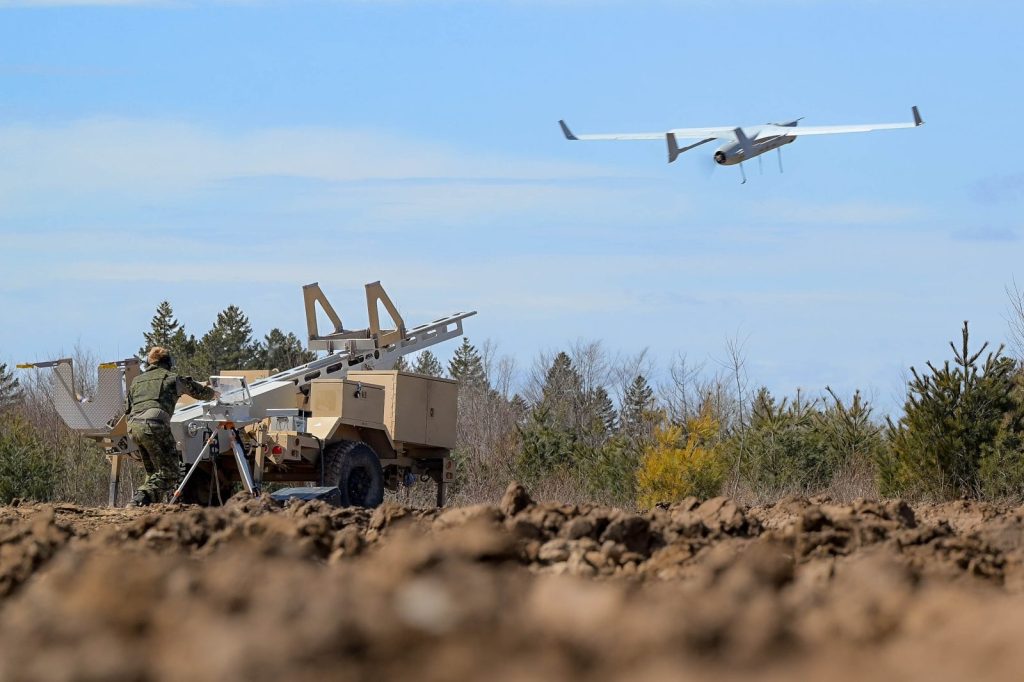
A member of the 4th Artillery Regiment (General Support) launches the CU-172 Blackjack during Exercise Golden Archer in April 2024, a training event focused on ground air defence capabilities and readiness, in preparation for deployment on Operation Reassurance. Photo: MCpl Stéphanie Labossière
Reinvigorating Air Defence
Housing the ADC will be a variant of the Light Armoured Vehicle (LAV 6.0), specially configured for ADC operations and to allow the Army to communicate jointly with air and naval assets.
“It’s full of servers,” she explained. “It’s really about networking and ensuring that we can receive the recognized air picture within the brigade for situational awareness and early warning, and then also contribute our tracks and ensure that our effectors are not shooting on friendly forces, and that anything hostile that we can’t affect ourselves, we’re passing on higher to other nations.”
The ADC platform is expected to achieve full operational capability early in 2025. When the Army’s incoming RBS 70 NG is delivered, “like C-UAS it will integrate through that vehicle – all our air defence capabilities will integrate through the ADC.”
The Regiment is currently completing preliminary trials with the new ADC platform. Testing will continue later this fall at Bold Quest, a U.S. Joint Staff demonstration of technical and tactical level interoperability related to the development of Coalition Joint All Domain Command and Control (CJADC2), before final trials in Gagetown, N.B., after Christmas.
In addition to ISR experimentation, the Regiment is investigating how best to manage airspace within the Army. The ASCC was last deployed in a counterinsurgency context in Afghanistan, where coalition forces controlled the skies. That won’t be the case in major combat operations, where the airspace is becoming increasingly saturated with UAS and other capabilities.
“We’ve sent a mentorship team to Latvia to help uncover best practice,” Skidmore said. “Ultimately, having the airspace will privilege what we’re using and when. I do think that comes down to command decision making at certain points. There’s only so much airspace, and we really have to be judicious in major combat operations about who gets that airspace, and when.”
The leadership role in Latvia and the arrival of new equipment is reinvigorating air defence. The Army’s last effector – the short-range air defence anti-tank system (ADATS) – was retired in 2012, but the system was already on “the downturn of activities” well before that, she noted. For air defenders who have waited years for a new capability, “the energy and enthusiasm – you can touch it.”
In preparation for the RBS 70 NG system, the first of which should be delivered in November, the Regiment stood up 127 Air Defence Battery last summer. The battery has conducted tactical training to acquaint soldiers with the tactics of VSHORAD, and to prepare sergeants as detachment commanders and second-in-command. When Skidmore spoke in mid-October, a second serial of RBS 70 operators was in Sweden to qualify on the system. And with Latvia operating an older variant of the RBS 70, Canadians have been training collaboratively with Latvian air defenders as well.
“Due to some really phenomenal collaboration with DLR (Director Land Requirements), we were able to position the Regiment to be prepared to deploy as soon as the kit arrived,” she said. “The school has developed some pilot courses and has put on a lot of training for us in advance. Everyone’s rowing on their oar to get it over there.”
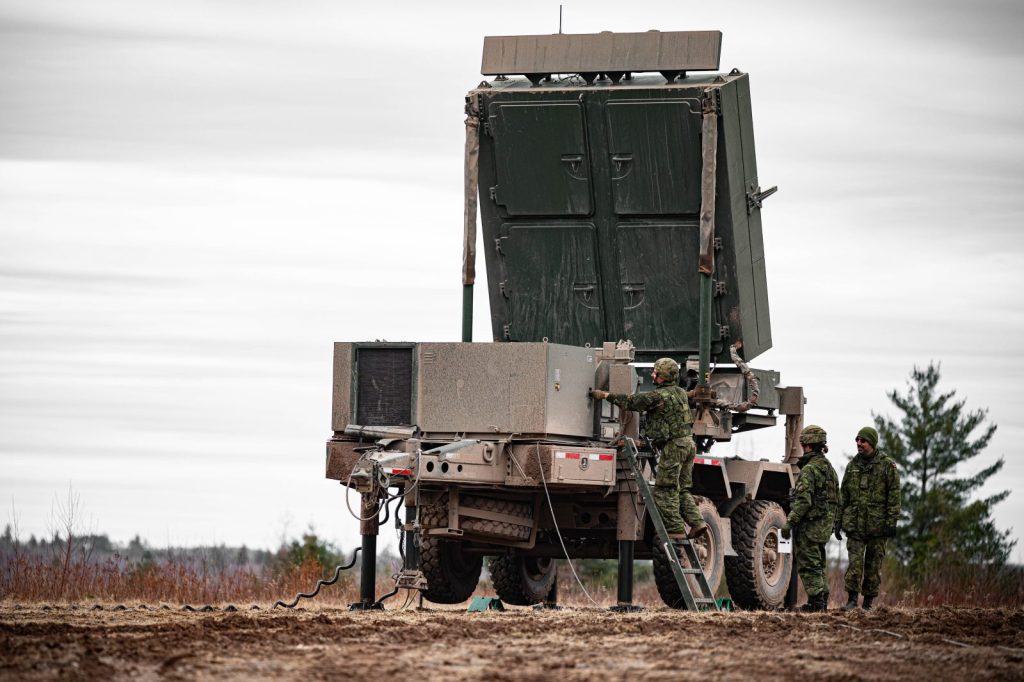
Deploying the medium range radar during Exercise Golden Arche. Photo: MCpl Stéphanie Labossière
GBAD and more UAS
The introduction of the RBS 70 NG and the inclusion of the MRR in an air surveillance role are contributing to a new Ground-Based Air Defence (GBAD) capability, slated to deliver in 2027. The Regiment will stand up a new battery, likely designated 119, in 2026 and follow a similar preliminary training path as 127 Battery with the VSHORAD. In the interim, it is hoping to better understand GBAD integration through the new air defence integrator vehicle, the MRR and the Latvian operated Saab Giraffe Radar, “and practice knitting those pictures together and sending them higher,” Skidmore said.
“The level of integration is quite strict in terms of time. No latency is permitted because you could be firing effectors on these tracks. We’re getting to play in that role, mature our thinking, and test the limits of this new capability.”
Even with the volume of new equipment arriving at 4 Regt (GS), there are ongoing discussions about acquiring additional SUAS equipment and platforms. With one system in Latvia and one dedicated to force generation training, there is an argument the Regiment could use at least one more, if only to support Canadians at home. In response to forest fires in the Halifax area last year, for example, the CU-172 would have been able to provide a sustained picture “because we have such a long time on station,” said Skidmore.
“There were lots of UAS that could view what was happening, [but] our platform actually offers something that isn’t available commercially. So, we’ve been making a lot of steps to ensure that, should Canadians need us domestically, we’re available. That’s going to be challenged if we only have one system here.”
Adding an additional Blackjack system is part of a larger conversation within the Army that includes discussions surrounding replacement for the mini-UAS CU-173 Raven B and the introduction of a general-purpose UAS, the quadcopter Teal 2, as well as consideration for other vertical take off and landing variants.
“They’ve been looking at purchasing more airframes,” Skidmore noted. “I can’t tell you what direction this is going to go, but I think the eyes of the Army are very much on SUAS. We recognize the significance of having a deep sense capability.”
At a time when the Army is wrestling with recruitment and retention, 4 Regt (GS) is seeing steady growth. If the government’s defence policy put a charge in the unit with funding for GBAD, the introduction of MRR, and CU-172, and now UORs for VSHORAD and other air defence platforms have ensured it remains a priority for the Army command team.
“We have seen considerably more growth than was originally identified,” Skidmore said. In the last year, the Regiment has grown by almost 100 soldiers, and should reach 500 by early 2025. To sustain rather than simply surge capability to Latvia and elsewhere, though, it may need considerably more.
Skidmore has proposed a number and is awaiting approvals, “so I won’t share it,” she said. “But the Army commander has identified us as a staffing priority. He wants up to 90 percent. That means we’re getting more gunners and more Combat Service Support (CSS), because air defence and SUAS are very reliant our mechanics, signalers, any of those specialized technicians. These capabilities traditionally have a big CSS footprint.”
Where possible, the Regiment is trying to force generate from the many Reserve units across Atlantic Canada and elsewhere, and purposely built its deployment structure to accommodate interested reservists, which Skidmore sees as key to sustaining operations.
“We’ve seen some really enthusiastic reservists come out, and we want to keep that trend up,” she said, by ensuring flexibility in how each rotation is constructed to accommodate the work and family lives of Regular and Reserve Force members.
Being on the receiving end of some of the Army’s newest equipment also helps with recruitment and retention, she noted. “We’re trying to leverage that power of attraction.”
If there’s a hiccup, it’s been the reluctance of soldiers to accept postings in Latvia before the RBS 70 NG and some other equipment is delivered. Soldiers want to be the first to operate it and some reservists are “holding out” on deployment until they can be trained.
“They won’t come and deploy with us until the RBS 70 lands, because they want to be some of the first operators,” she joked. “These are good problems for a unit commander to have. I feel very fortunate just to be here in this moment, at this Regiment, seeing what’s happening. It feels surreal sometimes.”