

by Allan Joyner
For years, something about the Canadian Rangers has been on the mind of their director, Colonel Benoit Mainville. “We were saying they were the eyes and ears of the North—but that was basically the depth of it. There was no transmission belt. There was no collection plan. There was no framework for what they were supposed to look for or where they were supposed to go.”
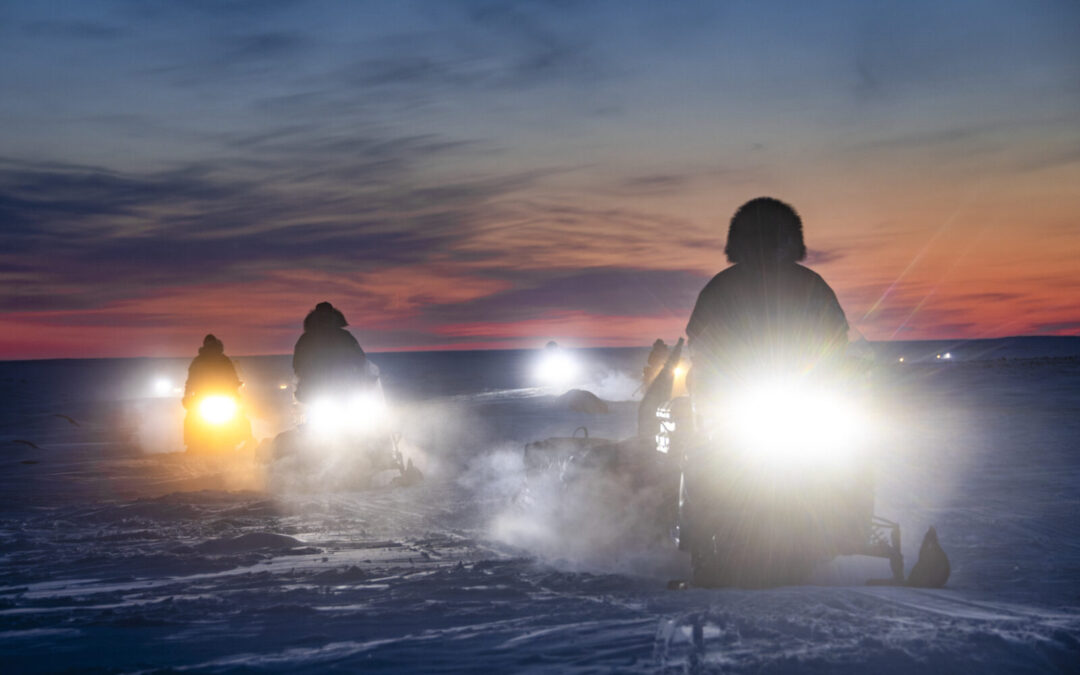
Mainville is the driving force behind the Canadian Ranger Enhancement (CRE) initiative, which Canadian Army Today first covered in Spring 2025. At that point, the program was still largely aspirational. A year later, the aspirations are becoming structure, the structure is becoming policy, and this past winter, on Operation Nanook-Nunalivut 2026, the Rangers of 1st Canadian Ranger Patrol Group (1 CPRG) completed the most ambitious sovereignty patrol the Canadian military has attempted in 80 years: a 5,000-kilometre long-range patrol screening the Northwest Passage from the Yukon-Alaska border to Churchill, Man.
Not everyone perceives the Ranger capability gap the same way. Lieutenant-Colonel Travis Hanes, commanding officer of 1 CRPG, noted that his patrol group has been routing information through Joint Task Force North (JTF-N) for years.
“I don’t know if that was necessarily true,” he said of the gap Mainville described. Hanes commanded the long-range patrol that combined Ranger ground truth with sensors from the RCMP, Parks Canada, Conservation Officers, Environment and Climate Change Canada, and Polar Shelf, transmitting the whole picture up to JTF-N.
Mainville doesn’t dispute it. His point is about the Canadian Armed Forces (CAF) side: The intelligence 1 CRPG was producing for JTF-N stopped there for the most part, and was never integrated into a pan-domain picture managed at Canadian Forces Intelligence Command (CFINTCOM) and shared with security partners.
That is one of the gaps the CRE is aiming to close. Hanes is quick to note that his model belongs specifically to 1 CRPG’s area of operations. Canada’s five Ranger Patrol Groups cover terrain so different in character—the High Arctic archipelago of Nunavut at one end, the mountains of British Columbia at the other—that no single operational template scales cleanly across all of them. Building a framework flexible enough to hold five genuinely different realities is challenging.
Mainville is committed to solving it through updated Soldat-Capteur training “that will be adapted with our security partners, and CFINTCOM is working on a framework to enable it,” he says.
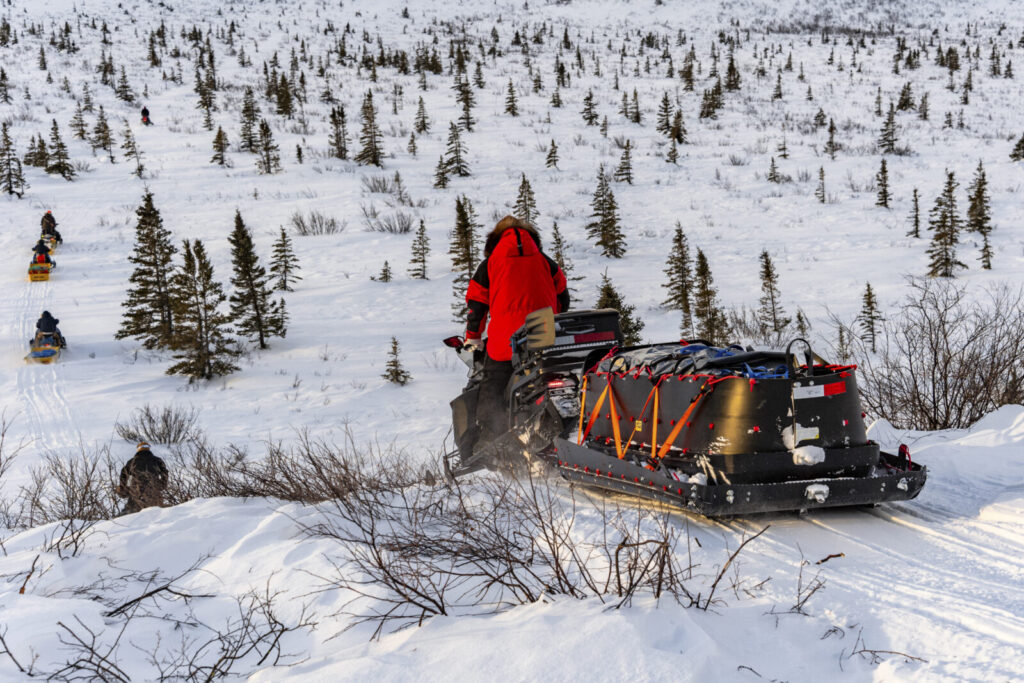
Members of 1 CRPG operate light over-snow vehicles on the long-range patrol during Op Nanook on Curtis Mountain near Fort McPherson, NWT. Photo: MCpl Antoine Brochu
Five Orphans Become a Family
As of April 1, Mainville’s directorate moved from an advisory function under the Army Commander to a formation-level headquarters under 2nd Canadian Division, which is itself transitioning into the Defence of Canada Division. All five Canadian Ranger Patrol Groups, currently reporting through four separate divisions, will now fall under a single Canadian Ranger Group.
“This takes us from five orphans to a family,” Mainville said.
The practical problem with orphans is inconsistency. A damage claim processed in days in one division becomes a financial investigation in another because the officer handling it has never seen one before. Equipment subsidies, training standards, and operational expectations all vary depending on which division a patrol group happens to fall under. A single formation creates, for the first time, a singular institutional voice for the Rangers inside the CAF. That alone is not a small thing.
Mainville will wear a dual hat in the new structure: commander of the Canadian Ranger Group, and strategic advisor on policy questions that are uniquely Ranger in nature. Policies, he notes, that have consistently been written for the first 100 kilometres from the border and historically fail the remote regions where the Rangers actually operate.
From out on the snow-covered ground, Hanes’s read on the new structure comes with caution. His concern is that the headquarters could layer itself between 1 CRPG and the JTFN relationships that make Arctic operations work. Access to 440 Transport Squadron air assets, contracting authority through a force employer rather than a force generator, JTFN’s connections to northern industry, the local airlines, the expedition outfitters, and the companies that actually know this terrain are key enablers. They are the infrastructure that made the long-range patrol possible.
“If it becomes more of an administrative headquarters, then I think it could be a huge benefit,” Hanes said. “But if it becomes something more like a traditional brigade, I don’t know how that’s going to work.”
Mainville does not dismiss the concern. But he explains that the Canadian Ranger Group Headquarters (CR Gp HQ) will be more than administration and policy. It will be responsible for force development, force management and force generation, while the Regional Task Forces will be the force employer. This is the same for all Canadian Army units. The headquarters will remove lots of the admin weights from the five CRPG, and it is intended to enable them to be more agile and responsive to operations.
Photo: DND
A Constitution Still Being Written
A Chief of the Defence Staff (CDS) directive on CRE, along with the related policy instrument DAOD 2020-2 Canadian Rangers, has been circulating in various forms for several years. The DAOD 2020-2 was submitted by the Army commander following extensive consultation in September 2022 and, as of April 2026, is still moving through approval channels. In parallel, a separate CDS directive on CRE—roughly seven pages in length—has also been in review for about four years.
Mainville concedes the reality of the situation: “These documents have taken a very long time to move through the system.”
It is also important to distinguish between the two streams. The DAOD 2020-2 represents the formal policy foundation for Canadian Rangers governance, while the CDS Directive on CRE is the operationally-driven implementation instrument. The CDS has, in fact, been notably proactive on CRE, issuing an initiating directive in May 2025 and planning an implementation directive in the coming weeks, without waiting for final DAOD approval.
Despite the administrative lag, the CRE team has continued to move. Equipment is being distributed, doctrine notes are being published, and the formation headquarters stood up on April 1 regardless of the directive status. “We’re progressing, assuming all these documents are blessed and good to go,” Mainville said, “because we don’t have any choice.”
Once fully signed, the CDS directive will do something the Army alone cannot: it will bind CFINTCOM, Canadian Joint Operations Command, Assistant Deputy Minister (Policy), and other Level 1 organizations to align behind CRE. Without it, the program’s influence remains limited to what the Army can directly control.
The policy gaps the directive addresses run deeper than paperwork. Without a medical standard for the Ranger position, even a baseline as minimal as “mobile, ambulatory, no clinical disability,” the CAF cannot medically release an injured member. Without that release, veterans’ benefits are off the table entirely. Rangers have no mandatory retirement age, and some continue operating into their late 60s, but the law governing death benefits was written without them in mind. A Ranger past 61 years loses a percentage of their coverage until they reach 69.
“So, the Ranger wants to go out,” Mainville said, “but if he goes out, he’s worth 20 percent of the life, because that’s the way the policy is drafted.”
What Mainville measures as success is a policy in development in the CR Gp headquarters that will help staff balance protecting administrative risks at the expense of operational risks. It will resolve a two-and-a-half-year fight over equipment damage liability if the CAF depends on a Ranger’s personal snowmobile or ATV to operate; the CAF will assume liability when that equipment is damaged in the line of duty.
“It sounds logical,” Mainville said. “It’s cheap, it’s economical, and it’s fair to the Ranger who brings his own equipment.”
The CR Gp headquarters will at least partially resolve this.
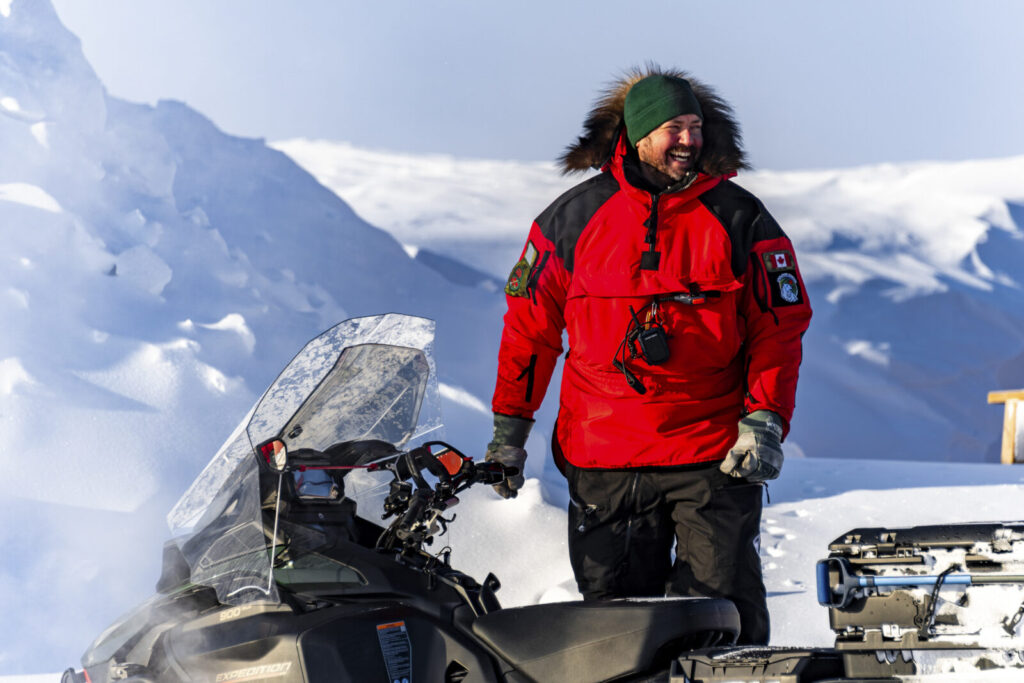
LCol Travis Hanes, commanding officer of 1st Canadian Ranger Patrol Group. Photo: MCpl Antoine Brochu
Being an Active Sensor
When Mainville sat down with Chief of the Defence Staff, General Jenny Carignan, in 2025 at a CR Advisory Group meeting, the CDS was direct. “I want them to be the active sensor. We have to enable them to become the sensor.”
That intent was built into Op Nanook-Nunalivut 2026 as a specific line of operation, with two distinct functions: active sensor tasking, in which patrols are directed to specific routes or infrastructure sites with defined reporting requirements; and passive sensor function, in which Rangers are briefed on what to watch for and climate change indicators, shifts in community patterns, and unfamiliar activity.
The distinction matters. What is new is not that Rangers haven’t been observing and reporting. It’s that the intent is now formalized, directed, and structured so that the whole institution can actually use what they see.
An Army doctrine note on Ranger operations was published in June 2025, formally establishing Ranger functions within the Army framework for the first time. A full doctrine document will follow. An addendum to the Army’s drone doctrine note is also in development. It will include how Rangers employ uncrewed systems in an operating environment defined not by traditional battle geometry but by cold, distance, and the maintenance demands of extended operations far from any base. Their relationship with these systems is simply not the same as that of a conventional unit’s.
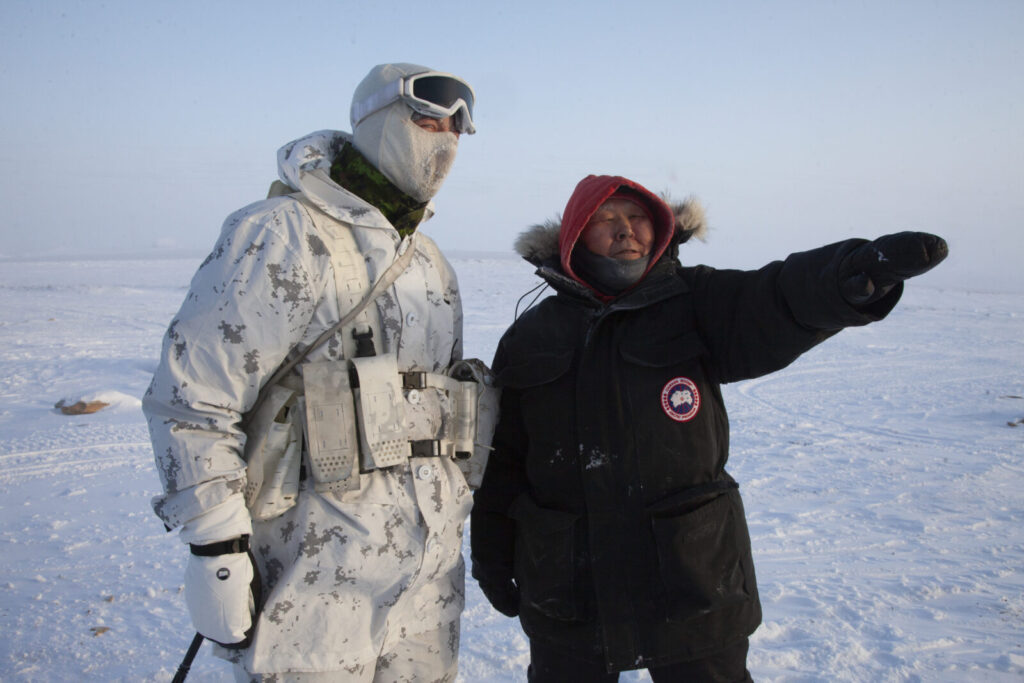
A member of the ARCG taking direction from a Ranger of the Cambridge Bay detachment of 1 CRPG during Op Nanook. Photo: Allan Joyner
Still Ahead for CRE
The Military Employment Structure, the foundational document that defines what a Ranger is at every rank, what skills are required, what equipment they rate, and how they develop across a career, is in its second year of a three-year development cycle. When complete, it establishes the administrative backbone that every other enhancement depends on.
However, Canadian Ranger Enhancement remains underfunded. The investment requested is significant at $200 million upfront, followed by $120 million annually. This covers the increased CR benefits, CR Clothing, CR Gp HQ, Strengthening the CRPG HQ, Increasing CR Training, communication and digitalization, drones and miscellaneous equipment, and infrastructure for training, storage and maintenance.
Mainville is also working to formalize equipment grants and low-interest loans for young Rangers who cannot afford the $30,000 snowmobile that effective Arctic operations require.
“If you’re a 21-year-old Ranger making less than $30,000 a year, you get maybe $5,000 in grants and a low-interest loan for the rest. You buy the equipment, you’re enabled as a Ranger, and you’re helping your community. You’re building national resilience,” he explained.
The CDS is fully on board, he added.
Photo: DND
A New Mindset
Asked what had actually changed for the Rangers in the past year, beyond equipment and directives, Mainville chose a word that wasn’t on the expected list.
“Mindset,” he said. “Sometimes there’s no document, there’s no directive, there’s nothing concrete. There’s just a smell. And the smell is that we are headed toward getting more attention in the Arctic.”
The Rangers have been promised a lot over 20 years. Mainville cited 14 directives since a Canadian Ranger Study was conducted in 2000, none of which delivered what an elder once described as the only honest measure of change: additional benefit for the Ranger. “All you have given us is more paperwork,” the elder told him. It is not a sentence Mainville has forgotten.
His measure of success is precise: Policy that streamlines administration, risk transferred from the Ranger’s shoulders to the CAF, benefits that give a young person in the North a reason to join and inject real money into communities that have been promised attention from the south before.
“The rest will follow,” Mainville said.