

By Maxime Leblanc
The Canadian Army is undergoing one of the most consequential transformations in its recent history. Unveiled in late 2025, Inflection Point 2025, the Canadian Army’s strategic modernization blueprint, confronts a frank operational reality: the Army we have is not the Army we need.
Central to this transformation is not only what soldiers fight with, but how they are trained. The Army is reorganizing for new divisional roles and preparing soldiers for an operating environment defined by dispersion, rapid technological change, and the constant pressure to be ready in a time and resource-constrained environment.
Training modernization should not be understood as a search for novelty, but rather as a practical effort to give soldiers more opportunities to learn, rehearse, and retain critical skills before they are tested in the field. Defence science work in this area increasingly points to virtual, augmented, and mixed reality as useful tools in that effort, especially when training must reach soldiers who are geographically separated from instructors, ranges, and specialized equipment.
Dispersed individual training—that is, training conducted by soldiers who are geographically separated from instructors, ranges, simulators, and collective exercises—creates a persistent tension between readiness and feasibility. A soldier at a remote base, unable to access a qualification range or a certified weapons instructor, is a readiness gap waiting to materialize.
Extended Reality (XR)—an umbrella term encompassing Virtual Reality (VR), Augmented Reality (AR), and Mixed Reality (MR)—is proposed as a solution to this gap. These technologies offer scalable and repeatable simulation experiences that, in principle, compress scheduling constraints and enable repeated deliberate practice without the logistical burden of live exercises.
Yet, as with any technology adopted under operational pressure, the imperative to move quickly must be balanced against the obligation to move wisely.
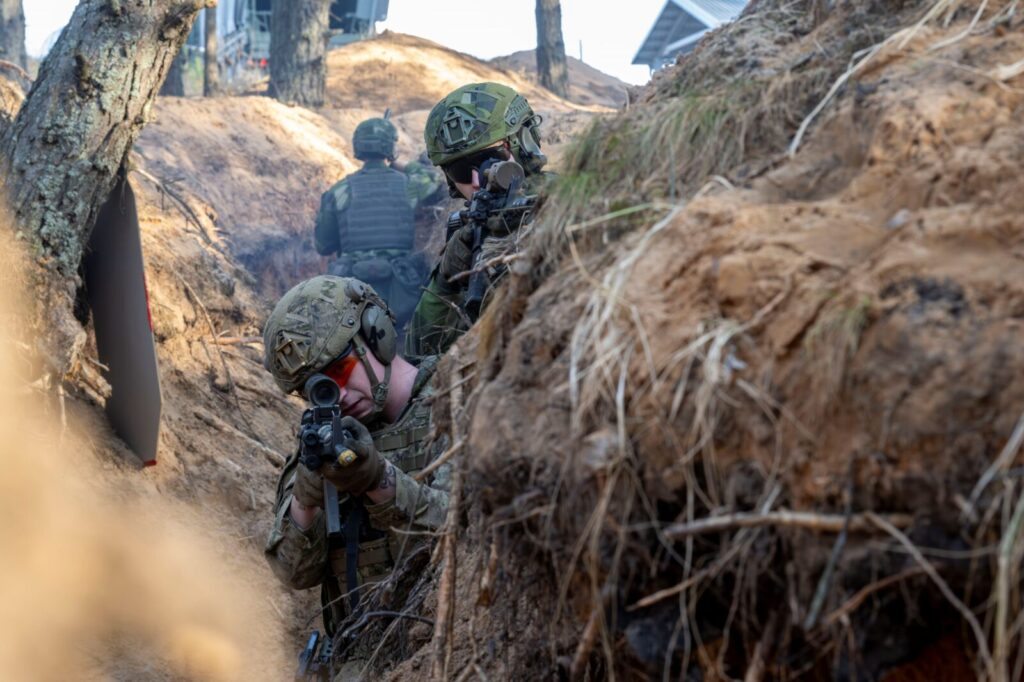
Members of 2 RCR and the Swedish Army conduct joint trench clearing training in Latvia in March 2026. Photo: Cpl Raj Dhagat
Blended Training
The strongest case for immersive training appears in tasks that are procedural, physical, or both. When soldiers need repetition and to make decisions under time pressure, simulation can create useful learning opportunities without waiting for the next available range or large exercise. It is particularly well suited to building familiarity and reinforcing sequences prior to confirming one’s skills in live exercises.
That does not mean, however, that every task should migrate into a headset. Research on simulator-enabled training shows that some skills transfer well, while others depend heavily on cues that are difficult to reproduce fully in synthetic environments, such as: recoil, depth perception, timing, stress, environmental conditions, and interaction with real equipment.
The broader pattern in the evidence from meta-analysis work conducted by the Canadian Army Operational Research and Analysis Team (CA ORAT) suggests that simulation can indeed reduce reliance on live ranges and help trainees build the necessary fundamentals, but it works best as part of a blended curriculum of training where soldiers train in both live and simulated environments together.
In the example of small-arms training, synthetic training environments cannot yet completely simulate the physical demands of shooting, meaning that live-fire remains essential for validation and confirming that simulator performance reflects genuine readiness rather than familiarity with a digital tool. That lesson applies far beyond marksmanship.
The Army should not ask whether synthetic training can replace live training in the abstract but rather ask which parts of a skill can be learned well in simulation, which parts still demand live confirmation, and how the two should be combined to produce the best result with the time available.
Retention Gap
What remains consequential is not what is known, but what remains unmeasured. Skill retention and long-term transfer are consistently identified as important in the literature yet are insufficiently measured longitudinally. Studies examining XR flight training, confined-space procedural training, and marksmanship all report short-term performance outcomes but do not track whether those gains persist weeks or months after training concludes.
If XR accelerates skill acquisition but does not prevent skill fade (a plausible outcome for tasks requiring regular live practice to sustain), then the Army may be trading one readiness bottleneck for another.
Dispersed training strategies often implicitly assume that on-demand, repeatable XR practice will improve retention; that assumption should be treated as a hypothesis requiring longitudinal validation, not an established fact.
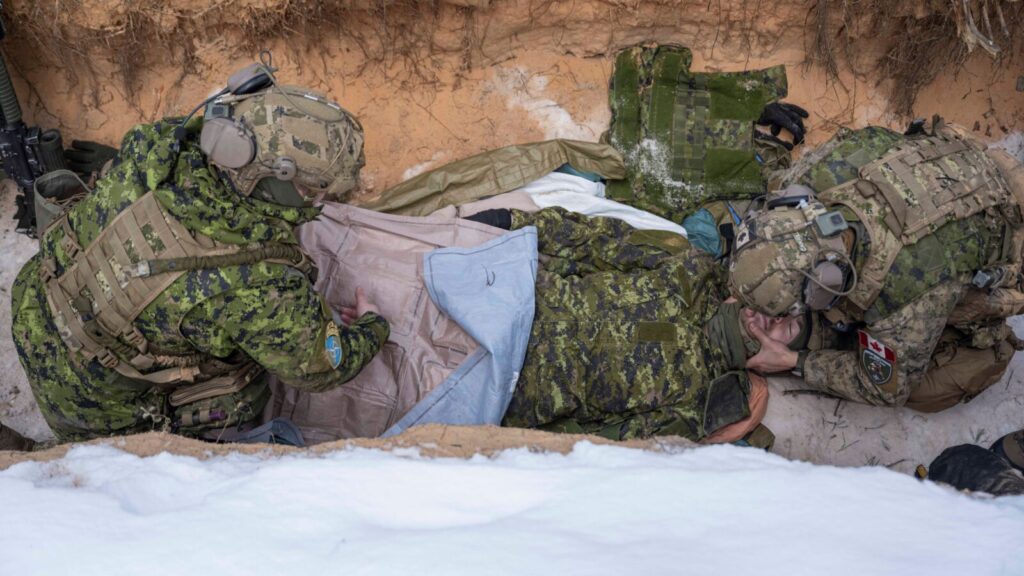
Students on a Tactical Combat Casualty Care Course in Latvia in January 2026. Photo: Cpl Peter Grieves
A Path Forward
The Army’s modernization agenda rightly identifies technology integration as foundational to the future force. The Canadian Armed Forces (CAF) is already advancing this agenda through projects which integrate live, virtual, and constructive training methodologies. VR and MR are enabling technologies that, when applied strategically, offer scalable, cost-effective, adaptive, and real-time-trackable training outcomes (provided they align with CAF Qualification Standards and operational objectives).
The opportunity now is to build a training system that is both modern and disciplined. That means using immersive tools where they expand access, increase repetitions, and improve feedback; preserving live training where realism and validation are essential; and treating training modernization as a readiness problem rather than a technology project.
For the Army, the promise of training modernization is real. Virtual and extended reality can help the force train more often, in more places, and with better use of scarce time and resources. But their greatest contribution will not come from replacing the fundamentals of Army training. It will come from helping the Army deliver those fundamentals more intelligently across a dispersed and increasingly demanding operational landscape.
Maxime Leblanc is a defence scientist with Defence Research and Development Canada (DRDC)’s Centre for Operational Research and Analysis (CORA) and a member of the Canadian Army Operational Research and Analysis Team (CA ORAT) embedded with the Canadian Army. The views expressed reflect the author’s own research findings and expertise and are not official positions of DND/CAF.

I was hoping to read about a scalable dispersed mobilisation strategy across Canada. Along the lines of Admiral Topshees’s Naval divisions based scheme. Unfortunately the article is a buzzword salad. The Canadian Army must step up and meet this moment with out of the box thinking. Hopefully they will, soon.