

by Allan Joyner
The Canadian Army is currently absorbing new equipment and capabilities at a pace that would have seemed extraordinary a decade ago. Drones, advanced sensors, upgraded Arctic kit—the hardware is showing up. The challenge now is ensuring that how the Army thinks, trains, and fights evolves quickly enough to make effective use of them.
Investments in new equipment and capabilities also demand reinvestment in the Army’s intellectual foundation. That work falls largely to the Canadian Army Doctrine and Training Centre (CADTC) in Kingston, Ont. Within CADTC two organizations—the Army Lessons Learned Centre (ALLC) and the Army Doctrine Centre (ADC)—play a central role in accelerating how the Army learns, adapts, and institutionalizes change.
Chief of the Army Lessons Learned Centre, Lieutenant-Colonel Stephen Rankin, and Chief of the Army Doctrine Centre, Lieutenant-Colonel Paul Marois, are candid about the strain their organizations are under. The pace of change consistently exceeds available capacity. Rather than downplaying that reality, both officers argue it makes change unavoidable. Their focus is on reworking processes, tools, and relationships so that lessons and doctrine move faster, stay relevant, and better support the force.
“Unquestionably, our Army is learning,” says Rankin. Recent doctrine publications on Counter‑Uncrewed Aerial Systems and Robotics and Autonomous Systems, along with ongoing modernization efforts, reflect that progress. The question, according to Rankin, is whether its learning fast enough. The ALLC is focused on ensuring that the Army has the institutional processes in place to learn faster than its adversaries.
ALLC is not short on observations. With ongoing conflicts in Ukraine and the Middle East, a high operational and training tempo, and rapid industry innovation, there is a constant flow of lessons observed. The challenge is ensuring that those are deliberately transitioned into lessons learned.
This happens in two ways. At the tactical and unit levels, formations adapt standard operating procedures in response to changes in the operating environment. This represents localized learning. The Army’s broader objective, Rankin explains, is institutional learning, embedding those insights into concepts, doctrine, and training so they shape the force more widely.
To support that effort, the ALLC collects observations from a broad range of sources, including current conflicts, allied reporting, academic and think‑tank research, and Canadian training exercises. Those inputs are then organized and distributed through two pathways.
The first pathway is dissemination of raw observations directly to the field force via Army Lessons Learned Centre Insights, a bi-weekly email aimed at putting observations into the hands of junior leaders as quickly as possible. The second pathway supports institutional change, with trends and issues passed to subject‑matter experts for deeper analysis.
This is described as the difference between information and intelligence. Information needs to be pushed out to the field force as quickly as possible. With intelligence, a more deliberate effort is required—looking for trends to inform deeper analysis in support of future concepts and adaptations to current doctrine.
Rankin is clear that the work is ongoing. Exploring new distribution methods and digital tools remains a priority, and progress has not closed the gaps entirely. That effort, Rankin notes, is closely linked to the ADC, which takes the learning identified by the ALLC and turns it into authoritative guidance for the force.
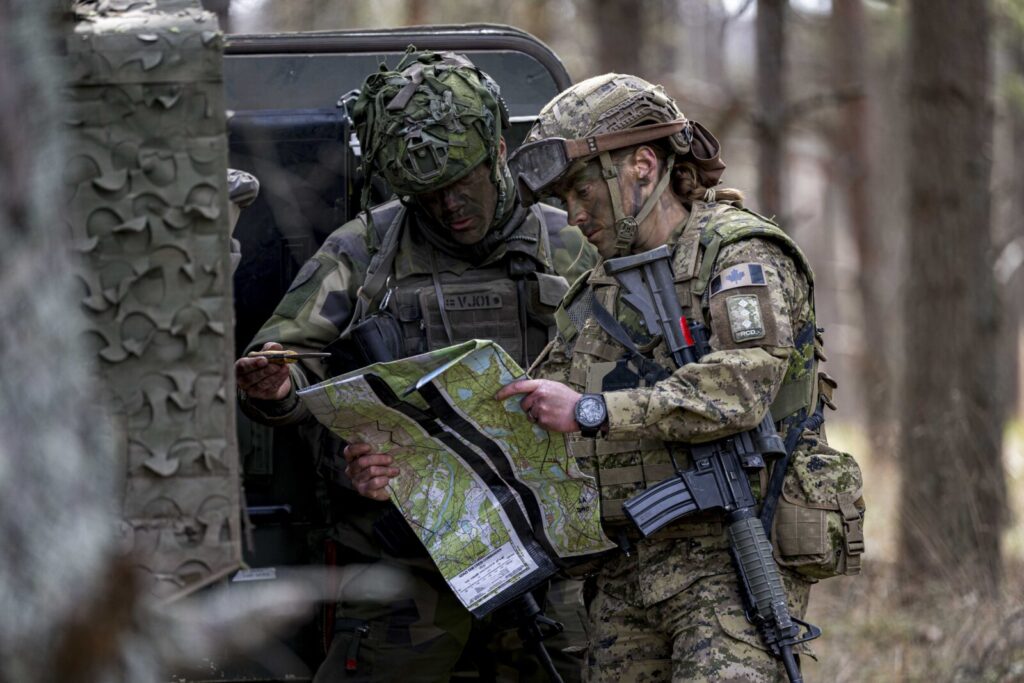
Canadian and Swedish soldiers coordinate during Mission Rehearsal Oak Resolve, Latvia, April 2026. Photo: Cpl Peter Grieves
The Meaning of Transformation
Doctrine represents the Army’s institutional wisdom. Marois, now in his second posting to the ADC, has returned with a clear intent to drive necessary changes. He is thinking carefully about what modernizing doctrine actually requires, and whether modernization is even the right word.
He describes his approach across three areas: getting publications out faster and in formats soldiers will use; investing in digital tools that make doctrine searchable in ways suited to how people look for information now; and rebuilding the communication link between the doctrine centre and the field force. Of the three, the last may matter most. It has also been fraying the longest.
On credibility, Marois is direct. “We have suffered a credibility issue with our doctrine.” Some publications carry date stamps that undermine a soldier’s confidence before the first paragraph is read. In a period of rapid capability introduction, that is not simply inconvenient.
To bridge the gap between what new capabilities demand and what formal publications can deliver, Marois has directed his staff to increase use of the Doctrine Note, a shorter, faster publication produced in one to three months rather than years. A recent Robotics and Autonomous Systems Doctrine Note developed with heavy input from the ALLC and drawing on experience from Task Force Unifier in Latvia is the current example. Doctrine at speed. Not the comprehensive publication the subject eventually warrants, but a credible and timely anchor while that larger work moves forward.
Marois agrees that transformation is a more honest term than modernization. “Modernization is kind of the buzzword that is easy to use.” The distinction matters in practice. Modernization implies upgrading what exists. Transformation means rethinking how you work. Marois is doing both simultaneously, and he is clear-eyed about which one is harder.
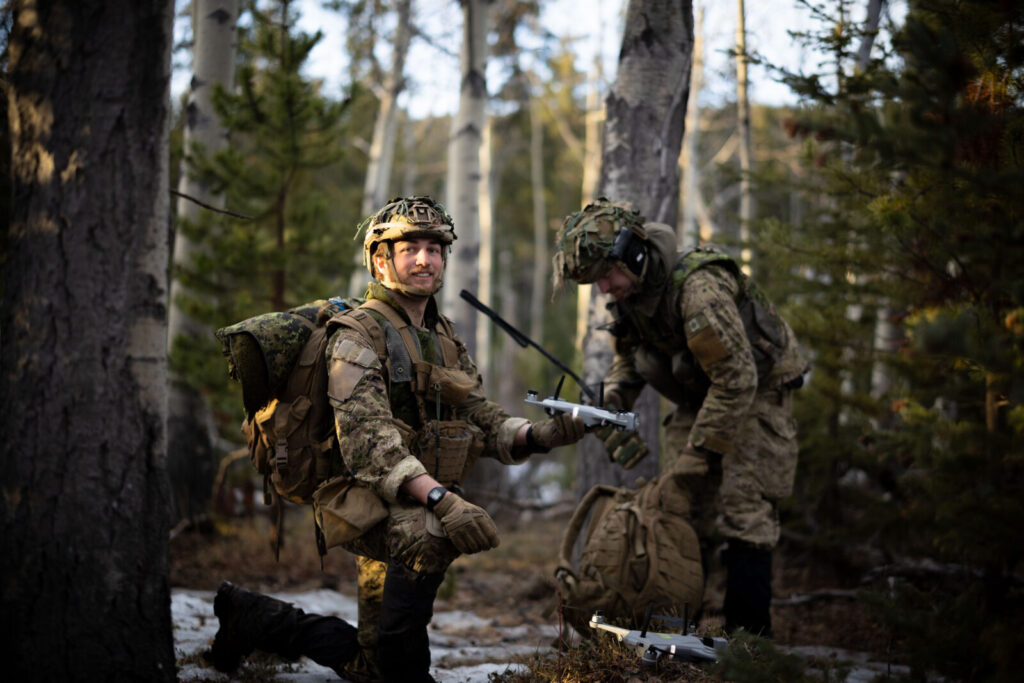
Members of 1 PPCLI launching a TEAL-2 drone during Ex Cougar Fortress in northern British Columbia, March 2026. Photo: Bdr Daniel Pereira
Pipeline from Field to Publication
The relationship between the two centres is deliberately structured. The ALLC is the intake arm. When something comes in from the field, from allies, or from open-source analysis of what’s unfolding in Ukraine, it flows first through Rankin’s centre where it is collated and organized. It is then quickly passed to Marois’ team to determine where gaps might exist within current doctrine. Fast-moving cases go into a Doctrine Note, more complex ones work into the larger publication cycle.
For the pipeline to function, both ends need to stay connected to the field force that’s generating the raw material. Rankin notes that the rapid distribution of drones and other emerging technologies across units is already creating opportunities for soldiers across trades to experiment, adapt, and in so doing generate lessons for the Army. The infantry will use these systems differently from the armoured corps, and both will use them differently than the artillery. That variation is where the value lives.
Marois has been taking the effort to communicate seriously, in ways that might surprise people who associate doctrine with dusty binders. Rather than assuming future leaders will absorb doctrine on their own, he has been taking it directly to them—engaging technical staff students at the Royal Military College and planning regular briefings for every Army Operations Course serial at the Canadian Army Command and Staff College. The intent: making doctrine a two-way street, not just pushing information out, but making clear that the field force’s input is wanted and valued.
Staffing Problem That Money Alone Cannot Fix
Both officers are working within a Canadian Army that is, by its own frank admission, short of experienced people at the levels this work most demands. Effective doctrine and lessons learned work requires a specific combination of operational experience, institutional familiarity, and the analytical depth to recognize which lessons transfer and which don’t. Rankin knows that a budget line cannot produce that on short notice.
“You can’t just knit new people,” he stresses. In a recent example, when his centre identified the need to stand up a new Robotics and Autonomous Systems Office of Collateral Interest, to bridge top-down unmanned aircraft systems (UAS) development work with the bottom-up innovation happening at the unit level, he had to find the people from within his existing resources.
Fortunately, new government investment in defence is beginning to change the picture. But as Rankin observes, funding solves the budget problem. Not the experience problem.
“It’s going to be a deliberate process,” he says of rebuilding the force’s depth. “It won’t be slow, but it’ll be deliberate.”
Whether the pace of learning and doctrine development can keep up with the pace of procurement is the key question, and it’s clear that both men understand that ensuring it does is the mission of their teams.
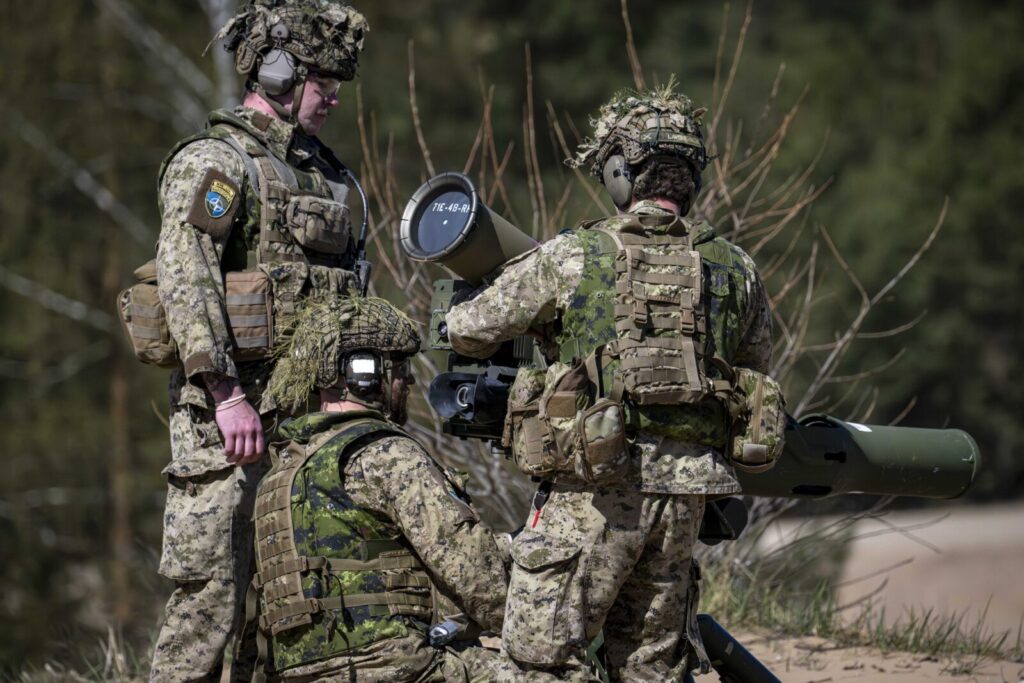
Firing on the Multinational ATGM range, Latvia, April 2026. Photo: Cpl Raj Dhagat
Enabling the Force
Near the close of his interview, Marois was asked what the current moment means to him after 30 years in uniform. His answer was not institutional.
“Seeing that investment now, it is absolutely amazing. It provides me such great hope for our younger soldiers and officers and what we’re going to be able to provide them.”
He returns, as he tends to, to doctrine’s fundamental purpose: “I really want doctrine to be a key component of that, to enable them, so they feel like they can go on operations, and they know what they’re doing.”
After three decades of watching the Army cycle through underfunding and institutional drift, he reads as genuine. The Army is getting new tools. The hard work that is being done at CADTC is making sure every soldier who picks one up understands what to do with it.