

by Chris Thatcher
It’s still early days, but if the Canadian Modular Assault Rifle (CMAR) is any indication, the newly created Defence Investment Agency (DIA) is already having a noticeable impact on defence procurement.
Within five months of the agency’s official launch in October 2025, the project to replace the Army’s C7 and C8 assault rifles was among a handful announced in the weeks after the federal government unveiled a Defence Industrial Strategy in mid-February.
To be fair, staff from the Directorate of Land Requirements (DLR), Assistant Deputy Minister (Materiel), Public Services and Procurement Canada (PSPC), and Innovation, Science and Economic Development (ISED) had invested several years of work on the project prior to its transfer to DIA.
CMAR also benefitted from its alignment with the Munitions Supply Program (MSP), a long-standing contracted arrangement with several manufacturers of ammunition and small arms, which reflects the type of long-term strategic partnerships the government is seeking to establish with industry.
Still, the way it was fast-tracked to contract with Colt Canada suggests a new way of doing business.
“The ability to speak with the company early, ask them questions, and get into the details allows for focused effort, improved decisions on procurement strategies, and a much-reduced timeline to get to contract,” observed Lieutenant-Colonel Benjamin Lafave, the Army’s capability advisor to the DIA.
“[CMAR] wasn’t starting from scratch. As the MSP was already established, we were able to talk with the company about what they could provide, what type of contract could be developed, and work towards a solution. The fact there was already an established structure for those conversations, with a legal framework and route for contracting, it really did support moving CMAR faster.”
The DIA was created to modernize and streamline Canada’s defence procurement, part of the Liberal government’s commitment to increase defence spending to meet NATO’s five percent Defence Investment Pledge by 2035 and deliver strategic economic value from the defence sector.
With the Defence Industrial Strategy (DIS), a document long sought by industry and a vital component in the DIA’s ability to meet its mandate, the government set ambitious targets: Over the next 10 years, it aims to grow the number of defence contracts awarded to Canadian companies from the current 43 percent to 70 percent, increase exports by 50 percent, invest more in defence-related R&D, and encourage and accelerate procurement of Canadian innovation to ensure Canadian control over intellectual property.
Lafave was among an initial group of seven Canadian Armed Forces (CAF) members who, when offered the opportunity to help reform procurement, eagerly packed up laptops and relocated to a new building in late September 2025, even before the DIA was officially opened.
As the Army’s capability advisor, the two-year secondment from DLR places him as a guide to the Army’s modernization plans and a liaison between Army and DIA leadership. As such, he attends project meetings under both the Chief of Staff Army Strategy (COS A Strat) line of governance and within the Procurement Branch of DIA, a necessary division of time to stay abreast of project priorities and reflect to the DIA where Army projects are encountering roadblocks and would benefit from DIA authorities and processes.
“There have already been initial authority and procedural changes that enable DIA to accelerate procurement. The way we are doing business here is already better than it was,” said Lafave. “But we still need to keep improving, and there are a lot of changes still to come … this is an iterative process of improvement.”
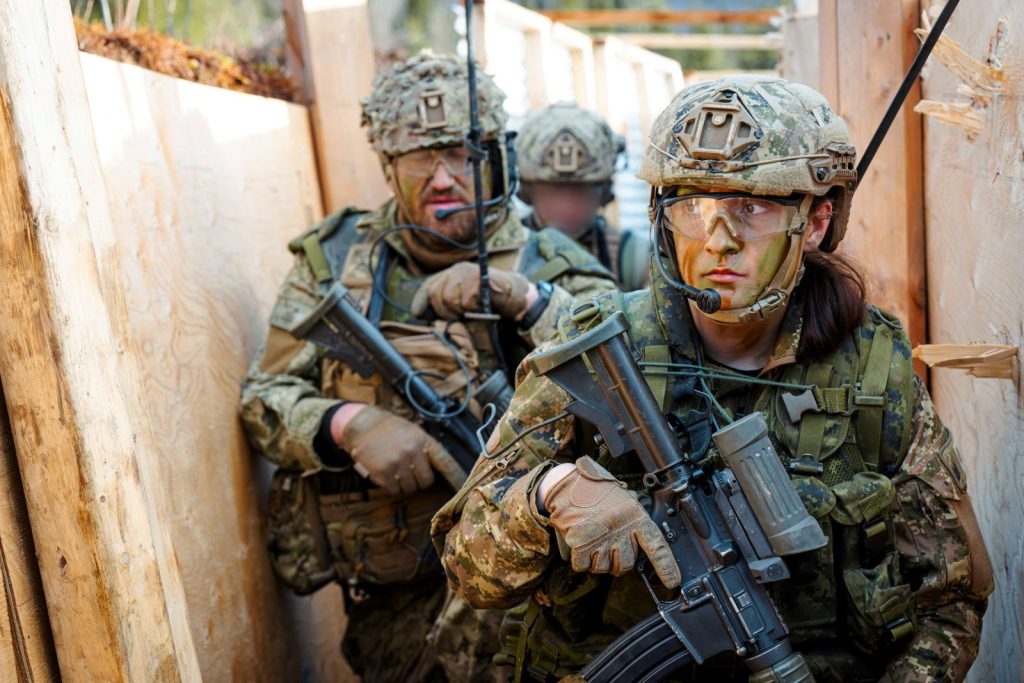
Members of 1st Battalion, Royal 22nd Regiment during an assault on a trench as part of Ex Maple Resolve in Valcartier, April 2026. Photo: Cpl Liam Stagg
While no Army project was listed among the initial eight posted on the DIA website, there are several among the over 30 projects held at DIA. Beyond CMAR, Lafave could not speak to any specifically until they are announced, but acknowledged the four-plus-one priorities of Army Commander Lieutenant-General Michael Wright—ground-based air defence, long-range precision strike, indirect fire modernization, and domestic Arctic mobility, plus C5ISRT (command, control, communications, computers, cyber, intelligence, surveillance, reconnaissance and targeting).
Wright’s consistent voice, both publicly and privately, on those priorities has been important in establishing focus for land procurement within DIA, he noted.
The DIA has contracting authority on procurement contracts above $100 million, but there are several factors also affecting how projects are being identified, including their priority for service commanders, the urgency to get capability into active theatres, and operational risk.
While meeting CAF requirements remains a primary procurement objective, alignment with the three pillars of the DIS—build in Canada, partner with allies, and buy from abroad when required, underpinned by industrial and technological benefits—will be an important factor. So, too, is the viability of a potential strategic partnership.
The DIS is a big part of every discussion, and DLR can relay through DIA the strength of the Canadian supplier base for a particular capability, said Lafave.
“Better communication between the many players in the procurement process, from DLR to DIA, and all those involved throughout, is helping the overall team to understand the environment within Canada, including the industrial base that exists for a particular type of capability,” he said.
“Improving communication and having detailed conversations earlier on is a focus of DIA, to develop those better integrated teams. This allows earlier consideration of all the factors and can allow more effective decision-making on procurement strategy, focusing efforts and leading to accelerated schedules.”
The process is being aided by a risk-based approach. Adopted during COVID to speed up the acquisition of vaccines and personal protective equipment, it means that “if a project has got the three authorities that it needs to move forward—project authority, spending authority, and contract authority—and it is medium risk or less, we only have to go to the Treasury Board once,” explained Steve Fuhr, Secretary of State for Defence Procurement. “As long as we stay within the budget of the program, we don’t have to go back and forth to the Treasury Board every time we hit a project milestone.”
What used to take potentially months of shuttling among Treasury Board and other departments has, in one case so far, been completed in as little as 30 days, added Lafave.
The change from risk aversion to risk management will reduce the multitude of reviews project documents receive. Where possible, the DIA is also looking to complete project steps in parallel rather than sequentially, foregoing the typical waterfall approach of finishing one process before starting the next.
Converging procurement expertise and resources under one tent should also lesson the risk of misunderstanding and miscommunication. Lafave noted a visible “mental shift” among those assigned to the DIA team. Where connecting with someone in another department might have required using lengthy chains of communication and writing formal documents or emails to get information, it is becoming, “why don’t we call them and just have that chat?” he said.
“While those chats were happening before amongst certain teams, we are taking one more step in the direction of having improved dialogue at lower levels so that we can get everyone on the same page early and work together on procurement solutions.
“When there are disagreements on the way forward, the increased dialogue will still improve the understanding of the other side’s point of view,” he added, “so that when the leadership gets together to discuss the differing opinions or recommendations, they can be better informed and prepared to address the concerns of those around the table, converse on risks, and reach decisions.”
The framework for the DIA and its authorities will be further refined over the next few months, and change will be a constant for the near future, as it will take time and be iterative in nature, Lafave cautioned. Nonetheless, he sees a real sense of urgency and commitment within the DIA, as well as already increased authorities and improved processes supporting Army requirements and defence industry engaging on Army projects.

This is good news. We have much ground to make up.
Seeing is believing.