


by Ken Pole
As the Canadian Armed Forces (CAF) plans for a world the 2025 federal budget calls “more volatile and dangerous . . . than ever,” the military is in the throes of what the government terms “generational investment” in an array of new technologies. One part of its response is the procurement of some 65,000 new rifles, mostly for the Regular Force, with some destined for the Primary Reserves as well as the Royal Canadian Air Force and the Royal Canadian Navy.
The Army’s answer is the Canadian Modular Assault Rifle (CMAR), an evolution in Colt Canada’s combat-proven family of compact gas-operated select-fire carbines currently in service as the C7 and C8. Introduced in 1984 and now arguably well past its best-before date, the C7 is supplied to the Regular Force while the shorter C8 is better suited to close-quarters operations.
The CMAR is based on Colt’s Modular Rail Rifle (MRR), which replaces old-school accessory mounting rails with M-LOK slots designed by Magpul Industries. Headquartered in Texas, with production facilities in Wyoming, privately held Magpul released its patented design in 2017 for use by other manufacturers.
(Magpul takes its name from its first product, a Magazine Puller which makes reloading from pouches faster, a life-or-death factor in combat. It was developed after most NATO members standardized the 5.56 x 45-millimetre round for their rifles, enabling in-theatre ammunition and magazine sharing between allies.)
This approach remains a key element of the project, confirmed Captain Pedro Cruz Duarte, the Army’s current CMAR project director.
“We’ve been looking at what our allies are using — as well as our adversaries,” he said. “Our C7s and C8s are obsolete and we need to improve optics, rifle precision, accuracy, etc. Many of our allies are buying off-the-shelf as well, so we’re picking their brains. We’re communicating with them and making sure that we’re aligning ourselves with a system that will be not only effective with our Canadian soldiers, but will also be interoperable with our NATO allies.”
In addition to affording shooters more versatility in the accessories they use on specific missions, the M-LOK also is lighter than traditional rails — a significant benefit for increasingly burdened dismounts.
Unlike previous monolithic designs, the barrel is only as thick as is needed to permit the rifle’s gas block to trap the gas from a fired round and direct it through a tube to the bolt carrier, which uses the pressure to eject the spent casing and chamber the next round. Current rifles can cycle at a rate of 750 to 900 rounds per minute (rpm) in fully automatic mode, but are limited to an actual 15 rpm at a sustained rate of fire. In semi-auto mode, which depends on how rapidly a shooter can pull the trigger, it can increase up to 65 rpm.
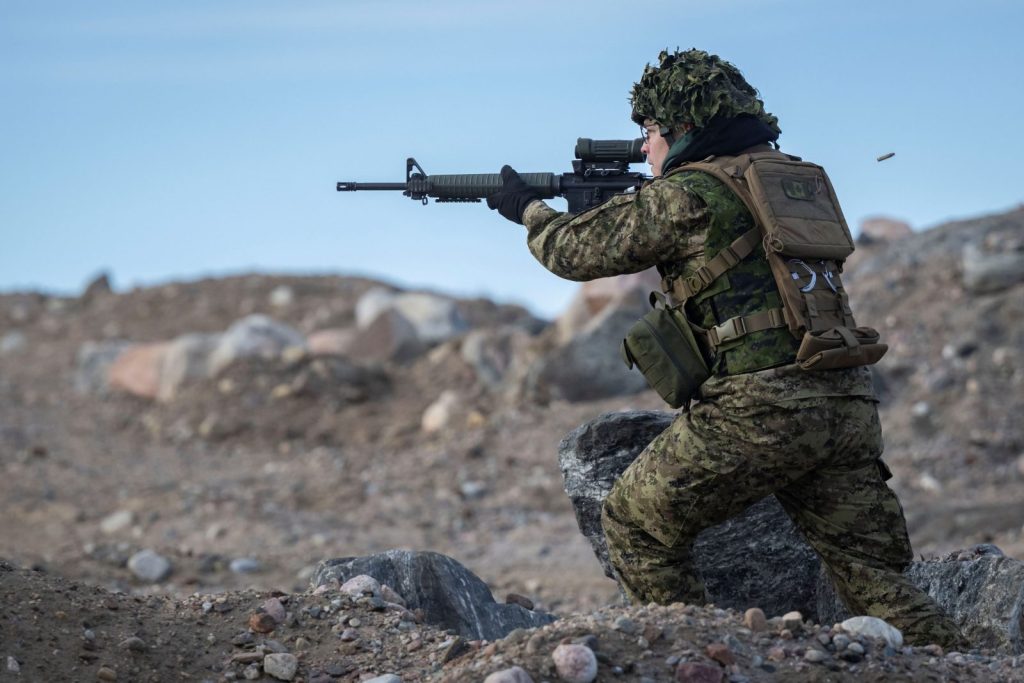
Cpl Joshua Bedard of Land Task Force Nunakput, armed with a C7 automatic rifle, advances on a target during live-fire training held at an austere range located near Pond Inlet, Nunavut in September 2025. Photo: Sgt Alana Morin
The legacy rifles will be replaced on a one-for-one CAF-wide basis. The current delivery schedule prioritizes deployed personnel, notably the 2,000 or so in Latvia under Operation Reassurance, which includes the Canadian-led multinational brigade, part of the largest reinforcement of NATO collective defence in a generation.
Cruz Duarte confirmed that “initial operational capability would be reached when all rifles, ancillary equipment, and ammunition is provided to at least one deployable unit,” but he was unable to discuss the broader delivery plan.
The Montrealer’s seven years and counting with the 1st Battalion, Royal 22nd Regiment — the storied Van Doos who are the largest regiment in the Army — included six months in Ukraine on Operation Unifier, the Canada-France initiative to train thousands of Ukrainian troops after Russia annexed Crimea in 2014.
When Cruz Duarte returned to Canada, he spent a year at Royal Military College in Kingston, Ont., on technical staff qualification, which saw him posted in 2024 to National Defence Headquarters where he began working with Major Carl Gendron, the long-time head of the Small Arms and Light Weapons Team.
“We’re still working in close partnership with Colt Canada, looking mostly at the precision of the barrels and testing their endurance,” Cruz Duarte said. “We’re also looking at the endurance and the noise reduction of the different suppressors we have in sight, as well as testing the trigger systems.”
Another key element under review, also in collaboration with Colt, is ammunition: whether the current 5.56x45mm round is “the right solution” for the future.
“As of now, it’s our option,” he noted. “However, we’re open to finding something else, so we’re also testing other ammunition to see if we can still get the required precision at the increased range of the rifles.”
The U.S. Army has been pushing a 6.8mm rimless bottlenecked cartridge, but Cruz Duarte said the CMAR team is not convinced because of the changes it would require on the legacy design’s magazine, barrel and other critical elements.
“We’re very comfortable right now with the 5.56,” he replied. “When it comes down to the actual punch and the precision, the 5.56 is what we’re going for.”
The plan is that once a contract is signed with Colt Canada, likely in 2027, it will be procured as an all-inclusive package. “We see it as not only a rifle, but as a system with all the optics, ammunition, magazines and training, etcetera,” Cruz Duarte said.
One of a group of companies owned by Colt CZ Group SE in the Czech Republic, Colt Canada is the exclusive supplier to the CAF and is the government’s Centre of Excellence for Small Arms. Once the contract is signed, it will have to approach other manufacturers for various pieces of equipment.
Cruz Duarte acknowledged that the rifle replacement program has been in the works for some time — not uncommon in Canada’s historically convoluted procurement process — but did note the government’s announcement of a Defence Investment Agency (DIA) in early October. Its stated goals are “centralizing expertise, cutting red tape and streamlining decisions” to ensure “faster delivery of critical equipment.”
“There seems to be more appetite to fast-forward some projects,” he said. “CMAR is one that is in the crosshairs to be accelerated.
“At this point, there are still ongoing discussions about the project and funding authorities, but we are 100 percent sure the rifles will be procured through a direct acquisition approach.”

Interesting article, always great to see copy by Ken Pole!
Cheers,
As an avid shooter, I do think the military should consider outfitting platoons with more than one cartridge. The older 7.62 and 5.56 are good old cartridges but the 7.62 becomes heavy to carry much ammo and the 5.56 will have problems penetrating armored enemies unless it is upgraded. I hope the military can at least allow for a switch barrel system to step to a more modern cartridge. I would like to see the lighter cartridge pushing 85-110 grain bullets and the 7.62 stepped down to a cartridge with more range and perhaps lighter weight. 125-140 grain bullet.