

by Chris Thatcher
Training with equipment you might one day deploy with seems a given, but at times it has been an issue for members of the Army Reserve.
That was apparent to Major Saajan Sarai, Operations Officer for 39 Signal Regiment, following a rotation in Latvia with 2 Canadian Mechanized Brigade Group Headquarters and Signal Squadron (2 CMBG HQ & Sigs Sqn) to support battlegroup communications and information systems as the Army transitioned to a brigade tactical network.
Posted to the Vancouver-based Regiment on his return, he noted the incompatibility between Reserve radios and the Integrated Soldier System (ISS) suite and TAK-enabled devices now being deployed by Regular force dismounted troops. With more reservists from 3rd Canadian Division in the pipeline to deploy, that raised a red flag.
In Latvia, he had helped train signallers to both operate and support the ISS and TAK (Android Tactical Assault Kit) on a local TAK server, but the new technology and its enhanced situational awareness systems were not well understood among the reservists.
Sensing an opportunity to build familiarity with the systems, he connected with Jim Peter Safar, president of Inter-Op Canada, a company based in Ste-Anne-de-Bellevue, Que., focused on next-generation tactical communications.
The two had met during Inter-Op’s participation in the experimentation conducted by 2 CMBG HQ & Sigs Sqn between 2022 and 2024 in Petawawa, Ont., to construct a dispersed yet connected command post with a resilient command-and-control structure. Inter-Op had provided new Trellisware radios with the TSM waveform and Safar suggested a similar trial with the Reserve.
Reserve units are often the federal government’s manpower response to requests for assistance by provinces when natural disasters strike. In recent years, members from across the country have battled wildfires, stemmed flooding, and helped communities after hurricanes and snow and ice storms.
Communications, especially during intense forest fires in remote locations, has been degraded or nonexistent, a critical deficiency when trying to track soldier locations and remain connected while working alongside government agencies and other first responders.
Beyond building familiarity with a system reservists might one day use and/or support, Sarai saw an opportunity to test and teach soldiers about the new systems in a natural disaster scenario with which many are all too familiar.
In 2018 he deployed with the 3rd Battalion, Princess Patricia’s Canadian Light Infantry, as their signals officer, when 2,115 fires ignited across British Columbia, burning 1.35 million hectares.
“We had zero comms with BC Wildfire Service, zero comms with the RCMP,” he recalled. “We had points of contact—cell phones—but we were mostly in the dark in terms of where our troops were. And in that mountainous terrain, cell signals were not good. We didn’t have TAK then. We’ve made a lot of strides since, but in 2018 it was a huge communications challenge, a huge common operating picture challenge.”
Multi-Agency Sensor Fusion
In late February, with approval from Army headquarters and some supporting funding to conduct an experiment, Sarai launched a trial with 39 Canadian Brigade Group (CBG) during Exercise Cougar Ready with prototypes of the Trellisware 750 radio and TAK-enabled phones and tablets.
Interoperable with the Army’s ISS suite, the radio has “a built in Wi-Fi and a belt holster, so reservists can have their headset connected to their radio, and then use the Wi-Fi on their TAK device,” he said. “In a cellular degraded zone, if you have Starlink [satellite internet service] in your company vehicle, and you have a link to the TSM integrated radio, you can get some network coverage to your edge user.”
“Essentially, we had TAK end user devices, we had Starlink within the brigade, but we didn’t have a way to merge those two capabilities. That’s where the Trellisware 750 radio came in.”
The technology quickly proved its value in a range of training scenarios, but it only gave the brigade a one- to two-kilometre range for most data sharing, depending on the density of the vegetation they were traversing.
“It’s a force multiplier in terms of coverage, just because it uses a UHF S-band and L-band signal,” he explained. “The pro of these high-frequency signals is that they can send a lot of data, which means you can share video, you can share pictures. But they get a lot of interference with terrain, and they don’t punch through as much as VHF.”
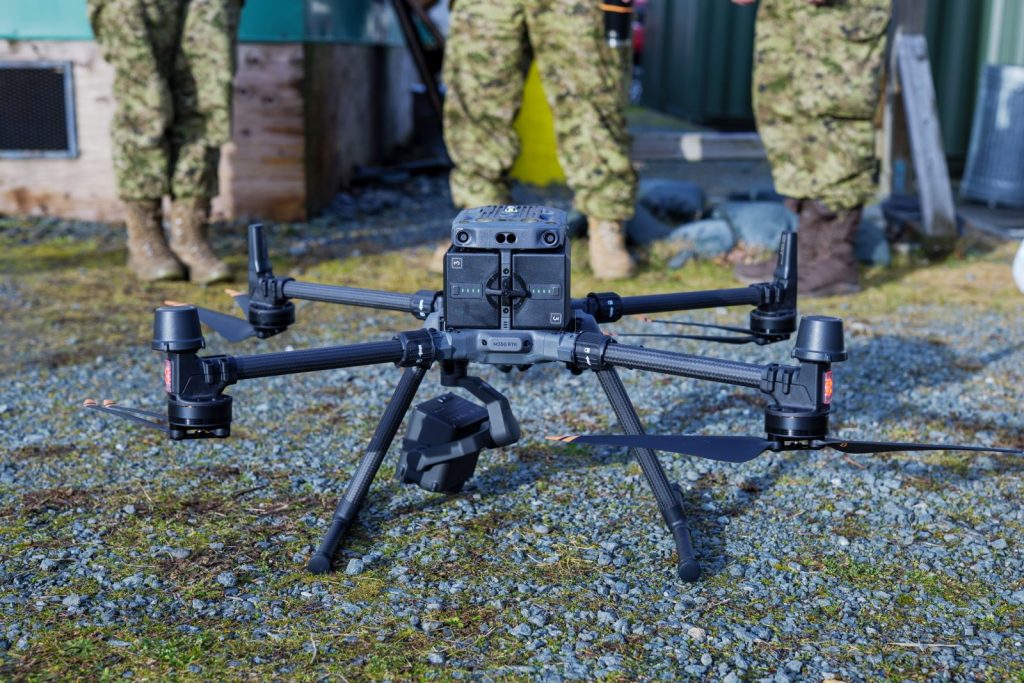
Having seen the utility of tethered drones as a communications relay during the 2 CMBG HQ & Sigs Sqn experiments and in Latvia, Sarai connected with Draganfly, a Vancouver drone system developer, with an offer to test and analyze their communications capability. In 2023, the company had signed an agreement with a provincial government to assist with wildfire mitigation, response and recovery.
Where infantry, artillery and armored units typically see an eye in the sky as a data source, signallers see a relay node, he noted. By integrating the TSM waveform onto several drones, the brigade can create a mesh network to move data over a much wider area.
“It is transparent to the combat arms folks, because they’re seeing video. But at the same time, we are utilizing their platform to bolster the land forces’ radio coverage. It’s a win-win.”
Since the Army rarely acts on its own when responding to a domestic natural disaster, Ex Cougar Ready included participation from the RCMP and observation by a representative from the B.C. government.
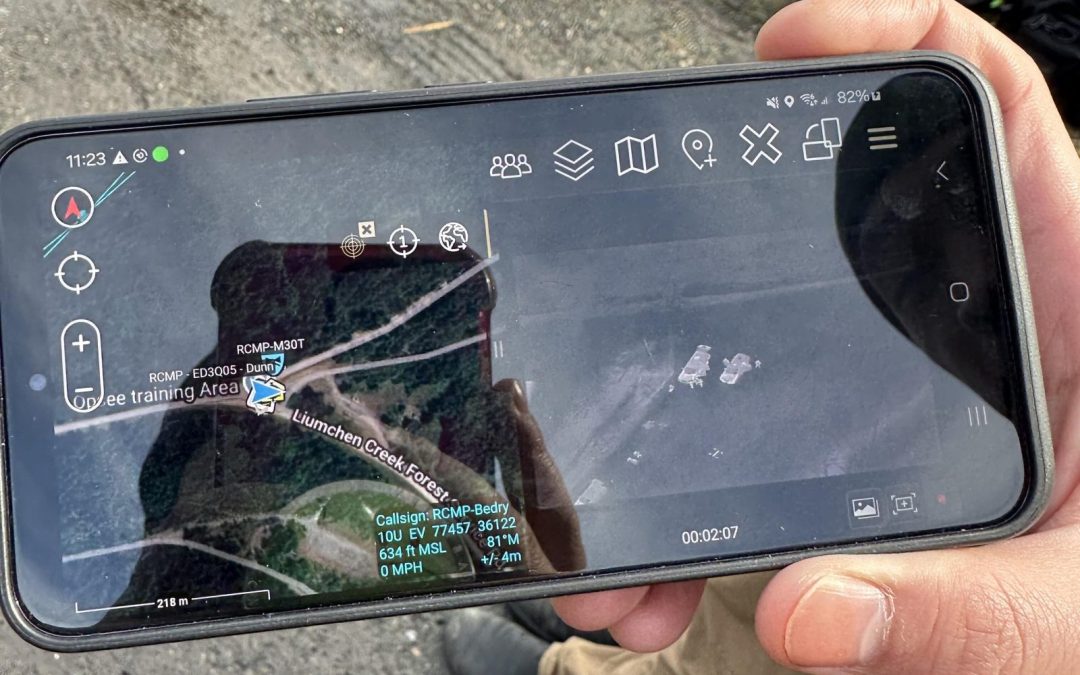
The RCMP is also experimenting with TAK software on its devices and was able to validate with the Army the ability to connect and share data, including each other’s drone camera feeds.
“We saw each other’s blue positioning, which blew the commander away,” Sarai said. “Plus, we were able to message one another and send ISR (intelligence, surveillance, reconnaissance) data to one another using Vidterra ISR integration software, which is coming into [the Army’s] Cloud TAK.”
“We had complete multi-agency sensor fusion happening.”
The broader goal is a multi-jurisdictional Cloud-TAK ecosystem, an effort the Directorate of Digital and Army Combat Systems Integration (DDACSI) has been fostering since it tested the civilian application of TAK (Team Awareness Kit) with members of the 2nd Canadian Division responding to forest fires across Quebec in the summer of 2023. The software allowed both Regular and Reserve members to work with provincial agencies, despite degraded communications, sharing a common map and conducting text chats from their personal cell phones.
Sarai believes the demonstration with the RCMP showed the B.C. Ministry of Emergency Management the value of a provincial common operating picture framework that could be scaled up in a disaster.
“It was a phenomenal display of interagency cooperation,” he said, adding that it would follow in the steps of several U.S. States that have adopted TAK for their emergency response coordination.
The lessons from Ex Cougar Ready will be shared with DDACSI and might encourage other Reserve units to conduct their own trials with provincial agencies. “There may be an opportunity for other Reserve units to widen the analysis of this technology,” Sarai said.
As for the Trellisware 750 radio, he noted that the technology is already in use with the Regular force and there is “keen interest in figuring out the next generation of Army Reserve tactical radios.” Force-generating reservists on the same system would make the transition to a Regular force unit on a mission like Operation Reassurance in Latvia easier.
“It makes the Army a lot more modular, in the sense that you could pick a company out of the Reserve and drop them into a Regular force battalion, and because their entire radio systems are interoperable, the battalion signal platoon could bridge them onto their comms system almost instantaneously.”
Importantly, trials like Ex Cougar Resolve are “a huge step in bringing the Reserve into the same architecture as the Regular force, so that we have One Army operating on same technology, with the same software.”