


by Chris Thatcher
For the first time on a NATO Combat Readiness Evaluation (CREVAL), the Canadian-led multinational brigade in Latvia deployed the full extent of its current resources, a demonstration of the growing combat power now taking shape.
Exercise Oak Resolve, an intense seven-day training event in late February, marked the first in-theatre CREVAL of the Canadian-led multinational battlegroup headquarters and subunits since the multinational brigade stood up. The task was previously conducted under the Latvian Mechanized Infantry Brigade, heavily supported by the expertise of the Canadian Manoeuvre Training Centre (CMTC).
“Even if it’s a Canadian-led battlegroup, it’s not a fully formed Canadian battlegroup, so we need to look at it a bit differently,” said Colonel Cédric Aspirault, commander of Multinational Brigade-Latvia and the previous commander of 5 Canadian Mechanized Brigade Group.
Oak Resolve is not a Latvian based version of Exercise Maple Resolve, he said, referring to the Army’s previous major collective training event and combat readiness assessment before deployment, held in the sprawling training area of Wainwright, Alta. Where Maple Resolve was a force-generation exercise focusing on the validation of a fully Canadian formed unit, Oak Resolve is a force-employer event focusing on the CREVAL for the Canadian-led multinational battlegroup that has more than half of its members coming from other nations.
That formation was the primary training audience (PTA), but rather than owning most of the assets and enablers as it had on previous exercises in Latvia, the battlegroup was now operating under a NATO brigade construct with extensive priorities.
“Assessing the battlegroup has changed,” said Aspirault the morning after a long final night in the field. “For me, it was extremely important to expose the battlegroup to the brigade concept.”
Though a battlegroup commander will be well acquainted with all the elements of a Canadian brigade in garrison, “a fighting brigade is different,” he said. “How do all those enablers, all those pieces of equipment that are part of the brigade, support a battlegroup? How do I use my artillery within that concept. For many years, the artillery was in direct command and control of the battlegroup. Now, they are under the brigade, which has multiple battlegroups. All those brigade enablers need to be shared and prioritized, depending on who my main effort is at the time.”
During the CREVAL, every asset in the brigade was deployed to ensure a realistic “bubble” around the battlegroup, “so they could learn and be exposed to the full potential of the brigade,” he said.
That included the newly added Swedish mechanized infantry battalion, which provided a flanking formation as well as members for a formidable opposing force (OPFOR) alongside CMTC’s OPFOR team. Other assets included the full artillery battalion, signals squadron, multinational logistics, medical unit, military police, brigade reconnaissance squadron, and the tactical aviation detachment of CH-146 Griffon helicopters.
“We had over 3,000 people deployed and all the equipment that comes with that,” he said. “It was an impressive exercise, but also an opportunity to learn and test new concepts.”
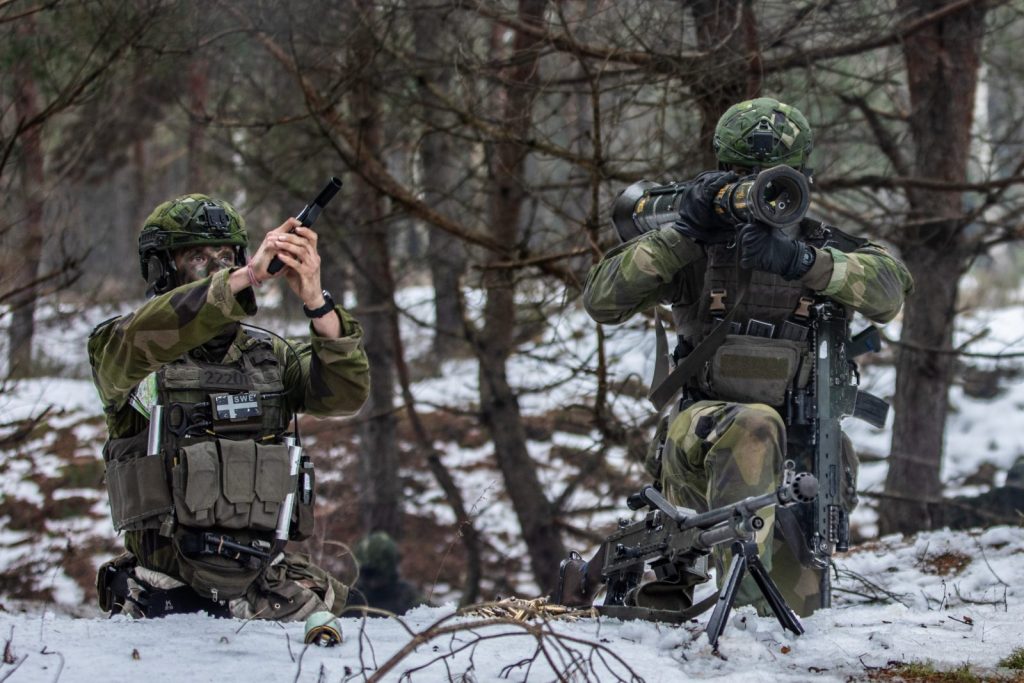
Swedish troops during the final attack of Ex Oak Resolve. Photo: MNB-Latvia Imagery Technician
OPERATIONAL CONTEXT
The overarching scenario of Oak Resolve involved a near-peer resilient and motivated adversary attacking from the north to seize Riga. The battlegroup was tasked with preventing that advance. With the Adazi training area lying to the north of Riga, “it was a scenario that made sense,” said Aspirault, as the PTA could be “fully oriented with the map as it would be in real life.”
The Swedish battalion, participating for the first time as a member of NATO, and a Latvian battalion occupied the flanks, while a reconnaissance squadron deployed forward and the multinational logistics battalion supported from the south.
After an initial defensive operation, the battlegroup conducted a passage of lines with the recce squadron and went on the attack. Throughout, the battlegroup maintained a gruelling 24/7 tempo, placing a particular emphasis on fighting at night.
It also faced repeated tests to its ability to handle detainees and medevac realistic casualties, which increased in numbers and complexity over the seven days.
Sustainment, whether food, fuel, ammunition or medical support, was at the forefront for both the brigade and battlegroup every day. If on previous exercises some elements were notional, on Oak Resolve everything was live.
“We wanted to challenge that sustainment cycle throughout, from the front line all the way back to the brigade sustainment area,” explained Colonel James L’Heureux, commander of CMTC, which worked in collaboration with the brigade and Canadian Joint Operations Command (CJOC) to develop, design and deliver a realistic force-employer event.
For incidents like casualties, “we were demanding of them to work through the process, from the point of injury all the way back until brigade responsibility,” he said.
“That’s a great win, because it’s not just the [battlegroup] commander that is being challenged,” said Aspirault. “Everyone can do their job fully, because there is somebody at the other side that can receive prisoners or injured personnel, or get fuel and rations on time. We really wanted to set the stage with this first exercise and put it at that level right away.”
The scenario adjustments and unexpected events that CMTC typically injects into an exercise to challenge the PTA proved unnecessary with the full brigade deployed. Vehicles broke down on their own and real-life incidents generated all the friction and problem-solving needed.
In fact, CMTC and the brigade deliberately avoided following a main event list, said Aspirault. “We really wanted to give the exercise a life by itself.”
“It made it very interesting for the battlegroup and for the opposing force, but it created a challenge for my own headquarters as well, because the brigade HQ didn’t know the scenario. They had an idea about what we were trying to achieve, but they didn’t know what was going to happen.”
As a result, he said, “I had to write orders extremely late at night. [But] we wanted to make sure that we were not creating anything artificial. When you spend that much energy developing an exercise at this level, it’s important everybody gains from it.”
Because Oak Resolve was an assessment of the entire brigade within Operation Reassurance, it did not end with the usual END EX on the final day. Rather, “we decided to write orders to continue the scenario, that somebody else would conduct a relief in place, and the [battlegroup commander] would need to do a real reconstitution, where he would give his area of operation to somebody and withdraw under control to the base in order to be resupplied and reconstituted,” Aspirault explained.
“We wanted it to be done within an operational context. We are not on an exercise here, we are conducting operations every day, and by keeping that mindset … there’s no actual end to what we’ve done—it’s just a pause.”
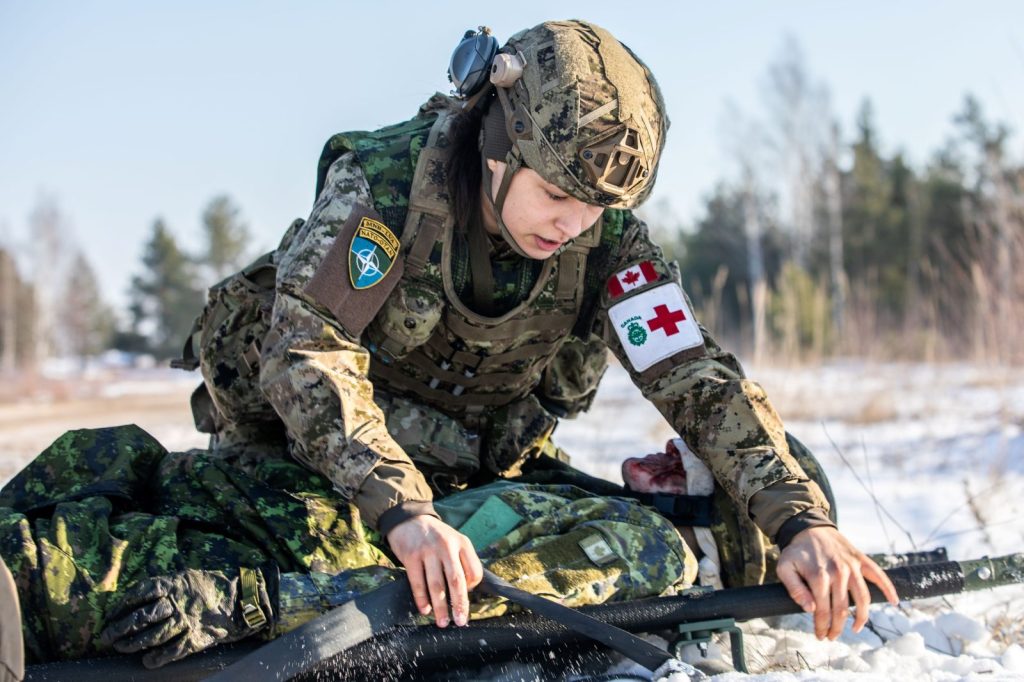
A member of the medical team prepares a soldier for evac. Photo: MNB-Latvia Imagery Technician
CAPABILITY ASSESSMENT
With Oak Resolved wrapped—or at least paused—and the immediate after-action reports concluded, the task of assessing the entire battlegroup’s performance, level of integration, and combat readiness falls to CMTC.
“We’ll provide a take home package where we nest the higher level tactical and operational feedback to inform not only the soldiers here, but also the next rotation and the wider Army, to showcase some of those new developments, new tactics, and new capabilities, and our assessment and our recommendations going forward so they can be incorporated,” explained L’Heureux.
CMTC had around 80 personnel on the ground, including support to the exercise control, Observer-Controller-Trainers in the field, and it’s dedicated OPFOR platoon, all gathering lessons from both sides of the fight. The Army also had representatives from Director Land Requirements, the Army Lessons Learned Centre, and Army Doctrine Centre doing additional analysis.
Those “sensors” provide the commander with a full picture of how his orders were understood and acted on, and highlight any disconnects in the chain, Aspirault explained.
Among their assessments will be the battlegroup’s ability to access and employ its enablers, or adapt if they were not available. Aspirault noted that since the stand up of the multinational battlegroup in 2017, it has had almost full control over all Canadian and partner assets in the formation, able to deploy where and when needed.
“During the exercise, we played moments where the commander didn’t have access to some of those,” he said. “However, he also had moments where he had way more assets than the battlegroup used to have—helicopters, electronic warfare, and high level ISR assets—because he was the main effort, and as the brigade commander, I prioritized those assets for him.”
The brigade also made a point of deploying every recently acquired urgent operational capability, including air defence, drones, counter-uncrewed aerial systems, and even a new tactical load carriage vest.
“This is the opportunity to test it, to make sure that we understand how to use it and stress test it in a real [operational] context,” Aspirault said. “This becomes a good battle lab where we can try a lot of new equipment, test different ways to use it, and be disciplined about it—write the right reports and make sure that we learn.”
Though it can be difficult at times to knit together 14 nations within a brigade and nine in a battlegroup, the dynamic is powerful in a training event like Oak Resolve, he observed.
“Integrating all those partners is hard to do at the beginning. However, the gain from it—how we are able to work together—creates a very cohesive, powerful and resilient brigade and battlegroup. The level of expertise and the experience that other countries are bringing is exceptional. When we see that working all together at the end, it creates something unique and something that I personally have never seen before. It’s a privilege to see that as a commander.”