


by Chris Thatcher
For much of the first 15 years of the century, counterinsurgency was the COIN of the realm, permeating most aspects of how the Canadian Army equipped and trained to fight. That COIN culture was common among U.S. and other NATO allies as well. Over the past 10 years, though, there has been a progressive reorientation to major combat operations.
There is an inherent risk to drawing lessons too early from a conflict and applying them to training programs. COIN still remains relevant, as the expanding conflict in the Middle East attests. But the lessons of Russia’s war in Ukraine and the return of a forward presence formation in Europe have noticeably shifted the preparation of Canadian soldiers for combat.
“We’re working to ensure that large-scale combat operations against peer adversaries is a feature of training and education,” said Colonel Fraser Auld, Commandant of the Canadian Army Command and Staff College (CACSC).
“That doesn’t mean counterinsurgency (COIN) is going away. But if you’re going to build and educate an army, you build your army towards the most difficult challenge, which is major combat ops (MCO) against a peer or a superior adversary. If you can do that, then it’s easier to pivot to COIN.”
The core skills required to serve as a planner for such operations have changed little since the First World War, but students attending the Army Operations Course will notice a distinct MCO flavour. As the Army continues to pivot to potential conflict in Eastern Europe and the Indo-Pacific, and each day gathers new insights from the Russo-Ukrainian war, CACSC is evolving the AOC to better reflect the challenges students will face working within a headquarters in a division or corps construct.
A former commander of Joint Task Force-Ukraine under Operation Unifier, and an instructor at the U.S. Army’s School of Advanced Military Studies, Auld noticed nuances to staff officer planning related to MCO that were missing when he became commandant in June, and has challenged the course directing staff “to add additional large-scale combat ops flavor to AOC.”
The course is a key step on the road for Captains progressing to Major, and beneficial for those working on the planning staff in a headquarters at any level. Through distance learning and a residence portion, on a full-time or part-time basis, it instills the skills to analyze key factors on a battlefield and provide conclusions and courses of action. Equally important, it teaches how to communicate those verbally and in writing, in a way that is clear, concise, and engaging for a commander.
“If they can think critically, do the analysis, and understand their environment, then they have the core skills to potentially be a good staff officer,” said Auld.
The AOC is delivered in four modules. The first, done through self-directed learning, focuses on the structure and purpose of the wider Canadian Armed Forces (CAF). The second, done remotely but at the direction of the directing staff, shifts to Army doctrine. The third and fourth modules are delivered over three and a half months at the College in Kingston. Module three teaches the skills of analysis and problem solving, and recognition of the linkages between problem sets. Module four tests that in the team environment of a headquarters, working collaboratively to develop solutions, and then briefing those up, down, and laterally within the chain of command. Ultimately, it’s a test of teamwork and leadership.

Over time, as the priorities of COIN training took hold, the “divisional flavor” of the course was less prevalent, often a higher entity with which students had less direct interaction.
“Anything that Canada contributes, we’re going to fight within some kind of multinational or U.S. division construct,” Auld noted. Students don’t need to become divisional experts, “but they should be exposed to the context of a division. Whether it’s a Canadian brigade within a U.S. or multinational division, or a Canadian battlegroup within a multinational brigade and a multinational division, you need to understand the headquarters above you if you want to be a good planner at your level.”
Consequently, he has pushed for lectures and simulations in exercises that “make the division play a little more robust.”
Under former Commandant Brigadier-General Tod Strickland, the College modernized how the AOC material was taught, adapting it to how students learn, but only some of that higher echelon flavour was present in the current evolution, said Lieutenant-Colonel Matthew Johns, Dean of CACSC.
“There was always a higher headquarters context in all the [AOC scenarios],” he explained, “But there have been some very deliberate steps taken, especially in the last year and a half, to put more emphasis on that divisional flavour. When I went through [AOC in 2010], the Army problem set was more COIN. Now we are intentionally trying to bring back in this divisional context. You are working not as a brigade that’s kind of static, sending out battlegroups to do discrete tasks that would be very COIN oriented; this is a brigade that is going to be picking up and moving rapidly across large areas, and they have to plan all that movement.”
As an example, the course has reinvigorated obstacle or wet gap crossing, a task with which many AOC students have limited experience. The emphasis is not on fighting across a river so much as the planning and logistics of getting all the components of a brigade across when higher headquarters has fixed timings.
“They have to go through that prioritization [of effort],” said Johns. “They realize that getting the stuff there becomes just as important as being on the ground. If they make a plan but it’s contingent on getting across a bridge that they don’t have the time or the resources to establish, then their plan is pointless.”
Meeting a division’s timing also reinforces an understanding that their brigade is one part of a larger formation with many moving pieces. Though Canadian battlegroups in Latvia and Afghanistan were part of a brigade or higher echelon, they were often able to operate somewhat independently.
“It can sometimes be difficult to remind students that that battlegroup is an important thing, but it is still just part of that bigger whole,” he said. Having two instructors from 1st Canadian Division join the directing staff this posting season, however, has “helped build out that narrative.”
“We give students some friction, where their brigade headquarters gets told something by the division, and there are now specific events that are set up where they have to cross a wet gap, and they don’t have enough time to move everything,” he said. “Initially, every single student goes back and says, ‘Just give us more time.’ The division says, ‘No, we’ve made our plan, and that’s your window.’”
“And if you miss it, it begins to be a real problem,” added Auld.
That experience has strengthened the notion of strategic humility, accepting the size of the Canadian military and its roles within a larger NATO mission, he said. “We need to get people mentally and culturally ready to realize that — we will have a boss, and we will work as a team with other people to our left and to our right.”
The relevance of that will be evident to the many officers who find themselves in the brigade headquarters in Latvia over the coming years, where the brigade now operates alongside a Latvian brigade, under Multinational Division North, headquartered in Karup, Denmark, which resides under Multinational Corps Northeast in Poland.
“We’re getting more and more demand from across the Canadian Army for our instructors to go and help the brigade level get ready with its planning and support,” said Auld. (Johns will lead that effort.) “The demand signal coming from our commitment to Latvia is energizing the Army at the brigade level.”

Layering Knowledge
Both Auld and Johns emphasized that while the AOC has changed significantly since they went through the course — in 2006 and 2010, respectively — the core skills remain essentially the same.
“It’s all about examining the factors that are presenting themselves to you on the battlefield, then coming up with deductions, conclusions, and tasks, and advising or presenting options to commanders for decision. I would argue there’s not a lot that has changed, probably in hundreds of years since the staff system came about,” said Auld, an armour officer who served as a tactics instructor at the Royal Canadian Armoured Corps School.
“The biggest difference from when I was here: There is a very methodical, progressive approach to layering information … and then reinforcing that through exercises.”
Johns, now in his third year as Dean, described the current staff officer learning process as less mysterious art form and more scaffolded knowledge. “The consensus from the directing staff … is that the quality of the work that the students do now is better, that their understanding is better. This was a combination of adult learning best practices and deliberate effort to take the program and say, ‘We need to modernize.’”
Among the understated objectives is a grasp of leadership within a team. Students will often find themselves leading a team of planners, many of them peers, some experienced specialists, a few of a higher rank or even civilians.
“That’s almost the underlying narrative to the whole course,” explained Johns. Students are challenged to exercise leadership while also being strong teammates, a test of their emotional intelligence that can impact how they are supported by others during the course.
It also fits with the CAF’s embrace of diversity. “Diversity is no surprise to people who are planners,” said Auld. “You could have a planning team of 20 people and you’re going to have very diverse opinions about what to do and not to do. You need to harness this and listen, because you’ll get great ideas from the diverse parts of your team.”
Leadership is more a thread throughout the AOC rather than a formal course, he added, “but I’ve challenged the directing staff to reinforce this through their coaching and mentoring.”
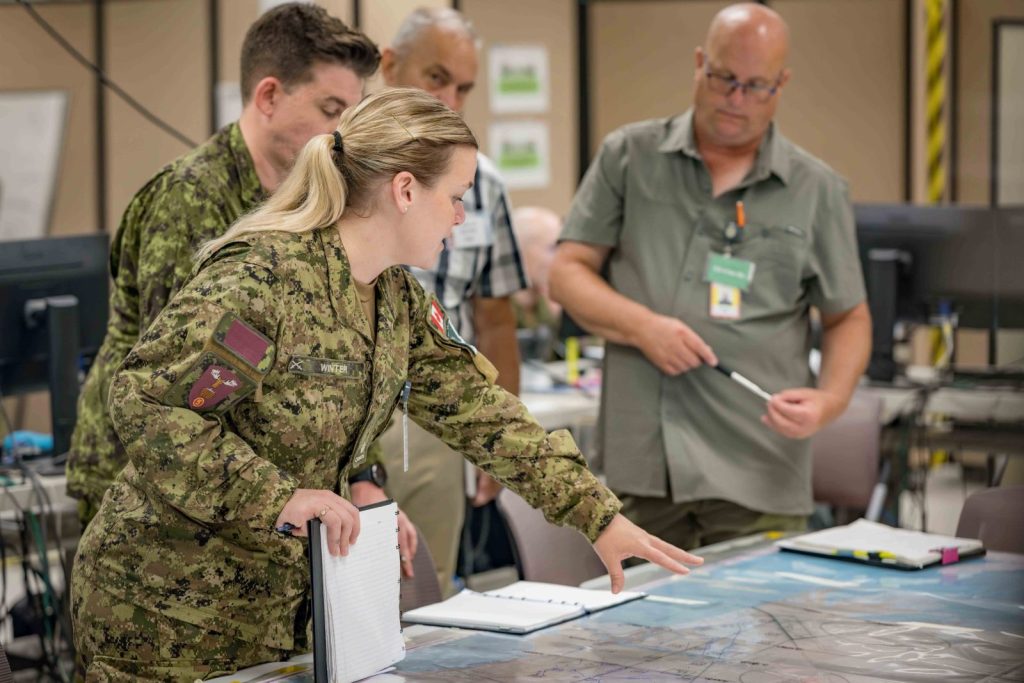
The AOC has always attracted international students and instructors — there are 10 students and two exchange officers on the current serial — who bring diverse perspectives and expertise to the program. But the course is now drawing directly from partner nation experience and Ukrainian soldiers as CACSC instructors deliver similar training to Ukrainian battalion staff. (Johns was recently awarded a Chief of the Defence Staff Commendation for his work establishing that training package.)
“We are not just teaching here [at the College], we are teaching staff processes like this downrange constantly,” said Auld. “And when instructors come back, they write reports saying, ‘We learned some things working with the Ukrainians, with the Latvians, and with other partners that we should think about, either briefing to our students or maybe including in our course.’ We are not an island doing our own thing; we’re doing our best to stay connected to the U.S., the U.K., to the effort in Latvia.”
One observed lesson from Ukraine has been the Russian practice of firing scatterable mines behind Ukrainian forces once they breach Russian lines, effectively closing the lane behind them. “That’s problematic if you’ve committed all your breaching stuff forward,” said Johns. “So, in an exercise, we can report these things and challenge the students to think, ‘Okay, what’s the risk-reward of keeping something in reserve?’
“That’s what we want them to do — think about those factors that might affect them. So, we’ll add flavour with additional challenges that reflect some of the things — cyber, electronic warfare, large numbers of drones — we’re seeing from contemporary battlefields. Whether we cyber attack them or not is immaterial. If they go through the process of planning to be able to deal with it, if they do that properly, then they’ve fundamentally addressed what we want them to do.”
You might consider pivoting away from the USA wrt alliances, training, operations, cross-training and so forth. More focus working with EU and NATO forces. We all know the reasons for this radical change.